

 USD
 EUR
 AUD
 GBP
 JPY
 INR
 MXN
 CAD
 JMD
Total: $0.00
Taxes and shipping calculated at checkout


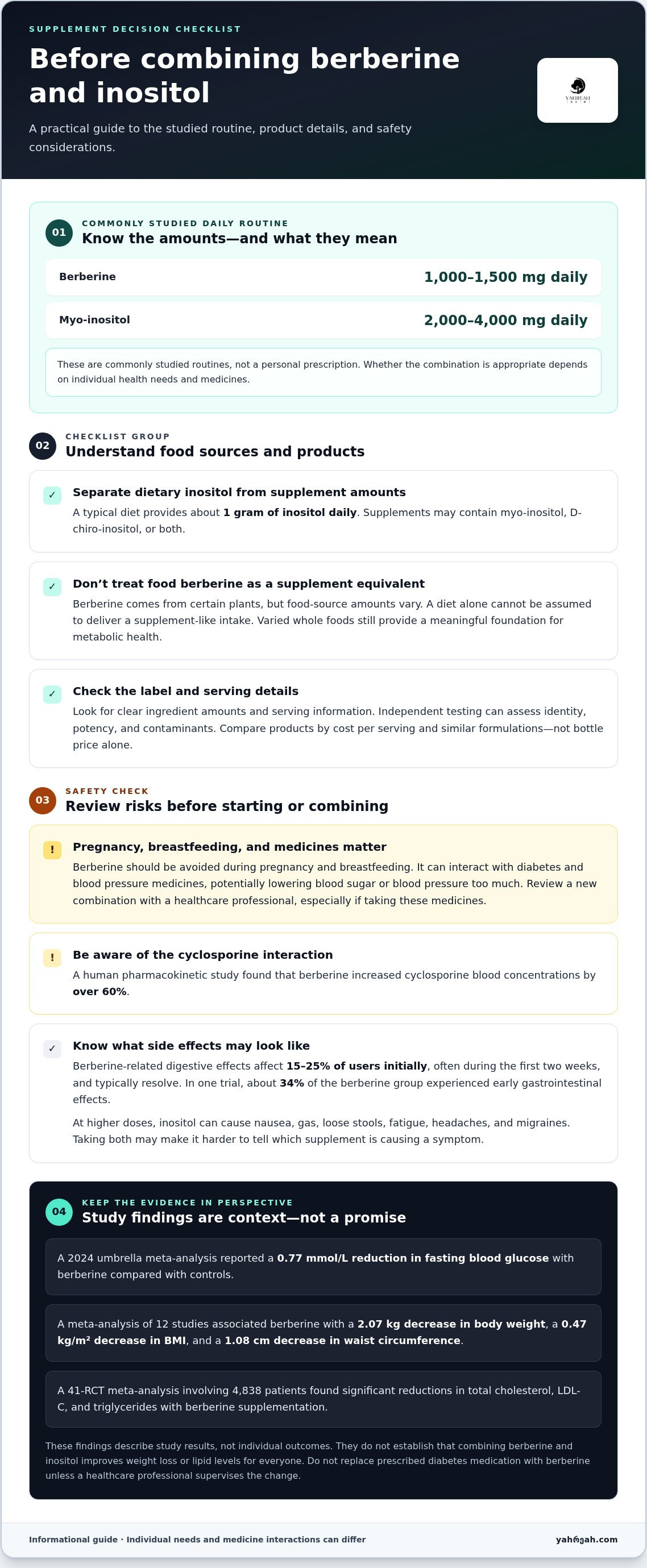
Yes, women may take berberine and inositol together, and commonly studied routines pair 1,000-1,500 mg of berberine daily with 2,000-4,000 mg of myo-inositol daily. That combination isn’t right for everyone: berberine can interact with medicines and should be avoided during pregnancy and breastfeeding. This Glucose Glow-Up: A Berberine and Inositol Manual for Metabolic Health explains how to think about the pairing without treating a studied routine as a personal prescription.
When comparing berberine and inositol, look beyond the supplement label. Food sources, the form of inositol, and timing can all affect how each fits into your daily routine.
This guide explains what food can contribute, how forms of berberine and inositol differ, and what research says about timing and dosing. It also covers important safety considerations to help you make informed decisions in light of your health needs.
Myo-inositol and D-chiro-inositol are forms of inositol, a compound involved in insulin signaling. Myo-inositol has been widely studied for PCOS, and supplements may contain either form or both.
Food can contribute inositol: the typical diet provides about 1 gram daily. Berberine comes from certain plants used in traditional medicine for centuries, but food sources aren’t equivalent to concentrated supplements. Their amounts vary, so a diet alone can’t be assumed to deliver a supplement-like intake. Still, meals rich in varied whole foods remain a meaningful foundation for blood sugar management and insulin sensitivity.
Berberine and inositol may affect related metabolic pathways, but they are not interchangeable. Berberine may activate cellular processes involved in glucose use and help lower blood sugar. Inositol participates in insulin signaling and may support insulin sensitivity. For PCOS, these pathways are relevant to menstrual cycles and ovulation, but fertility outcomes depend on more than supplements. Balanced meals and regular movement can support metabolic health. Prescribed treatments serve a different role: do not replace diabetes medication with berberine unless a healthcare professional supervises the change.
Research offers useful context, not a universal result. A 2024 umbrella meta-analysis reported that berberine reduced fasting blood glucose by 0.77 mmol/L compared with controls. A meta-analysis of 46 clinical trials found improved metabolic profiles among people with type 2 diabetes, alone or alongside standard medication. One trial involving 218 people reported blood sugar control comparable to metformin after three months. These findings don’t establish equal effects for every person, or prove that combining berberine and inositol improves weight loss or lipids for everyone. Some studies also report changes in weight and lipid markers, but results depend on the population and study design.
In the United States, berberine is sold as a dietary supplement, not an FDA-approved drug. Check labels for clear ingredient amounts and serving details, and look for independent testing of identity, potency, and contaminants. To compare prices, calculate the cost per serving using the package’s stated number of servings. Compare similar formulations rather than relying on bottle price alone.
Formulation affects the amount and ingredients in each serving, but it does not remove berberine’s interaction risks. The key question is how it may fit with your medicines and symptoms.
Digestive effects are stomach or bowel symptoms that can appear after taking a supplement. Berberine-related gastrointestinal effects affect 15-25% of users initially, often during the first two weeks, and typically resolve. In the Yin et al. trial, about 34% of the berberine group experienced early gastrointestinal effects. Inositol can also cause nausea, gas, loose stools, fatigue, headaches, and migraines at higher doses.
Combining berberine with inositol may make it harder to identify which supplement causes a symptom. More importantly, berberine can interact with diabetes and blood pressure medicines, potentially lowering blood sugar or blood pressure too much. A human pharmacokinetic study found that berberine increased cyclosporine blood concentrations by over 60%. Review a new combination with a healthcare professional, especially if you take these medicines.
Weight and cardiovascular markers offer different ways to assess metabolic changes, including body weight, blood lipids, inflammation, and blood-vessel function. A meta-analysis of 12 studies associated berberine with a 2.07 kg decrease in body weight, a 0.47 kg/m2 decrease in body mass index, and a 1.08 cm decrease in waist circumference.
Those findings describe study averages, not a personal outcome. A review of 44 trials found improvements in some inflammation and blood-vessel-function markers, particularly alongside standard treatment, although evidence was mixed. In practice, weight alone doesn’t show whether insulin resistance or cardiovascular risk markers have shifted. Consider the specific measure being tracked, and don’t treat a supplement as a substitute for prescribed care.
Cholesterol effects refer to changes in blood lipids such as LDL-C, total cholesterol, and triglycerides. A 41-RCT meta-analysis involving 4,838 patients found significant reductions in total cholesterol, LDL-C, and triglycerides with berberine supplementation.
Another meta-analysis of 16 randomized controlled trials found lower triglycerides, total cholesterol, and LDL cholesterol, alongside increased HDL cholesterol, in dyslipidemia treatment. These results make lipid markers relevant when considering berberine’s possible effects, but they don’t establish that every formulation works identically. Keep the product’s serving information clear, and discuss combining supplements with medicines with a healthcare professional. If you’re exploring a broader routine, consider women’s health supplements as one part of your supplement research.
Women may take berberine and inositol together, but their effects and timelines differ. For PCOS, consider metabolic markers, menstrual patterns, and the reason for taking each supplement.
PCOS is a hormonal syndrome often associated with insulin resistance, so metabolic function can be part of the picture. Berberine and inositol relate to different pathways: berberine is studied for blood sugar and metabolic markers, while inositol compounds participate in insulin signaling. That distinction matters when considering both supplements, since using them together doesn’t make their roles identical.
A small study compared berberine, myo-inositol, and metformin in women with PCOS over three months. Its findings can inform a discussion about options, but they do not show that one approach suits everyone or that combining supplements improves every PCOS symptom. Diabetes risk, current treatment, and the outcome being tracked all affect how relevant the results may be.
Menstrual regularity and ovulation are separate outcomes that can help describe reproductive function in PCOS. The authors of the cited inositol study reported that 68% of women with PCOS restored regular menstrual cycles while supplementing with inositol. A 2021 network meta-analysis also found myo-inositol plus D-chiro-inositol superior to metformin alone for recovery of menstrual frequency.
Timing matters: reported improvements in ovulation and cycle regularity with inositol generally take 8 to 12 weeks of consistent use. Berberine’s measurable blood sugar effects are reported within 2-4 weeks, with full effects at 8-12 weeks. These are distinct measures, so glucose changes don’t automatically indicate a cycle change.
Fertility involves ovulation, cycle timing, and other factors, so menstrual regularity alone doesn’t measure every aspect of fertility. Inositol studies commonly examine PCOS-related cycle and ovulation outcomes; a 2023 trial of berberine phytosome reported restored menstrual regularity in 70% of participants with PCOS.
For hormone balance, track the specific concern rather than assuming one symptom reflects every change. Inositol’s reported mood, hormonal, fertility, and menstrual benefits often take four to eight weeks of consistent use, while PCOS symptom changes may take 1 to 3 months. Allowing at least three months before assessing the combination aligns with the article’s suggested evaluation period. Keep prescribed diabetes treatment distinct from supplement use.
Studies commonly use berberine at 900-1,500 mg daily in divided servings, and inositol at 2-4 grams daily. Berberine is often taken before meals, while inositol schedules depend on the formulation and study.
Study doses describe research protocols, not a universal personal dose. Berberine studies often use 500 mg per dose, taken two or three times daily. Inositol studies commonly use 2-4 grams daily, with 4 grams of myo-inositol frequently studied.
Combination products often pair myo-inositol with D-chiro-inositol at a 40:1 ratio, but researchers haven’t established the ideal dose or ratio. Labels may list a single inositol form or a blend, so compare the amount of each active compound per serving. A staged introduction can make side effects easier to notice: one article protocol starts berberine at 500 mg once daily for the first week, then increases toward the full dose over two to three weeks.
Timing means how a supplement’s servings fit around meals and throughout the day. Berberine is typically taken 30 minutes before a meal or between meals, with daily amounts divided into smaller servings. This approach reflects the schedules discussed in studies, not a requirement that applies to every formulation.
The cited dose information ties inositol timing less closely to meals. Taking it consistently can make a routine easier to follow, especially when the daily amount is split into servings. Follow the product’s serving directions and keep them distinct from study doses: capsules and powders may provide the same daily amount in different ways.
Clinical protocols vary, so compare the dose, formulation, and duration together rather than focusing on one number. For example, a 2008 head-to-head trial used berberine at 500 mg three times daily for 13 weeks, comparing it with metformin at the same dose. That protocol doesn’t establish an ideal schedule for everyone.
Berberine comes from plants, but plant origin alone says little about dose or formulation. Research may discuss enzyme-related mechanisms, but those do not determine when to take a supplement. Keep outcomes such as glucose and triglycerides distinct, and treat study schedules as context, not a substitute for prescribed diabetes care.
Yahreah Skin offers women’s health supplements for those considering supplements as part of a thoughtful wellness routine. Its products feature clean ingredients and cruelty-free formulations, and are made in the USA in an FDA-registered facility. These qualities can help you compare labels and decide what matters most to you.
Use this guide to prepare a focused conversation about berberine, inositol, timing, and your current medicines. Supplements can be part of a broader approach to wellbeing, but they do not replace prescribed treatment. Explore Yahreah Skin’s women’s health supplements to learn more about the range.
Visit yahreah.com to explore Yahreah Skin’s offerings.
A useful next step is to clarify what you want to support, what you already take, and how you will recognize meaningful progress. Use The Glucose Glow-Up: A Berberine and Inositol Manual for Metabolic Health to shape thoughtful questions, not as a substitute for care tailored to your health. If you take prescription medicines, discuss supplements with a healthcare professional before making changes.
When you’re ready to explore supplements, Yahreah Skin offers women’s health supplements, men’s health supplements, and premium supplements. Consider your priorities and overall wellbeing as you choose.
Contact Yahreah Skin today to explore its offerings and take your next step with intention. A steady, informed approach can make wellness feel less like a scramble and more like a ritual that belongs to you.
Both supplements can cause side effects, and berberine has important interaction risks. It can affect blood sugar and blood pressure when taken alongside related medicines, and should be avoided during pregnancy and breastfeeding. Inositol may cause digestive symptoms, fatigue, or headaches, particularly at higher doses. Use The Glucose Glow-Up: A Berberine and Inositol Manual for Metabolic Health to prepare questions about your routine for a healthcare professional.
These labels describe different delivery formats, but the name alone does not show that one works better. Compare the amount of berberine per serving, the full ingredient list, and whether research relates to the specific format and health outcome you care about. Evidence from a study of one formulation does not automatically apply to another. Choose based on clear labeling and relevant evidence, not a “high absorption” claim alone.
Yes, women may take berberine and inositol together, but combining them calls for attention to medicines and pregnancy status. For example, berberine may add to the effects of medication for blood sugar or blood pressure. Do not stop or replace prescribed treatment to add supplements. Keep a written list of your medicines and supplements so a healthcare professional can review possible interactions.
Berberine is a plant-derived compound studied for its effects on glucose metabolism and blood lipids. It may help lower blood sugar, but it is not insulin or metformin, nor is it an FDA-approved weight-loss medication. Research on metabolic markers does not make berberine a substitute for diabetes treatment. Consider the specific outcome being measured, such as fasting glucose or cholesterol.
Berberine and inositol affect different processes involved in metabolic function. Berberine is studied for its effects on glucose handling, while inositol compounds participate in insulin signaling. Myo-inositol and D-chiro-inositol are distinct forms, and supplements may contain either or both. That is why the ingredient panel matters: the form should match the research or intended use you are considering.
Study protocols commonly use divided doses of berberine and a daily amount of inositol, but schedules vary by formulation and purpose. The Glucose Glow-Up: A Berberine and Inositol Manual for Metabolic Health explains how to interpret study schedules. Berberine is often taken before meals, while inositol can fit into a consistent daily routine. Compare the amount of active ingredient per serving, not just the capsule count. Study doses are not personal dosing instructions.


