

 USD
USD EUR
EUR
 AUD
AUD
 GBP
GBP
 JPY
JPY
 INR
INR
 MXN
MXN
 CAD
CAD
 JMD
JMD
Total: $0.00
Taxes and shipping calculated at checkout


A plausible biological role isn’t proof of a repaired gut barrier. L-glutamine is used by cells lining the intestine, which helps explain interest in l-glutamine powder for gut barrier integrity, but a mechanism and a proven benefit aren’t the same thing.
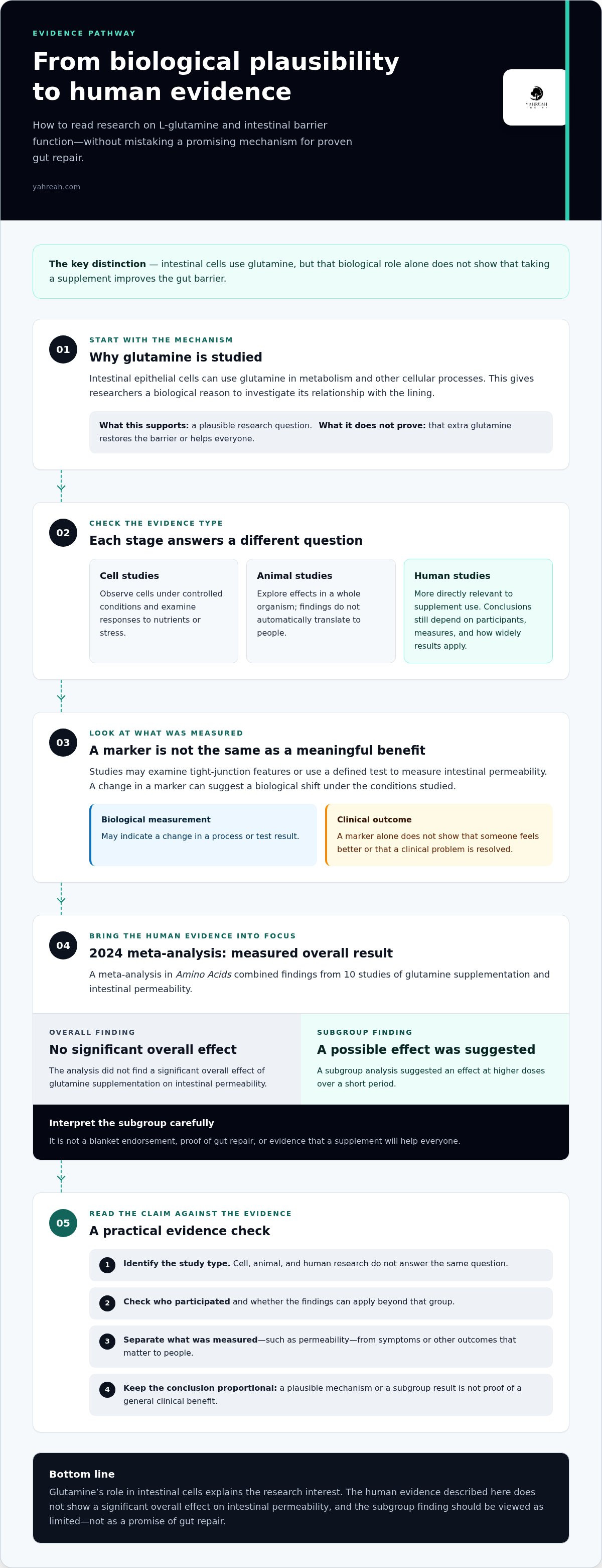
If you’re sorting through claims about “leaky gut,” it’s reasonable to want more than a promising theory. Research in people offers a measured picture: a 2024 meta-analysis of 10 studies in Amino Acids found no significant overall effect of glutamine supplementation on intestinal permeability, though a subgroup analysis suggested an effect at higher doses over a short period. That finding isn’t a blanket endorsement or proof that a supplement will help everyone.
This article explains how the intestinal barrier works, why glutamine has attracted scientific interest, and what human studies can and can’t establish. We’ll look at evidence limitations and practical safety considerations, so you can assess supplement claims carefully and make a thoughtful choice rather than relying on promises of “gut repair.”
Confident claims about “gut repair” can be hard to sort through, especially when supplements are described as essential on one page and unnecessary on another. Start with the biology: the gut barrier is a working interface, not a sealed wall. And a nutrient’s plausible role doesn’t by itself prove that taking more will improve health.
The intestinal barrier separates the contents of the gut from the tissues and circulation beneath it. Its lining includes epithelial cells, which absorb nutrients, and tight junctions, which help regulate the spaces between neighboring cells. Mucus and immune components also contribute to this protective interface. The intestinal mucosal barrier describes these interacting parts in more detail.
Gut-barrier integrity is the ability of the intestinal lining and its supporting defenses to regulate what passes through while allowing normal absorption. That selectivity matters: permeability is a normal biological feature, not automatically evidence of disease. The barrier must allow water and nutrients to move while limiting the passage of substances that should remain in the gut.
“Leaky gut” is common shorthand for increased intestinal permeability, but using the phrase doesn’t establish a specific diagnosis. Nor does bloating or discomfort, on its own, show that the barrier is impaired. Symptoms can have many causes, so they need to be understood in context rather than treated as proof of a particular gut problem.
L-glutamine is an amino acid found in the body and in protein-containing foods. The body can make it, and cells use amino acids for a range of functions. Intestinal epithelial cells can use glutamine, giving researchers a biological reason to investigate its relationship with the gut lining.
That connection is a starting point for research, not a consumer-health conclusion. Cells using a nutrient doesn’t mean everyone needs a supplement or that extra glutamine will directly restore the intestinal barrier. The body’s ordinary use of an amino acid and the effects of a concentrated supplement are different questions.
This distinction is central when evaluating claims about l-glutamine powder for gut barrier integrity. Researchers may examine how glutamine relates to intestinal cells or barrier measurements, but those findings don’t automatically show that a powder changes symptoms or benefits people broadly. Look at the type of evidence behind a claim, who was studied, and what outcomes were actually measured.
The biological question is narrower than many supplement claims suggest: could glutamine availability influence how intestinal cells function under particular conditions? Researchers study this because intestinal epithelial cells use glutamine in their metabolism and other cellular processes. That makes a connection plausible, but it doesn’t establish that taking extra glutamine improves barrier function in everyday life.
In laboratory research, scientists can examine cells under controlled conditions and observe how they respond to nutrients or stress. Animal studies can explore effects within a whole organism, but their results don’t automatically translate to people. Human studies are more directly relevant to supplement use, though conclusions depend on who participated, what was measured, and whether the results apply beyond that group.
A review of experimental and clinical research, Glutamine and intestinal permeability, discusses proposed links between glutamine and barrier regulation. A review can help map a research area, but it brings together studies with different designs and populations. It isn’t proof that a supplement produces a particular result.
A proposed mechanism explains how an effect might occur; a proven clinical benefit requires reliable evidence that people experience a meaningful improvement. This distinction matters because a cell’s use of glutamine is not the same as showing that a powder changes symptoms, prevents illness, or “repairs” the lining.
Tight junctions are structures that help control movement between adjacent epithelial cells. In research, investigators may examine their appearance or measure permeability using a defined test. A change in one of these markers can suggest that a biological process has shifted under the conditions studied. It doesn’t, by itself, show that someone feels better or that a clinical problem has been resolved.
Imagine a laboratory experiment in which a measurement changes after cells are exposed to glutamine. That result could support a mechanism worth studying. It wouldn’t establish an effective supplement amount, predict who might benefit, or tell us whether a person’s ongoing digestive symptoms come from altered permeability. Those questions require evidence in people and outcomes that matter to patients, not only changes at the cellular level.
Read claims about l-glutamine powder for gut barrier integrity with attention to the evidence type. Cell and animal findings can guide hypotheses; controlled human research is needed to test whether those ideas translate into meaningful outcomes. If you’re exploring supplements as part of a broader wellness routine, a careful look at thoughtful supplement choices can keep the focus on transparent information rather than promises.
Read the evidence by asking what researchers studied, in whom, and what they measured. A mechanism can suggest a question worth testing, but it can’t establish that a supplement improves gut-barrier function in people. Animal findings offer another kind of clue, while human trials are more directly relevant to people considering a supplement. These forms of evidence aren’t interchangeable.
Mechanistic research looks at biological processes, often in cells or laboratory systems. Animal studies explore effects in living organisms, but differences between animals and people limit how directly those findings translate. Human clinical research tests outcomes in people; its value depends on the study design, participants, duration, comparison group, and measures used.
For a gut-barrier claim, a change in a permeability measure is not automatically the same as fewer symptoms or better daily functioning. Human outcomes matter, but they must be interpreted within the specific population studied.
A 2024 meta-analysis in Amino Acids brought together 10 studies and found no significant overall effect of glutamine supplementation on intestinal permeability. Its subgroup analysis reported a significant reduction in permeability in studies using doses above 30 grams per day for less than two weeks. That subgroup result is a signal to examine, not a general recommendation: it doesn’t show that the same effect applies to other doses, longer use, or every person.
The finding concerns intestinal permeability, not necessarily symptom relief. A measured change in one outcome cannot establish a broad benefit, and a result in a particular study setting may not apply to people with different health circumstances.
Studies can differ in health status, dose, duration, and the way they assess permeability. Even when two studies examine the same broad topic, they may not be answering exactly the same question. A supplement’s form and use in a trial also may not match products or routines outside research.
Use a few questions to keep claims in perspective:
For l-glutamine powder for gut barrier integrity, the findings support continued investigation, not a promise of universal benefit. The research doesn’t show that glutamine works for everyone, repairs the gut, or relieves a wide range of symptoms. The most careful reading leaves room for possible effects in particular contexts while recognizing that the evidence has limits.
Considering a supplement is a personal decision, not a test of how committed you are to your health. A useful approach is to define what you hope to learn or support, understand what the evidence can say, and account for your health circumstances before deciding whether to use it.
Start with your goal. Are you curious about a research finding, hoping to address a specific symptom, or responding to a broad claim about “gut repair”? A clear question makes it easier to judge whether the available evidence is relevant. It also helps keep expectations realistic: a supplement may not produce the outcome you’re hoping for.
Next, consider your medical history and medicines. If you’re pregnant, managing a health condition, taking medication, or considering a supplement for a child, discuss L-glutamine with a qualified healthcare professional or pharmacist first. They can consider individual factors and whether persistent symptoms need evaluation rather than self-treatment.
Seek medical advice for digestive symptoms that persist, are severe, or feel concerning. L-glutamine shouldn’t be used to postpone evaluation or replace care. The research reports that oral glutamine was generally well tolerated in clinical trials at doses up to 30 grams per day, but trial findings don’t establish that a particular amount is suitable for everyone. Reported side effects include constipation, headache, nausea, vomiting, and stomach upset. This is context, not a dosing guide.
Powder is a format, not a quality guarantee. It doesn’t establish purity, effectiveness, or personal suitability. Read the complete ingredient and allergen information, serving details, directions, and warnings rather than relying on phrases such as “clean,” “natural,” or “gut support” on the front label. Consider whether the claims describe a product’s contents or promise a health outcome.
Look for clear information about manufacturing and quality controls. FDA registration applies to a manufacturing facility; it isn’t FDA approval or endorsement of a supplement. The FDA hasn’t evaluated L-glutamine dietary supplements for safety and effectiveness, so a polished label or confident marketing language shouldn’t be mistaken for evidence of benefit.
For a closer look at label transparency and quality considerations, explore this clean supplement brands guide. Apply the same care to any brand: look for specific, understandable information, and be cautious of claims that promise to repair the gut or treat disease.
If you’re exploring wellness supplements, browse thoughtful supplement options with your goals and individual needs in mind.
Once you’ve considered the evidence, the next question is how a supplement fits into your life, if at all. L-glutamine may be worth discussing in a particular context, but it isn’t a shortcut to better digestion or a substitute for understanding what’s behind symptoms. A measured approach leaves room for research while keeping individual needs at the center.
A wellness routine is made up of many choices, not one ingredient. A varied diet, appropriate medical care, and attention to persistent symptoms all matter; a supplement shouldn’t displace them. If you’re considering l-glutamine powder for gut barrier integrity, treat it as a question to explore, not an established way to correct permeability or resolve digestive complaints.
The evidence discussed here offers a biological rationale and some human research, but it doesn’t support sweeping promises. A finding in a specific study population may not apply to someone with different health circumstances. Digestive symptoms can have different causes, so attributing them to a damaged barrier without evaluation may draw attention away from what needs care.
Evidence-aware supplement education is useful beyond this ingredient. For example, a healthy liver supplements guide can help illustrate how to approach claims with attention to evidence and context rather than assuming one product suits everyone.
There’s a meaningful difference between a proposed biological mechanism and a proven benefit in people. Researchers’ interest in glutamine and intestinal cells can explain why the relationship is being studied; it doesn’t prove that supplementation guarantees repair, cures a condition, or improves unrelated symptoms. Be cautious of marketing that presents those outcomes as certain. Strong claims deserve clear evidence tied to the specific result being promised.
Before making a choice, consider what the research actually measured, whether the people studied resemble your circumstances, and what a qualified healthcare professional advises. That perspective can help you weigh potential relevance alongside your health history and other care. You don’t have to decide based on urgency or bold language.
At Yahreah Skin, the brand’s stated values include clean ingredients and cruelty-free formulations. Its products are made in FDA-registered manufacturing facilities in the USA; registration should not be mistaken for FDA approval or endorsement. These details can inform how you think about transparency, but they don’t establish that a supplement will produce a particular health outcome.
Choose with care, and keep your expectations grounded in evidence and your own needs. If you’d like to explore the brand’s broader wellness range, discover Yahreah wellness products at your own pace.
Your next step doesn’t need to be a quick decision. If you’re considering l-glutamine powder for gut barrier integrity, use what you’ve learned to frame a clear question for a qualified healthcare professional, especially if symptoms persist or you have individual health considerations. Thoughtful choices begin with curiosity, not pressure.
A supplement can be one part of a personal wellness routine, but it shouldn’t replace a varied diet, appropriate care, or attention to ongoing symptoms. Look for straightforward information and claims that respect the difference between a promising idea and an established benefit. That clarity can help you choose with greater confidence, whether or not a supplement is right for you.
Yahreah Skin emphasizes clean ingredients and cruelty-free formulations, and states that its products are made in FDA-registered manufacturing facilities in the USA. FDA registration is not FDA approval or endorsement. If you’d like to explore the brand’s wellness range, discover Yahreah Skin wellness products at your own pace. Let your choices reflect what feels informed, considered, and right for you.
The gut barrier is the set of structures and defenses that regulate movement between the digestive tract and the rest of the body. Its integrity describes how well that system performs its selective role, not whether it blocks everything. Nutrients, for example, need to pass through during digestion. A barrier-related measurement is one piece of biological information, not a stand-alone assessment of someone’s overall digestive health.
“Leaky gut” is commonly used to describe increased intestinal permeability, but it isn’t generally used as a formal diagnosis on its own. A clinician evaluates symptoms in context and considers possible causes rather than concluding that a person has a barrier problem based on a phrase or symptom alone. If digestive issues continue, describing when they occur, how long they’ve lasted, and what affects them can support a more useful medical discussion.
Glutamine may affect barrier-related processes in particular research settings, but the evidence doesn’t establish that powder reliably improves gut-barrier integrity for everyone. The phrase l-glutamine powder for gut barrier integrity describes an area of interest, not a guaranteed outcome. Before considering a supplement, distinguish a measured research effect from a benefit you can expect personally, and discuss persistent symptoms with a qualified healthcare professional.
Human evidence remains limited and doesn’t support a universal claim. A 2024 meta-analysis in Amino Acids combined 10 studies and found no significant overall effect on intestinal permeability; a subgroup analysis reported a reduction in studies using higher doses for a short period. That result doesn’t settle whether people feel better or whether findings apply to other populations, doses, or durations.
Yes. Glutamine occurs naturally in protein-containing foods, including meat, fish, eggs, dairy products, beans, and other legumes. Protein foods contain a mix of amino acids, so eating them provides glutamine as part of ordinary nutrition rather than as a concentrated supplement. A varied diet can include different protein sources according to personal preferences and needs. Food intake alone doesn’t establish whether supplementation would be useful for a particular person.
No. L-glutamine and glutamic acid are related amino acids, but they’re chemically distinct and aren’t interchangeable names for the same substance. Their structures differ, and the body can convert glutamate and glutamine through its own metabolic processes. This distinction matters when reading an ingredient panel or research paper: evidence about one compound shouldn’t automatically be treated as evidence about the other.
Speak with a qualified healthcare professional before considering it if you’re pregnant, taking medicines, managing a health condition, or thinking about giving it to a child. They can help consider your circumstances and whether a supplement is appropriate. Get medical advice for digestive symptoms that are persistent, severe, or concerning rather than trying to manage them with a supplement alone. Don’t stop or change prescribed medication without professional guidance.
No. FDA registration of a manufacturing facility is not FDA approval or endorsement of a dietary supplement. The FDA doesn’t evaluate dietary supplements like medicines for safety and effectiveness before they’re marketed. Treat registration as a statement about the facility’s registration status, not proof that a product works or is suitable for you. Read the full label and assess health claims separately from manufacturing information.


