
 USD
 EUR
 AUD
 GBP
 JPY
 INR
 MXN
 CAD
 JMD
Total: $0.00
Taxes and shipping calculated at checkout


SPF 30 is the recommended minimum for daily sunscreen use. A mineral face sunscreen with SPF 30 and a non-nano zinc claim pairs a stated protection level with a particle-size claim, while “fragrance-free” describes a separate product attribute. Nanomaterials are measured in billionths of a meter, according to the National Institute of Standards and Technology.
Clear labels can help when choosing a face sunscreen, but each answers a different question. Learn what non-nano zinc and fragrance-free mean, how to interpret “reef-safe” claims and Hawaii’s sunscreen restrictions, and which specifications help compare options. SPF, active ingredients, texture, packaging, and directions can all help you find a mineral sunscreen that fits your routine.
Non-nano refers to particle size, while fragrance-free describes the formula’s scent ingredients. The National Institute of Standards and Technology defines nanometers as billionths of a meter, a useful distinction when reading mineral sunscreen labels.
White cast is a visible pale film that can appear when zinc oxide remains on the skin’s surface. It may be more noticeable on deeper skin tones, depending on the formula’s particle dispersion, tint, and how evenly the lotion spreads. A tinted option adds visible pigment, while an untinted formula may leave a more apparent cast. Check the finish in daylight before applying makeup.
Are there risks or drawbacks to using non-nano mineral sunscreen on your face? Practical drawbacks can include visible cast or a texture that feels heavy under makeup. A non-nano label alone doesn’t tell you how a formula will look or feel on your skin.
For sensitive skin, a fragrance-free facial lotion avoids added fragrance, but that label doesn’t mean every ingredient suits every person. Compare the ingredient list and finish with your preferences: a tinted zinc formula may reduce the look of a white cast, while an untinted one may show more clearly. Introduce one new sunscreen at a time, and patch test it on your inner forearm 24 hours before first use.
Mineral filters such as zinc oxide work at the skin’s surface, unlike the idea that a non-nano label guarantees zero absorption. In a human-volunteer study, less than 0.01% of sunscreen zinc entered the bloodstream after participants applied sunscreen twice daily for five days. Particle size and skin penetration are related questions, but the label alone doesn’t describe the complete formula or its finish.
| Option | Skin-tone finish | Useful comparison |
|---|---|---|
| Untinted zinc lotion | May leave a visible cast | Spread and texture |
| Tinted zinc lotion | Pigment may soften the cast | Tint match and makeup layering |
| Fragrance-free mineral lotion | Depends on tint and formula | Ingredient list and feel |
Compare how the finish looks on your skin tone, the fragrance label, and how comfortable it feels under makeup.
Zinc oxide is a mineral UV filter used alone or alongside titanium dioxide in face sunscreen. Are non-nano mineral sunscreens as effective as other broad-spectrum sunscreens? A non-nano claim alone doesn’t establish protection, so compare the product’s SPF and broad-spectrum label.
Non-nano zinc oxide describes a particle-size claim for this mineral active ingredient, not a separate type of UV protection. Face sunscreens may use zinc oxide as the sole active ingredient or in a blend, so read the active ingredients instead of relying on “mineral” or “nano zinc” wording alone. The full formula also affects spread, feel, and how comfortably it layers over moisturizer.
Zinc oxide and titanium dioxide are the two mineral sunscreen ingredients currently recognized by the FDA as GRASE. Either may appear in a mineral lotion, and formulas may combine them. Their shared mineral category doesn’t mean their ingredient lists or finishes are identical. Compare the named active ingredients and how the lotion applies, rather than assuming one is always gentler or more suitable for every face.
The listed zinc oxide percentage shows how much of that active ingredient a formula contains, but concentration alone doesn’t describe the sunscreen’s overall performance. Compare the active ingredients, stated SPF, and broad-spectrum claim together. Consider how much formula is needed for even facial coverage and whether its texture makes consistent application comfortable. A moisturizer-like finish may suit one routine better than a thicker lotion.
A non-nano description is about particle size, while broad-spectrum wording describes the sunscreen’s protection claim. An SPF 30 sunscreen should shield skin from 97% of the sun’s UVB rays. That figure doesn’t make particle-size wording a substitute for the SPF or broad-spectrum label. Compare mineral and chemical options by their stated protection and active ingredients, then choose a texture you can apply evenly as directed.
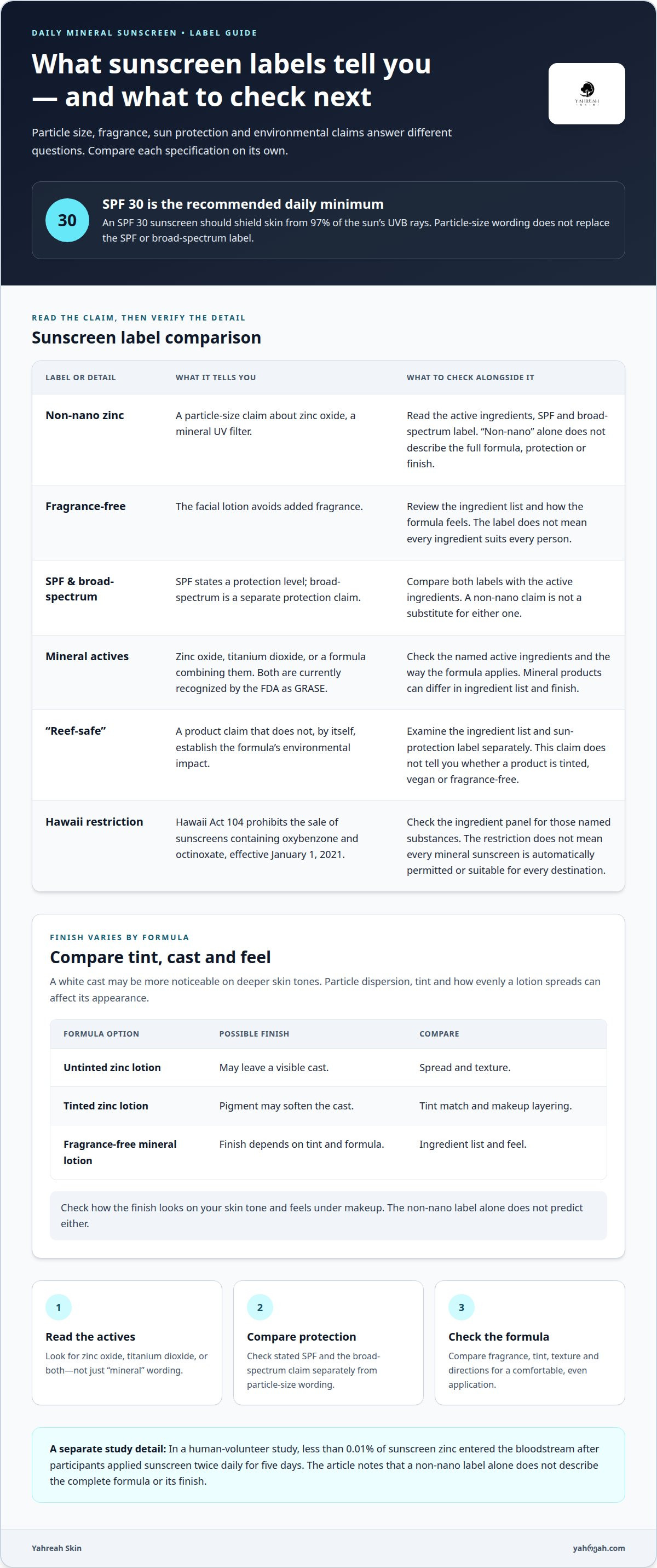
“Reef-safe” and “non-nano” describe different product claims, so compare the ingredient list and sun-protection label separately. A mineral formula may use zinc oxide, but that alone doesn’t account for every ingredient or establish the product’s environmental impact. Treat “reef-safe” as a prompt to examine the formula, not a substitute for reading its active ingredients.
Hawaii’s rule is specific. According to the Hawaii State Legislature, Hawaii Act 104 prohibits the sale of sunscreens containing oxybenzone and octinoxate effective January 1, 2021. This restriction names those two ingredients; it does not mean every mineral sunscreen is automatically permitted or suitable for every destination. If a product is intended for travel, read its ingredient panel for the named substances and distinguish that check from a broad “reef-safe” claim.
“Vegan” and “natural” describe formula attributes, not SPF or broad-spectrum sun protection. Vegan commonly signals a claim about animal-derived ingredients, while natural is a broad descriptive label. Neither term alone tells you whether a sunscreen contains oxybenzone or octinoxate, how it performs, or whether its tint suits different skin tones. For example, a tinted nano zinc oxide formula still needs to be assessed by its active ingredients and protection claims.
Non-nano wording doesn’t replace an ingredient review. Compare the stated particle-size claim with the active ingredients, SPF, and directions for applying an even layer. “Reef-safe” cannot tell you whether a formula is vegan, fragrance-free, or tinted; each is a separate specification. For a practical comparison, note the named ingredients and label claims, and consider whether the formula fits your routine. These distinctions help separate marketing language from the details that guide an informed choice.
Compare the label, format, finish, and directions together. For everyday use, SPF 30 is the recommended minimum, and texture can affect how readily a formula fits your routine.
| Specification | What to compare |
|---|---|
| SPF and coverage | SPF 30 and broad-spectrum wording |
| Finish | Tinted, untinted, or “no white cast” claim |
| Format | Facial lotion, powder, or spray |
| Water resistance | Whether the label states a duration |
| Directions | Application amount and reapplication guidance |
Finish claims need context. “No white cast” describes a desired appearance, not a universal result across skin tones. A tint may change the visible finish, while an untinted lotion may look different after spreading. Compare the stated tint and texture, then consider how the formula layers with makeup or moisturizer. For sensitive skin, review the full ingredient list and fragrance information alongside the active ingredients.
Format matters, too. EWG advises against loose powder makeup or spray sunscreens containing zinc oxide or titanium dioxide, regardless of particle size. A facial lotion offers a different application format, so consider how its directions fit your everyday routine. If a product includes water-resistance wording, the FDA allows sunscreen to claim water resistance for up to 80 minutes. That label detail helps distinguish it from products without that claim.
Make application directions part of the comparison. Apply facial sunscreen at least 15 minutes before going outside, then reapply every two hours. Consistent use matters during sun exposure; a finish that feels comfortable can make the routine easier to maintain. Check whether the package clearly explains how much to apply and when to reapply, rather than judging texture alone.
Compare these specifications before choosing a formula for your daily routine. Explore natural skincare products as part of a considered approach to everyday care.
Yahreah Skin offers natural skincare products for readers refining a thoughtful daily care routine. After comparing sunscreen labels, finishes, and application directions, consider how skincare fits with the rest of your routine. Yahreah Skin emphasizes clean ingredients and cruelty-free formulations, with products made in the USA at FDA-registered facilities.
Explore Yahreah Skin to complement informed sunscreen choices with natural skincare. The brand also offers women’s health supplements, men’s health supplements, and premium supplements as part of its broader wellness range. Explore Yahreah Skin’s natural skincare products online.
Let your everyday routine guide the final choice. A mineral face sunscreen with SPF 30 and non-nano zinc can be a considered option when its finish, ingredients, and application directions suit your preferences. The most useful product is one you can apply comfortably and consistently, rather than one chosen for a single label claim.
As you refine your skincare routine, consider how each product works alongside the textures and ingredients you already use. Yahreah Skin offers natural skincare products to explore as part of mindful care beyond this sunscreen comparison.
If you’d like to continue the conversation, contact Yahreah Skin about sunscreen choices. Take your time, stay attentive to what feels right for your routine, and let each thoughtful choice support a more grounded approach to daily care.
Some zinc oxide formulas can look sheer after application, but “transparent” isn’t guaranteed by the mineral filter or a non-nano claim. To compare, apply a small amount along your jawline and check it against your face and neck in natural light. A tinted formula may blend differently from an untinted one, so assess the actual finish rather than relying on the label alone.
Solara Go! Daily Defense Soothing Mineral Face Sunscreen is identified as SPF 30. An SPF rating alone doesn’t establish that a product carries a non-nano label, so treat those as separate specifications. Look for explicit particle-size wording on the product packaging, alongside its SPF and active ingredients. Don’t infer a non-nano claim simply because a sunscreen uses zinc oxide.
Compare the full ingredient panel, fragrance information, and how the formula feels in your routine. For sensitive skin, a fragrance-free label may help narrow choices, but it doesn’t describe every ingredient. Introduce one new facial product at a time and patch test before applying it broadly. Texture and compatibility with your existing skincare also matter for everyday wear.
Active ingredients and zinc oxide percentages vary by formula, so read each product’s Drug Facts panel rather than estimating from its texture or packaging. Note whether zinc oxide appears alone or alongside titanium dioxide, then record the printed percentage for each active ingredient. Compare those details with the SPF and broad-spectrum statements. A non-nano claim doesn’t provide or predict an ingredient percentage.
Compare untinted and tinted formulas by testing the finish on your jawline, where your face and neck tones meet. Check whether the product leaves a pale edge after spreading and whether its tint blends evenly without changing your makeup shade. A product’s tint description doesn’t prove it suits every complexion. A consistent swatch in daylight gives a more useful impression than the label alone.
Tint options and shade names are product-specific; don’t assume every non-nano SPF 30 formula is tinted or comes in multiple shades. Compare the exact shade names provided for each product and consider how the tint looks along your jawline. Finish, undertone, and blending affect the result.


