

 USD
USD EUR
EUR
 AUD
AUD
 GBP
GBP
 JPY
JPY
 INR
INR
 MXN
MXN
 CAD
CAD
 JMD
JMD
Total: $0.00
Taxes and shipping calculated at checkout


The most persuasive glucosamine label isn’t necessarily the most informative. If you’re comparing mens joint mobility supplements with glucosamine, gendered promises can distract from more useful details: the ingredient form, amount per serving, evidence behind the formula, and whether it fits your needs.
It’s understandable to want a clear answer when products combine unfamiliar ingredients and make confident claims. But research on glucosamine for joint concerns is mixed. A careful comparison is more useful than assuming a supplement will produce a particular result.
This 2026 guide explains what glucosamine is and what current evidence can and can’t establish. You’ll learn how to compare common forms and combination formulas, read labels consistently, and consider sourcing, possible interactions, and other safety questions. The aim isn’t to promise a quick fix. It’s to help you make an informed choice that fits thoughtfully into your wellness routine.
Two bottles can both feature glucosamine and still be hard to compare. One may name a specific salt form, while another combines glucosamine with several ingredients. Serving amounts may also be presented differently. Start with what the label actually says, then distinguish a supplement’s intended use from what research has demonstrated.
Glucosamine is a compound found in connective tissues, including cartilage, and is commonly used in dietary supplements. Products may contain different forms and combinations, but the presence of an ingredient doesn’t establish that a formula will restore joint tissue or change how you move. Evidence varies by product, research question, and health context.
It also helps to separate everyday mobility goals from medical care. You may want to stay comfortable during walks, exercise, or routine activities, but that goal alone doesn’t identify the cause of discomfort or show that glucosamine is the right response. Supplements aren’t proven to restore joints or treat a diagnosed condition, and they shouldn’t replace medical advice or treatment.
A supplement’s intended use describes what its ingredients are meant to support; it doesn’t, by itself, prove a clinical outcome.
Look for the precise ingredient name, not just the large-print word “glucosamine.” Labels may list glucosamine sulfate or glucosamine hydrochloride. The form and stated amount per serving are useful starting points, but neither name alone establishes that one product is universally better. Study findings can depend on the preparation and the outcome researchers measured.
For a broad overview of the compound, forms, and research context, see Glucosamine. Treat general summaries as a starting point, then check ingredient definitions and health claims against reputable medical or government health references. On a product label, distinguish the amount of the named ingredient from the serving size, and note whether other active ingredients are included.
Men may look to joint supplements to support an active routine, maintain ease of movement, or keep everyday activities comfortable. Those are personal goals, not proof that men need a distinct glucosamine ingredient. A product marketed specifically to men still deserves the same scrutiny of its formula, evidence, directions, and safety information as any other supplement.
Age, activity patterns, dietary preferences, and health history can all shape an individual’s choices. Someone who exercises regularly may be comparing options for a different reason than someone focused on day-to-day movement. Neither situation establishes a diagnosis or predicts a supplement’s effect. If symptoms are persistent, worsening, or affecting normal activities, a healthcare professional can help assess them.
As you compare mens joint mobility supplements with glucosamine, begin with your goal and the exact label details. This keeps the decision grounded in personal fit and evidence, rather than gendered marketing or the assumption that a familiar ingredient guarantees a result.
Research offers no simple verdict that applies to every glucosamine supplement or every person. Much of the clinical evidence concerns people with osteoarthritis, particularly of the knee. That’s different from asking whether glucosamine improves everyday mobility in healthy adults or supports healthy aging. Those outcomes can’t be assumed from studies of a diagnosed condition.
The National Institutes of Health-funded GAIT study examined glucosamine hydrochloride, chondroitin, their combination, and other treatments in people with knee osteoarthritis. Overall, the glucosamine-containing treatments didn’t significantly reduce pain more than placebo. A subgroup with moderate-to-severe pain showed a possible benefit from the combination, but that finding doesn’t establish a general effect for all users or formulas. The National Center for Complementary and Integrative Health (NCCIH) on Glucosamine and Chondroitin summarizes this mixed evidence and its limitations.
Human studies provide mixed, condition-specific evidence for glucosamine, not proof that it improves general mobility or prevents age-related joint changes.
Glucosamine occurs naturally in the body and is associated with molecules found in cartilage. This biological connection is one reason researchers have studied it as a supplement. But a plausible role in connective tissue doesn’t prove that taking glucosamine repairs, rebuilds, or protects joints. Proposed mechanisms remain hypotheses, and a supplement’s effects can’t be inferred from its ingredient name alone.
A trial measures a defined outcome in a particular group, such as knee pain in people diagnosed with osteoarthritis. A label phrase like “supports joint health” is broader and doesn’t necessarily describe an outcome proven in those trials. Compare the studied ingredient form and population with the product’s formula and claim, while remembering that study results don’t predict an individual’s experience.
Differences between studies help explain why conclusions vary. Researchers may test glucosamine sulfate or hydrochloride, use different amounts or study durations, and enroll participants with different symptom levels or health histories. They may measure pain, function, or structural changes, which are not interchangeable outcomes. A result for one form or diagnosis can’t automatically be applied to another form, a combination product, or someone seeking general mobility support.
For men comparing mens joint mobility supplements with glucosamine, treat evidence as context for a careful decision, not a promise of a particular result. Note which population was studied, what outcome changed, and whether the tested formula matches the product label. For a broader wellness routine, you can also browse men’s health supplements, keeping ingredient transparency separate from claims about glucosamine’s clinical effects.
A useful comparison starts with details you can read, not promises on the front of the bottle. Check the named glucosamine form, amount per serving, other active ingredients, and whether the serving directions make the amounts easy to understand. The Mayo Clinic's Guide to Glucosamine discusses forms and research, but no form or combination is a guaranteed fit for everyone.
These labels name different forms of glucosamine. Research has examined both, but findings depend on the preparation, participants, and outcomes studied. A form’s name alone doesn’t show that it’s more effective or appropriate for you. Compare what the label declares, and don’t assume products are equivalent just because both list glucosamine.
| Formula type | Declared form and amount | Additional ingredients | Label clarity check |
|---|---|---|---|
| Glucosamine sulfate | Look for “sulfate” and the stated amount per serving. | Note whether it’s the only active ingredient. | Can you tell how much is in the full serving? |
| Glucosamine hydrochloride | Look for “hydrochloride” and its amount per serving. | Check whether other actives are included. | Is the ingredient form clearly named? |
| Multi-ingredient formula | Identify the form and amount of glucosamine, if stated. | Check each listed ingredient, such as chondroitin or MSM. | Are individual amounts disclosed, or hidden in a blend? |
A single-ingredient formula can make it easier to see what you’re taking. Combination products may pair glucosamine with chondroitin or MSM, but more ingredients don’t automatically mean stronger evidence, greater value, or a better fit for your goals. Assess claims for the specific ingredients and formula rather than inferring benefits from a longer ingredient list.
Use the label to compare like with like. Record the form, amount per serving, serving directions, and any additional active ingredients. If a blend lists several ingredients without individual amounts, it may be harder to judge how much of each is included. Distinguish active ingredients from other listed components, and read the full label rather than relying on a prominent front-panel claim.
For mens joint mobility supplements with glucosamine, gendered branding doesn’t change the comparison criteria. Look for clear declarations, understandable serving information, and claims that don’t overstate what research can show. Chondroitin and MSM are additions to evaluate, not automatic evidence of a more effective formula. A simpler label may be easier to interpret; a more complex one may need closer scrutiny.
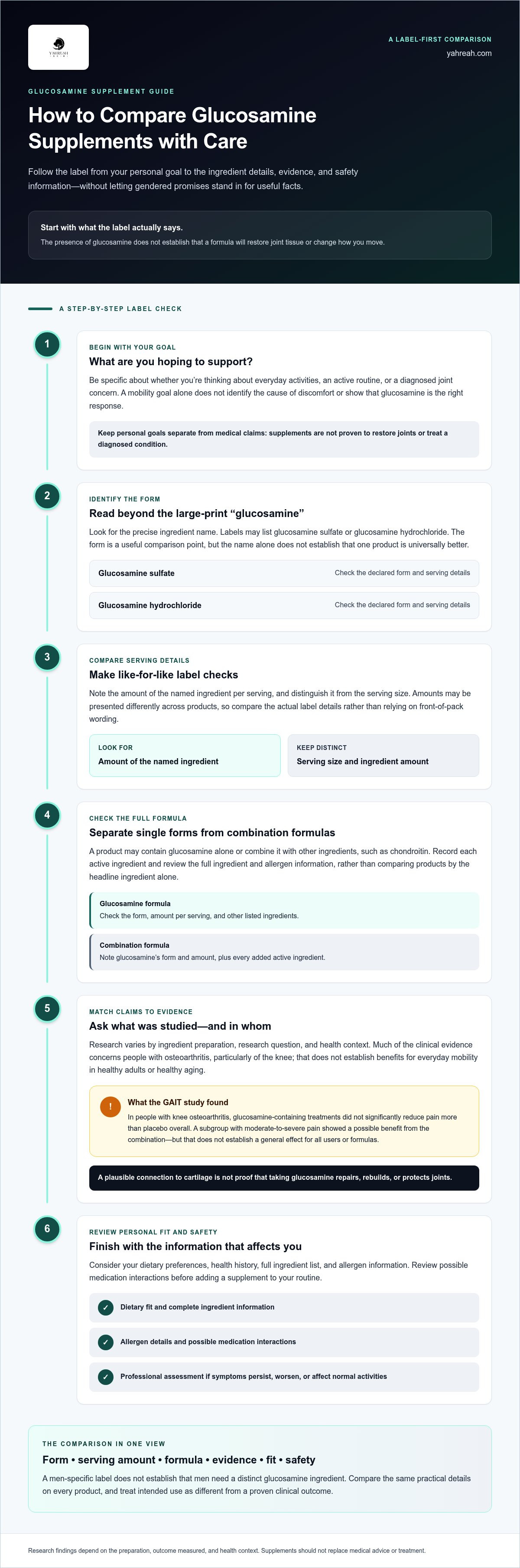
Start with your needs, not a promise on the front of the bottle. Use this checklist to compare products without assuming a men-specific label means the formula is uniquely suited to men.
Compare the form and amount of glucosamine per serving, then check how many capsules or other units make up that serving. Read the directions and allergen statements, and note additional active ingredients. Manufacturer information can add context, but broad promises such as “complete joint support” don’t establish a clinical benefit. Pay particular attention to blends that don’t clearly disclose their ingredients or amounts.
Seek professional guidance before use if you take medication, manage a health condition, have an allergy, or have a procedure planned. Warfarin is one medication to mention, since glucosamine may interact with blood thinners. A clinician or pharmacist can consider your circumstances and the product label. Don’t change prescribed treatment or choose an individual dose based on general supplement information.
For a wider framework on evaluating men’s products, explore supplements for men’s vitality. Apply the same thoughtful standards to mens joint mobility supplements with glucosamine: clear ingredients, understandable directions, and realistic claims. Explore men’s health supplements as part of a considered wellness routine.
A sound comparison brings together the strength and limits of the evidence, label clarity, safety information, and how well a product fits your circumstances. No single quality signal answers every question. A clean-ingredient statement, detailed label, or manufacturing claim may help you assess a product, but none proves that glucosamine will improve mobility or produce a particular clinical result.
Yahreah Skin emphasizes clean ingredients, cruelty-free formulations, and manufacturing in the USA at FDA-registered facilities. These are the brand’s stated standards, not details about a particular glucosamine formula or evidence of a health benefit. Clear ingredient information can support careful shopping, while research is still needed to assess whether an ingredient or formula produces a claimed effect.
FDA registration of a manufacturing facility is not FDA approval of a supplement. In the United States, dietary supplements are not approved by the FDA for effectiveness before marketing. Registration describes the facility’s status; it doesn’t mean the agency has evaluated or endorsed each product. For broader context, consider how ingredient and label information can help you assess supplement quality.
Before choosing, compare complete labels and look for research relevant to the formula and outcome you care about. Check whether ingredient amounts and directions are clear, then weigh the evidence alongside dietary fit and safety information. If you take medication or manage a health condition, discuss supplement questions with a qualified healthcare professional. That conversation can put general product information in the context of your health history.
For mens joint mobility supplements with glucosamine, a thoughtful choice considers evidence, transparency, safety, and personal fit, rather than relying on gendered promises or a single quality signal. The same measured approach can guide any wellness routine: understand what a product says, what research can support, and what remains uncertain.
Explore Yahreah Skin’s men’s health supplements as you consider your next step in a considered wellness routine.
Your next step doesn’t have to be finding the most persuasive bottle. Start by deciding what matters to you, then assess whether a product’s details support that choice. For mens joint mobility supplements with glucosamine, leave room for uncertainty: research can guide what you consider, but it can’t guarantee how an individual will respond.
Let clarity be your standard. Choose claims you can understand, information you can evaluate, and a routine that feels considered rather than pressured. If a question about your health or medications remains, pause and discuss it with a qualified healthcare professional before starting something new.
Yahreah Skin offers men’s health supplements as part of its broader focus on wellness. Take the next step at your own pace: explore Yahreah Skin’s men’s health supplements.
A more informed choice is a meaningful place to begin.
No. Glucosamine supplements aren’t limited to older men, but that doesn’t mean every adult needs one or that age predicts a benefit. Research often focuses on people with a specific joint diagnosis, so it may not apply to a younger person seeking support for general activity. If you’re considering mens joint mobility supplements with glucosamine, base the decision on your goals, health history, and relevant evidence rather than age-based marketing.
Yes. Some glucosamine is produced through fermentation and may be suitable for people avoiding animal-derived ingredients. Still, check the full label: a product’s capsule, coatings, or other ingredients may not fit a vegan diet even if the glucosamine itself does. Look for clear vegan or shellfish-free statements and review the ingredient information rather than assuming the source from the word “glucosamine” alone.
Often, yes. Glucosamine is commonly sourced from shellfish, though shellfish-free versions made through fermentation are also available. If you have a shellfish allergy, don’t rely on a general front-label claim; review the allergen statement and source information for the specific product. Ask a healthcare professional or pharmacist for guidance if you’re uncertain whether a product is appropriate for your allergy history.
No. In the United States, glucosamine is sold as a dietary supplement, and the FDA doesn’t approve supplements for effectiveness before they reach the market as it does drugs. The agency regulates supplements and can take action against products that are adulterated or misbranded. A facility’s FDA registration isn’t the same as FDA approval of its products, and it doesn’t establish that a supplement works.
It depends on the product’s directions. Check the serving instructions on the exact bottle, since formulations may differ. If the label allows it, taking a supplement with a meal may be more comfortable for some people, but don’t change the recommended directions based on general advice. If you have a condition that affects digestion or follow a prescribed diet, ask a healthcare professional whether the product’s instructions suit your situation.
There isn’t a reliable timeline that applies to everyone, and some people may not notice a benefit. Studies assess particular formulas and outcomes over set periods, but those findings can’t predict an individual response or establish when a product should work for you. Avoid taking more or extending use to chase a result. If you’re unsure whether to continue, discuss your expectations and the product with a healthcare professional.
It may interact with warfarin, a blood thinner, so discuss glucosamine with your healthcare professional or pharmacist before using it. Share the exact product label, including other active ingredients, since combination formulas may raise additional questions. Don’t stop, change, or adjust a prescribed blood thinner to accommodate a supplement. Professional guidance can help assess the potential interaction in light of your medication and health history.


