

 USD
USD EUR
EUR
 AUD
AUD
 GBP
GBP
 JPY
JPY
 INR
INR
 MXN
MXN
 CAD
CAD
 JMD
JMD
Total: $0.00
Taxes and shipping calculated at checkout


What if the best plant based digestive enzyme capsules for nutrient absorption aren’t the ones with the longest ingredient list? Enzymes help break down particular components of food during digestion, but that doesn’t mean a supplement will improve how much your body absorbs. The distinction matters, especially when bold marketing claims make digestion support sound like a proven nutrient benefit.
It’s understandable to want a clean, plant-based option and clear evidence of what’s inside. Yet supplement labels can be hard to compare: enzyme names describe different functions, and activity units such as HUT or DU measure different types of enzyme activity. Milligram amounts alone don’t tell the whole story.
This guide will help you read those details with more confidence. You’ll learn how digestive enzymes work, how to assess enzyme function and activity information, and what ingredient transparency can reveal. Just as importantly, you’ll learn to separate reasonable expectations from claims that go beyond the evidence, so you can make a thoughtful, safety-conscious choice without assuming a capsule will solve an absorption concern.
Digestive enzymes are proteins that help break food components into smaller molecules. The body makes enzymes as part of digestion, and different enzymes act on different components of a meal. Some supplements provide enzymes from plant or microbial sources, but the source alone doesn’t establish what an enzyme can do for a particular person.
A useful distinction: Enzyme-assisted digestion helps break food down; it does not, by itself, prove that more nutrients will be absorbed into the body.
Digestion is the process of breaking food into smaller components. Absorption is a separate step: nutrients pass through the lining of the gastrointestinal tract and enter circulation or other pathways in the body. Enzymes can assist with specific parts of digestion, but absorption also depends on what happens along the digestive tract. For a general overview of enzyme types and functions, see Digestive Enzymes.
That difference matters when evaluating claims about plant based digestive enzyme capsules for nutrient absorption. A formula may be described as supporting digestion, but that language shouldn’t be treated as proof that it increases the amount of vitamins, minerals, or other nutrients your body absorbs. A capsule can’t guarantee an absorption outcome, and a longer enzyme list doesn’t establish one either.
If digestion is working adequately, taking an enzyme supplement isn’t automatically necessary. Consider the specific reason you’re looking at a supplement rather than assuming that adding enzymes will improve nutrition. A varied, suitable diet and the body’s own digestive processes remain central; a supplement shouldn’t be treated as a substitute for investigating a concern.
Ongoing digestive symptoms can have many possible causes, not just a shortage of digestive enzymes. Symptoms such as discomfort, changes in bowel habits, or trouble tolerating certain foods don’t identify the cause on their own. Persistent, severe, or unexplained symptoms deserve medical assessment rather than an assumption that an over-the-counter enzyme blend is the answer.
There’s an important distinction between general digestive discomfort and diagnosed pancreatic enzyme insufficiency. The latter requires clinician-directed care. If you have a diagnosis, or suspect a medical issue may be affecting digestion, discuss supplement use with a qualified healthcare professional instead of relying on a general-purpose capsule or changing care on your own.
A thoughtful decision starts with realistic expectations. Ask what digestive function a supplement is intended to support, and keep that separate from claims about nutrient absorption. If a label or advertisement blurs the distinction, read the promise carefully. Supporting one step in digestion isn’t the same as demonstrating a measurable benefit to the next.
Digestive enzymes are selective helpers, not all-purpose food dissolvers. Each acts on a particular type of substance, called its substrate. That specificity is why the enzyme names on a label can be more useful than a large total enzyme count: a blend’s relevance depends on whether its enzymes match the food components and digestive function you’re considering.
Enzyme type matters more than the number listed. A capsule advertising many enzymes isn’t automatically a better fit; look at what each enzyme acts on and whether that function is relevant to your needs.
These examples offer a practical way to read a formula. If you’re examining a blend because a meal contains substantial fat, for instance, lipase is more directly relevant to that component than an enzyme that acts on starch. A meal may contain several food types, but that doesn’t mean every person needs a broad blend or will benefit from taking one. Match the stated enzyme function to the question you’re trying to answer, rather than treating an impressive count as a measure of effectiveness.
“Plant-based” describes an enzyme’s source, not proof that it works better than enzymes from another source. The label still needs context: which enzyme is present, what substrate it acts on, and how the formula is intended to be used. For anyone searching for plant based digestive enzyme capsules for nutrient absorption, that distinction keeps the focus on function rather than assuming a plant-derived ingredient guarantees a particular nutrition outcome.
Some wellness topics may sound related while involving different processes. Enzymes act on food components; gut-barrier discussions concern the intestinal lining, not the breakdown of a meal. The L-glutamine guide to gut barrier integrity explores that separate subject.
Let function lead, then consider whether the source and full ingredient list align with your preferences. For a more intentional approach to supplement shopping, you can explore wellness supplements with ingredient transparency in mind, without assuming that any one category promises a digestive or absorption result.
A useful label comparison goes beyond the number of enzymes or a prominent “plant-based” claim. Look for the specific enzyme, the food component it acts on, any stated activity information, and the product’s serving directions. Then read the rest of the ingredient panel to see what else the capsule contains.
| Enzyme name | Intended substrate | Activity information to look for | Serving directions |
|---|---|---|---|
| Amylase | Starches and other carbohydrates | DU may be used | Follow the directions on the label |
| Protease | Proteins | HUT may be used | Follow the directions on the label |
| Lipase | Fats | FIP may be used | Follow the directions on the label |
| Lactase | Lactose | ALU may be used | Follow the directions on the label |
Activity units describe an enzyme’s measured activity, while milligrams show ingredient weight. When activity is stated, it can tell you more about an enzyme’s functional strength than weight alone. Common units include HUT for protease, DU for amylase, FIP for lipase, and ALU for lactase. These units measure different enzyme activities, so don’t compare their numbers as if they were equivalent. A proprietary blend that groups ingredients without clear amounts or activity details can be harder to assess, but that lack of detail alone doesn’t prove it’s ineffective.
Compare function, activity disclosure, serving directions, and excipients. Use this checklist to keep the label readable and your comparison focused. If the label names a blend but doesn’t show activity information, note that limitation rather than inferring strength from a large total milligram amount or enzyme count.
Look beyond the active enzymes. The ingredient panel may list capsule material, fillers, flow agents, coloring, herbs, probiotics, or other additions. Separate those components from enzymes when judging what the formula is designed to do. Review listed allergens and ingredients you prefer to avoid, and check whether the capsule material fits your needs. A long ingredient list isn’t automatically a sign of a more suitable formula.
Quality statements can offer context, but they don’t establish that a supplement improves digestion or nutrient absorption. FDA-registered manufacturing facilities are not the same as FDA approval of a supplement, and registration doesn’t prove effectiveness. For plant based digestive enzyme capsules for nutrient absorption, prioritize clear, relevant label information over expansive promises. A measured approach to wellness supplements starts with transparency and realistic expectations.
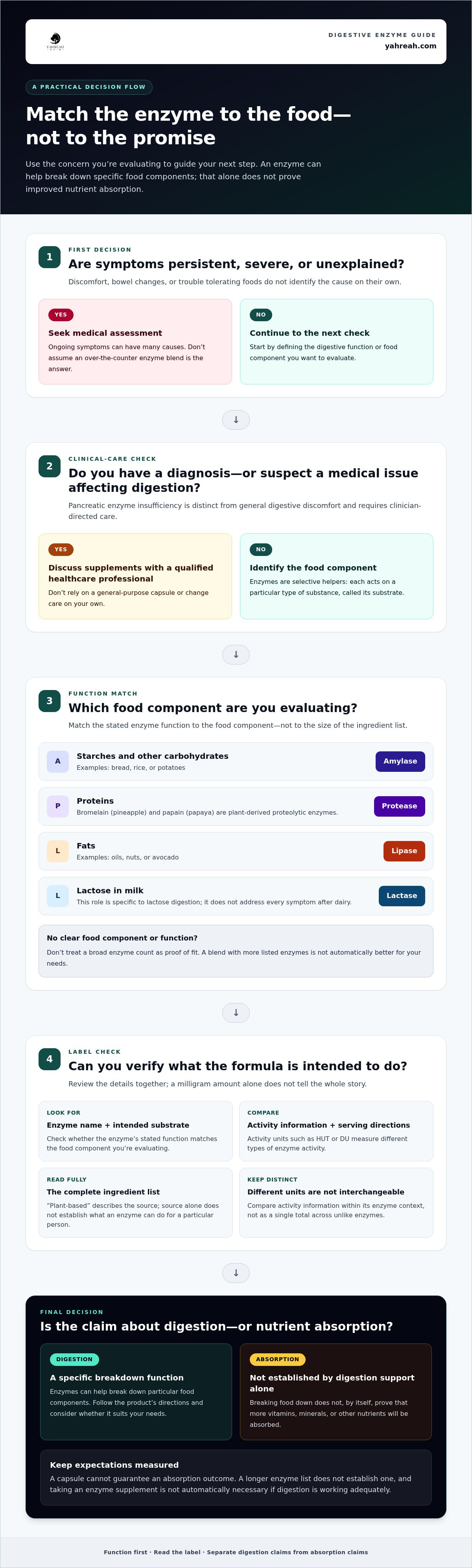
A considered choice begins with a clear question, not a promise on the front of a bottle. Before deciding whether an enzyme capsule is suitable, identify the concern you want to address, then check whether the label describes a relevant enzyme and gives clear directions. If you’re considering plant based digestive enzyme capsules for nutrient absorption, keep expectations measured: a label claim alone doesn’t establish that a supplement increases nutrient absorption.
Compare formulas by the function they describe, not capsule count, enzyme count, or broad wellness language. A label may identify enzymes that act on particular food components, but a long list doesn’t show that every ingredient is relevant to you. General claims about nutrient-absorption enhancement aren’t established simply because they appear on a label. Let the stated function guide your comparison, while keeping the expected benefit modest.
Read the complete ingredient list and serving instructions before use. Pay attention to capsule materials, fillers, allergens, and added ingredients, especially if you have sensitivities. There’s no universal dose or schedule for every enzyme product, so follow the directions on the specific label and don’t take more than it states. Stop using it and seek professional advice if you experience a concerning reaction.
Some circumstances call for a conversation with a qualified clinician before starting a supplement. Discuss use if you’re pregnant, managing a health condition, or taking medication, since your individual situation may affect whether a product is appropriate. Share the full ingredient list and directions so the discussion can focus on the actual formula rather than a general category.
Ongoing digestive symptoms also deserve attention. If symptoms are persistent, severe, unexplained, or changing, seek medical assessment instead of cycling through supplements and interpreting each response on your own. Digestive concerns can have different causes, and trying another blend may delay finding the right explanation. Supplements shouldn’t replace clinician-directed care for a diagnosed condition.
Choose with care, use only as directed, and pause if the product doesn’t seem suitable. For a broader look at Yahreah Skin’s wellness supplements, explore the options with ingredient transparency and your personal needs in mind.
A thoughtful supplement choice rests on three things: a clear function, transparent activity details, and realistic expectations. For plant based digestive enzyme capsules for nutrient absorption, that means looking beyond a product’s headline claim to see which enzymes it contains, what activity information is shared, and what the label actually directs you to do. A promise on a label isn’t proof of a health outcome.
Look for ingredient lists that name what’s in the formula and serving directions that are easy to understand. Clear communication makes it easier to assess whether a supplement fits your preferences and routine. If a label uses broad claims or groups ingredients in a way that’s difficult to interpret, take that as a reason to pause and evaluate the available details, not as automatic evidence for or against the formula.
Quality and manufacturing statements also need context. Manufacturing standards can describe how a product is made, but they don’t establish that a particular formula produces a specific health result. Yahreah Skin states that its products are made in FDA-registered manufacturing facilities in the United States. FDA registration is not FDA approval of a supplement, and it doesn’t prove effectiveness. For broader guidance on assessing ingredients and label claims, the clean supplement brands guide offers another lens for comparing products thoughtfully.
More supplements don’t necessarily make a routine more supportive. Before adding one, name the reason you’re considering it and decide what information would help you assess its suitability. Food choices, health history, sensitivities, and medications all matter. If you’re pregnant, managing a health condition, or taking medication, discuss supplement use with a qualified clinician. Persistent or unexplained symptoms call for assessment, not an expanding cycle of trial and error.
Yahreah Skin’s stated values include clean ingredients and cruelty-free formulations, alongside U.S. manufacturing in FDA-registered facilities. These are company-level commitments, not claims that a specific digestive enzyme formula is offered or that any supplement will improve absorption. A measured approach makes room for values and transparency while keeping health claims in perspective.
Choose with intention. Read carefully, keep your expectations grounded, and let your routine serve a clear purpose rather than becoming crowded with products. If you’d like to explore the brand’s broader wellness and beauty offerings, Explore Yahreah Skin.
Your next step doesn’t need to be adding another capsule. Start by noticing what you want support with, what information would help you make a decision, and whether a supplement is appropriate for your circumstances. If you’re still considering plant based digestive enzyme capsules for nutrient absorption, let clear, relevant information guide you rather than a promise of results.
Mindful wellness can also mean choosing brands whose values align with your own. Yahreah Skin emphasizes clean ingredients and cruelty-free formulations, and states that its products are made in FDA-registered U.S. facilities. That manufacturing detail is not FDA approval of a supplement or proof of a health outcome. Transparency is a useful starting point, paired with a measured view of what any product can reasonably claim.
Give yourself room to choose carefully. Explore Yahreah Skin’s broader wellness and beauty offerings when you’re ready to make your next choice with care: Explore Yahreah Skin. Thoughtful decisions, made at your own pace, can help make wellness feel more intentional.
They haven’t been shown to reliably improve nutrient absorption for generally healthy people simply because they’re plant-based. Enzymes may help break down particular food components, but that doesn’t establish that more nutrients cross the intestinal lining. If you’re considering plant based digestive enzyme capsules for nutrient absorption, treat the phrase as a claim to assess, not a proven outcome. Ongoing concerns about nutrient deficiencies or digestion warrant medical advice.
Look for enzymes whose stated function matches the food component you’re concerned about. Amylase acts on starches, protease on proteins, lipase on fats, and lactase on lactose. Some formulas also contain plant-derived bromelain or papain, which are proteases. Check whether the label names each enzyme and provides activity information; a broad “multi-enzyme” description alone may not show what the blend is intended to do.
Follow the directions on the specific product label, since instructions can differ between formulas. Don’t assume every capsule should be taken at the same time or in the same way, and don’t increase the serving if you think it isn’t working. If the directions are unclear or conflict with advice you’ve received for a health condition, ask a qualified healthcare professional or pharmacist before using the supplement.
Not inherently. “Plant-based” identifies a source, but it doesn’t prove superior effectiveness or suitability for every person. Compare the enzyme’s function and disclosed activity, then consider the full ingredient list and your dietary preferences. A specific medical need may call for a different approach than a general over-the-counter supplement, so people with diagnosed enzyme insufficiency should follow clinician-directed care rather than choosing based on source alone.
They may be relevant to a particular food-digestion concern, but they aren’t a dependable fix for bloating in general. Bloating can have many causes, and the symptom alone doesn’t identify an enzyme issue. Notice whether it is persistent, severe, unexplained, or associated with other changes, and seek medical assessment in those cases rather than repeatedly trying different blends or restricting foods without guidance.
No. Under the Dietary Supplement Health and Education Act, the FDA doesn’t approve dietary supplements for safety and effectiveness before they’re marketed. Manufacturers are responsible for ensuring supplements are safe and that their claims aren’t misleading. A statement about manufacturing or facility registration isn’t FDA approval of a supplement, and it doesn’t demonstrate that an enzyme formula works for digestion or nutrient absorption.
Talk with a qualified healthcare professional before use if you’re pregnant, managing a health condition, or taking medication, since personal circumstances can affect whether a supplement is appropriate. Anyone diagnosed with pancreatic enzyme insufficiency should follow clinician-directed care. Seek medical assessment for persistent, severe, or unexplained digestive symptoms, and stop taking a supplement and seek professional advice if you experience a concerning reaction.


