

 USD
USD EUR
EUR
 AUD
AUD
 GBP
GBP
 JPY
JPY
 INR
INR
 MXN
MXN
 CAD
CAD
 JMD
JMD
Total: $0.00
Taxes and shipping calculated at checkout


“Cellular detox” describes a real area of biology, but not the dramatic cleanse that supplement claims can imply. It’s understandable to wonder whether a reduced glutathione supplement for cellular detox can help your body clear unwanted substances. Glutathione supports antioxidant defenses inside cells, but that role alone doesn’t prove a supplement can deliver a broad detox effect or remove specific toxins.
This guide separates established biology from claims that need stronger evidence. You’ll learn how glutathione helps cells manage oxidative stress, what studies of oral supplements can and can’t tell us, and why results from one formulation may not apply to another. You’ll also see what “cellular detox” can mean, which safety questions to consider, and why oral supplements shouldn’t be confused with injectable glutathione. The goal isn’t to dismiss the science or promise a shortcut. It’s to give you a practical, evidence-minded way to assess supplement claims and make informed choices.
Can a reduced glutathione supplement for cellular detox help cells clear unwanted substances? The answer depends on what “detox” means. The term is often used as a catch-all for normal processes that handle or eliminate substances, but it isn’t one medically defined process or a single body-wide cleanse. Without a named substance or measurable outcome, a detox promise is difficult to evaluate.
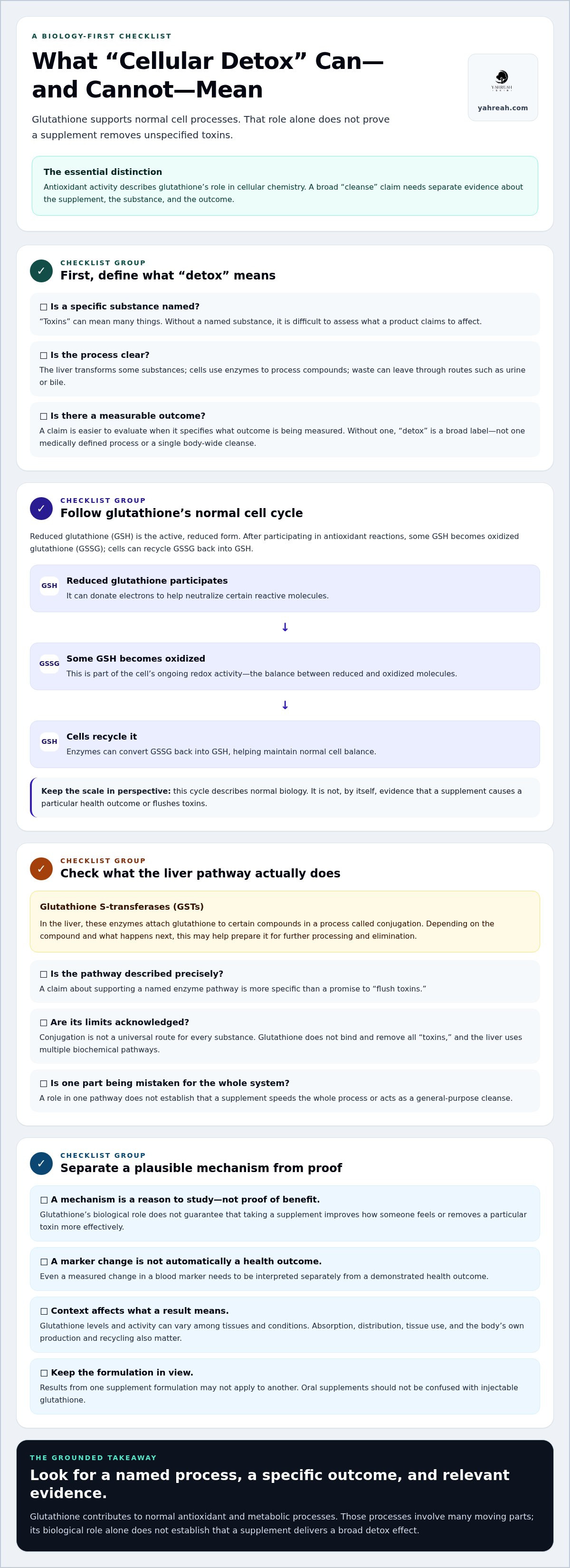
Glutathione is a small molecule made from three amino acids. Inside cells, it exists in two closely related forms: reduced glutathione, or GSH, and oxidized glutathione, or GSSG. GSH is the reduced, active form that participates in antioxidant reactions. After helping neutralize reactive molecules, some GSH becomes GSSG, which cells can recycle back into GSH. This balance contributes to redox activity, the ongoing exchange of electrons that supports normal cell function.
A helpful overview of glutathione’s chemistry and biological roles is available in Glutathione: The Master Antioxidant. The key idea is not that cells are being “flushed.” Cells use interconnected systems to maintain balance and process different compounds.
Think of GSH as part of a cell’s built-in protective toolkit, not a standalone shield. It helps limit oxidative stress by reacting with certain oxidizing molecules, while enzymes and other antioxidant systems also contribute. The body continually makes and recycles glutathione as part of ordinary biology.
That role describes a biological function, not a guaranteed result from taking a supplement. A measured change in glutathione levels doesn’t automatically show that someone feels better or eliminates a particular toxin more effectively. Glutathione levels and activity can also vary among tissues and conditions.
“Detox” may refer to several distinct processes. The liver chemically transforms some substances, cells use enzymes to process compounds, and the body eliminates waste through routes such as urine or bile. Glutathione participates in some of these pathways, but that doesn’t make a supplement a general-purpose cleanse. A product’s role in one pathway doesn’t prove that taking it accelerates every step or removes an unspecified burden.
For example, a claim about supporting a named enzyme pathway is more precise than a promise to “flush toxins.” A meaningful detox claim should identify the substance or process, explain the outcome being measured, and point to relevant evidence. Otherwise, the word can imply more than the science establishes.
Antioxidant activity describes how glutathione participates in cellular chemistry; it does not, by itself, prove that a supplement removes unspecified toxins from the body. This distinction keeps the conversation grounded: glutathione has a recognized role in normal cell biology, while broad cleanse promises require specific evidence about the supplement, the substance, and the claimed outcome.
Glutathione’s role is clearer when viewed as part of a network, rather than as a standalone cleansing agent. Cells use antioxidant reactions to manage reactive molecules, while enzymes help process a range of compounds. The liver also transforms substances, and the body relies on connected routes, including bile and urine, to eliminate waste. Each step has its own biology. A supplement’s involvement in one pathway doesn’t establish that it speeds up the whole system.
Glutathione is one participant in the cell’s ongoing chemical balance, not a promise of a particular health outcome. That distinction matters when evaluating claims about a reduced glutathione supplement for cellular detox. A plausible mechanism is a reason to study a supplement, not proof that it produces a meaningful benefit.
During antioxidant reactions, reduced glutathione (GSH) can donate electrons to help neutralize certain reactive molecules. In doing so, some GSH becomes oxidized glutathione (GSSG). Enzymes in cells can convert GSSG back into GSH, helping maintain redox balance, the dynamic relationship between reduced and oxidized molecules.
This cycle is part of normal cell function, not a simple gauge of overall health. A supplement’s effects can’t be inferred from the cycle alone. Absorption, distribution, tissue use, and the body’s own production and recycling all matter. Even a measured change in a blood marker needs to be interpreted separately from a demonstrated health outcome.
In the liver, glutathione participates in reactions involving enzymes called glutathione S-transferases (GSTs). These enzymes attach glutathione to certain compounds in a process known as conjugation. Depending on the compound and what happens next, conjugation can help prepare it for further processing and elimination. It isn’t a universal route for every substance, and it doesn’t mean glutathione binds and removes all “toxins.”
The liver’s work is broader than one enzyme family. It transforms substances through multiple biochemical pathways, and the resulting compounds may be handled through different routes. A claim that a supplement “cleanses” or “repairs” the liver goes beyond describing glutathione’s role in these reactions. It requires evidence for that specific effect and outcome.
For a wider look at evidence and supplement claims in this area, explore this healthy liver supplements guide. The practical takeaway is measured: glutathione contributes to normal antioxidant and metabolic processes, but those processes involve many moving parts. A considered wellness routine starts with clear, specific claims and transparent ingredient information. You can also explore wellness supplements and skincare with an informed eye toward ingredients and each product’s intended role.
Human research offers some evidence that oral glutathione can affect glutathione measurements in the body, but a biomarker change isn’t the same as proof of better health, toxin removal, or disease prevention. Results also depend on the people studied, the dose and duration, how levels are measured, and the exact product formulation. That makes broad claims about a reduced glutathione supplement for cellular detox difficult to justify based on a single study.
A 2015 clinical trial reported increased blood glutathione levels after six months of oral supplementation. A daily 250 mg dose was associated with a 17% increase, while 1,000 mg daily was associated with a 30-35% increase. These are changes in a measured marker, not direct evidence of a cleanse or meaningful health outcome.
Other findings need the same careful reading. A small pilot study of liposomal glutathione reported a 40% increase in whole-blood levels after two weeks at 500 mg per day. A 2025 study reported a 16.1-fold increase in bioavailability for a specific liposomal delivery system. Neither result should be assumed to apply to all products or to prove a clinical benefit for users. Small samples, short follow-up, differing populations, and formulation-specific methods can limit how widely findings apply.
Reduced glutathione is GSH, the active reduced form the body uses in cellular reactions. Liposomal products package an ingredient in lipid-based structures intended to influence delivery, but the evidence needs to match the exact formulation. N-acetylcysteine (NAC) is different: it’s a precursor the body can use to make glutathione, not glutathione itself. A concise overview of that distinction appears in this NAC capsules guide.
Conventional oral, liposomal, and other approaches shouldn’t be ranked by a single absorption claim. Compare like with like: the ingredient form, amount used in the study, measurement method, length of use, and whether the research tested the same formulation being discussed. A result for one specific liposomal system, for example, doesn’t establish that every liposomal product has the same bioavailability. The liposomal technology reference guide offers further context on how delivery methods are described.
For a practical evidence check, ask what was measured and what the study can actually support. Blood or whole-blood glutathione levels are biomarkers; they don’t, by themselves, show that a particular substance was eliminated or that health improved. Look for human research rather than treating laboratory or animal findings as if they establish human outcomes. The evidence is evolving, so keep your confidence proportional to the study design and its limitations.
Thoughtful supplement choices begin with clear ingredient information and claims that match the evidence. Explore wellness supplements as part of an informed, considered routine, rather than as a shortcut to a promised detox.
A thoughtful supplement decision starts with a pause, not a promise. Assess claims about a reduced glutathione supplement for cellular detox in four steps: identify the claim, inspect the label, review relevant evidence, and consider your health context. This approach helps separate useful product information from reassuring language that doesn’t say exactly what a supplement is expected to do.
Manufacturing in an FDA-registered facility is not the same as FDA approval of a supplement. Registration does not establish that a product is approved, effective, or proven safe for every person. In the United States, dietary supplements are regulated, but they don’t undergo FDA premarket approval for safety and effectiveness in the same way as prescription drugs.
Personal context matters. If you’re pregnant or nursing, managing a health condition, or taking prescription or over-the-counter medicines, discuss supplement use with a qualified clinician who understands your circumstances. Ingredients may affect people differently, and a clinician can help consider possible interactions, existing care, and whether a supplement is appropriate for you.
There isn’t one universal dose that suits everyone, and a supplement shouldn’t replace prescribed treatment or medical advice. Keep the route of use in view, too: findings or safety information about oral supplements shouldn’t be applied to injectable or intravenous glutathione, which involves different risks and clinical considerations.
Choose with care and clear information. Explore wellness supplements with transparent ingredient information as part of a considered routine, rather than relying on a quick-detox promise.
Glutathione has a meaningful role in normal cellular processes, but that biology shouldn’t be mistaken for a quick cleanse. A supplement is one possible part of a broader wellness routine, not a substitute for the body’s interconnected systems or for medical care. The most useful question isn’t simply whether a product promises “detox.” Consider the specific, realistic goal you hope to support and whether evidence for that product fits the goal.
Start by naming your intention. Are you interested in general nutritional support, or are you hoping to address a particular symptom or health concern? Those are different aims, and a supplement’s mechanism alone can’t tell you whether you’ll experience a personal benefit. Research showing a change in a glutathione measure, for example, doesn’t automatically demonstrate a noticeable improvement in health or prove that a product removes toxins.
Foundational habits deserve attention, too. Regular meals with a variety of nourishing foods, adequate sleep, hydration, and movement suited to your circumstances can help create a steady wellness routine without relying on a dramatic detox promise. These habits aren’t a treatment plan, and they don’t guarantee a particular outcome. They help keep supplement use in perspective. If you have a medical concern, consider that context first rather than trying to manage it with a cleanse.
Clear information is more useful than grand language. Look for the exact ingredient and form, serving details, other ingredients, and accessible explanations of the product’s quality practices. Benefit statements should be measured and consistent with the evidence, not framed as guaranteed results or sweeping claims about toxin removal. A “clean” label can be a helpful starting point, but it doesn’t by itself establish effectiveness or suitability.
Yahreah Skin emphasizes clean ingredients and cruelty-free formulations as part of its broader approach to wellness. Those values can inform how you think about ingredients and transparency, while remaining separate from claims about a specific glutathione product or result. For broader considerations when reviewing ingredient and quality information, see this clean supplement brands guide.
Whether you’re considering a reduced glutathione supplement for cellular detox or another wellness product, let your specific goal, the quality of the evidence, and your individual health context guide the decision. If you’re pregnant or nursing, managing a condition, or taking medicines, discuss supplement use with a qualified clinician. Choose care over urgency. You’re welcome to explore Yahreah Skin's wellness products as part of a considered routine, with room to make informed choices at your own pace.
Your next step can be simple: decide what you hope to support, then let clear information guide your choices. A reduced glutathione supplement for cellular detox shouldn’t need dramatic promises to sound worthwhile. Thoughtful decisions leave room for uncertainty, personal health needs, and the difference between a biological role and a proven result.
That same care applies to the standards behind the products you choose. Yahreah emphasizes clean ingredients and cruelty-free formulations, and states that its products are made in FDA-registered facilities in the USA. FDA registration is not FDA approval, nor proof that a supplement is effective. Look for transparency, and choose at a pace that feels considered rather than pressured.
Wellness is built through informed choices over time, not a quick cleanse. Explore Yahreah's wellness products and take a considered approach to your next wellness choice. Let curiosity lead, keep your expectations grounded, and make each choice with confidence.
Reduced glutathione, or GSH, is one chemical form of glutathione; oxidized glutathione, or GSSG, forms after glutathione takes part in certain reactions. Cells can convert GSSG back to GSH as part of their ongoing activity. The two forms are related, not separate supplements with interchangeable meanings. A measurement of either form also needs context, since one result alone doesn’t describe every tissue or establish a health benefit.
A reduced glutathione supplement may affect glutathione levels, but that doesn’t establish that it “detoxes” cells or removes a particular toxin. Detox can refer to different processes, so look for a specific substance and a measurable outcome behind any claim. Evidence that a supplement changes a glutathione marker, for example, is not the same as evidence that it removes a named compound or improves a health outcome.
Some human studies report increases in measured glutathione levels after oral supplementation, but results can vary by study and formulation. A blood measurement may not represent levels in every tissue, and a change in a marker doesn’t prove a noticeable benefit. When comparing study findings, check how glutathione was measured, who participated, how long the study lasted, and whether the tested product matches the formulation you’re considering.
“Reduced” describes glutathione’s chemical form, while “liposomal” describes a delivery format in which an ingredient is carried in lipid-based structures. These terms aren’t direct alternatives: a product may describe both its glutathione form and its delivery method. Absorption findings for one specific liposomal formulation shouldn’t be assumed to apply to every product using that description. Review the full ingredient label and the research linked to the exact formulation.
Daily use isn’t automatically appropriate for everyone. Oral glutathione has generally been tolerated in clinical studies, but that doesn’t establish long-term safety for every person, product, or dose. Follow the product label and consider your health circumstances rather than assuming that more is better. If you’re pregnant or nursing, have a health condition, or take medicines, discuss regular use with a qualified clinician before starting.
Potential interactions depend on the person, the medication, and the supplement’s ingredients. Don’t assume a product is interaction-free because it’s sold without a prescription. If you take medication, show a clinician or pharmacist the complete label, including added ingredients and serving directions. This is especially useful when several supplements are part of your routine, since overlapping ingredients can be easy to overlook.
Check that the label names the ingredient and form, states the amount per serving, defines the serving size, and lists other ingredients such as fillers or flavorings. Look for clear directions and manufacturer quality information, including independent testing details if provided. Match any evidence cited to the same form and delivery method. Broad detox language, a polished label, or a facility-registration statement is not proof of effectiveness.


