

 USD
 EUR
 AUD
 GBP
 JPY
 INR
 MXN
 CAD
 JMD
Total: $0.00
Taxes and shipping calculated at checkout


A calming bedtime routine doesn’t make every sleep supplement a proven sleep aid. People take reishi hoping to support relaxation and sleep, but reishi mushroom capsules for restful sleep have no established standard dose, and claimed benefits should be weighed against the evidence and safety considerations.
It’s understandable to look for a gentle addition to an evening routine. To assess reishi, look beyond the bedtime label: supplement directions vary, and potential side effects or medication interactions matter. This guide explains why people take reishi, what research and product claims say about sleep, and what to consider when reading capsule ingredients. It also covers practical safety points, including when reishi may be a poor fit alongside certain medicines. Weighing both the possible benefits and the limits can help you make a more informed choice.
Reishi is a mushroom used as a dietary supplement, often chosen for general wellness, stress, or hoped-for sleep support. Some people choose reishi mushroom capsules for restful sleep because a capsule can fit into an existing bedtime routine. Traditional use does not establish that reishi treats insomnia or reliably improves sleep.
Supplement timing means fitting a product’s directions into your routine. Directions vary: some products say to take 2 capsules before bed, while other labels may differ. If a patient and doctor decide reishi is appropriate, one approach is taking it 30-60 minutes before bed. Timing and method depend on the supplement, so follow its label rather than borrowing directions from another form.
How long does reishi take to affect sleep? There is no single established onset time for sleep effects. Allow 2-4 weeks before evaluating whether it seems helpful, and note any changes in sleep and stress during that time. This is an observation window, not a standard dose or proof of an effect.
Supplement form describes how reishi is prepared for use: capsules, liquid, and powder are available. Reishi extracts are often taken at around 1 to 3 grams a day, although there is no standard dose for sleep. Grams of extract and capsule counts aren’t automatically interchangeable because strength and preparation depend on the product. Follow the label’s serving instructions; don’t convert a gram amount into capsules without matching product details.
U.S. dietary supplement rules differ from those for conventional foods and drugs. In the United States, manufacturers don’t have to demonstrate a supplement’s safety or effectiveness before selling it. Read the label for the product form, serving directions, and any extract description. Reishi tea may be taken in the evening, one to two hours before bed. Capsule, powder, liquid, and tea routines differ, so follow the directions for the form you choose.
Reishi can cause unwanted effects and may interact with some medicines. Review these risks before adding it to a sleep routine.
Side effects are unwanted physical reactions that may occur while taking reishi. Reported effects include dizziness, itchiness, rash, headache, stomach upset, nosebleed, and bloody stools. In a survey of 1,374 reishi users with cancer in China, 9% reported side effects, while 3% reported insomnia. These survey findings describe those participants, not everyone who uses reishi. If a symptom appears after starting a supplement, stop taking it and seek medical advice, especially for bleeding signs such as bloody stools or nosebleeds.
An interaction occurs when reishi affects how a medicine or another supplement works. Reishi may increase bleeding risk and interact with anticoagulant or antiplatelet medicines. High doses may also raise bleeding risk for people with a very low platelet count. Reishi may interact with high blood pressure medicines, too. Before combining reishi with medicines, give a clinician or pharmacist a complete list of prescription medicines, over-the-counter products, and supplements. This helps them assess the combination rather than considering reishi alone.
Reishi safety means weighing possible harms against a person’s health conditions, medicines, and planned procedures. If surgery is planned, the guidance advises stopping reishi about two weeks beforehand because of bleeding concerns. Ongoing insomnia lasting more than 3 months may warrant further medical evaluation; persistent sleep problems deserve attention beyond supplement choices. Bring the product label and a list of medicines to a medical appointment, so the ingredients and potential interactions can be reviewed together. People with bleeding concerns or taking blood pressure medication should discuss reishi before use, rather than treating a supplement as automatically safe because it is medicinal or natural.
Reishi’s sleep benefits remain a claim to weigh against limited human evidence. A controlled trial can provide a measurable result, but its findings need careful interpretation.
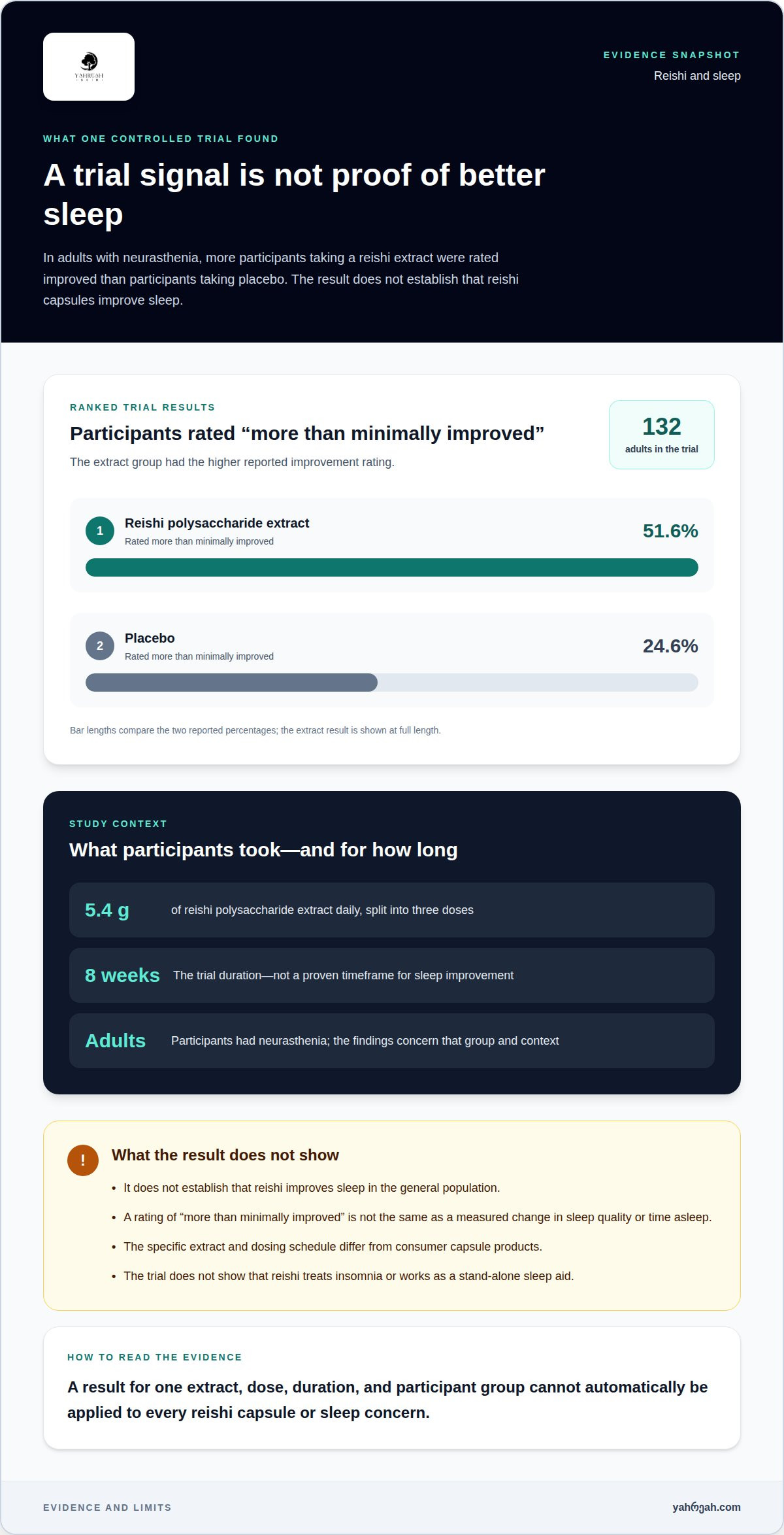
Human sleep evidence comes from studies involving people, while animal evidence comes from nonhuman models. In a controlled trial, 132 adults with neurasthenia took reishi polysaccharide extract or placebo for eight weeks. According to The study authors, 51.6% of participants taking the extract were rated more than minimally improved, compared with 24.6% taking placebo. The result concerns improvement among adults with neurasthenia; it does not establish that reishi capsules improve sleep in the general population. Animal findings alone also cannot demonstrate a sleep benefit in people.
A research limitation is a factor that narrows what a study’s results can show. The trial used 5.4 grams of reishi polysaccharide extract daily, split into three doses. That specific extract and schedule differ from the capsule directions and formulas available to consumers. Its eight-week duration also describes the trial, not a proven period for sleep improvement. A rating of “more than minimally improved” isn’t the same as a measured change in sleep quality or time asleep.
For people considering reishi mushroom capsules for restful sleep, the distinction matters. Results for a particular extract cannot automatically be applied to every capsule, dose, or sleep concern. The trial’s participants had neurasthenia, so its findings relate to that group and context. They don’t show that reishi treats insomnia or works as a stand-alone sleep aid. A careful reading separates the reported improvement from broader claims about sleep and recognizes that one trial cannot establish a reliable sleep effect for everyone.
An ingredient is a component listed in a supplement’s formulation. Sleep Capsules contain reishi mushroom extracts described as 10:1 fruiting body extracts. “Fruiting body” identifies the mushroom part used, while “extract” indicates that material has been prepared into a concentrated form. The ratio describes the extract, not a measured sleep effect or a guarantee of how someone will feel after taking it.
A 10:1 extract ratio is a label detail, not proof of potency in the body. It doesn’t tell you how much active compound a capsule delivers, or whether the formula improves sleep. Read the serving directions alongside the ingredient description. For example, don’t assume that a 10:1 extract can be compared directly with another product’s capsule count or extract weight without matching those details.
Claimed benefits are the effects associated with a product or ingredient. Reishi is used in sleep-focused formulas with the aim of supporting rest, but the extract description alone doesn’t establish that benefit. Research on a particular reishi extract also doesn’t automatically apply to every capsule. The study discussed earlier used a specific polysaccharide extract, so its findings shouldn’t be treated as proof for all 10:1 fruiting body extracts.
Use the label as a practical reading guide: identify each named ingredient, note the serving instructions, and distinguish extract ratios from evidence of results. If a capsule lists reishi as a 10:1 fruiting body extract, that is the ingredient description to assess. Avoid interpreting “sleep” in a product name as evidence that the supplement treats insomnia. A careful review separates what the formula contains from what it claims to support.
For a considered approach to wellness ingredients, explore mindful wellness essentials and compare each product’s stated ingredients with your needs.
Yahreah Skin offers supplements and natural skincare for people building a thoughtful wellness routine. After weighing reishi’s possible benefits against its limits and safety considerations, explore options that align with your broader wellbeing priorities.
Yahreah Skin’s range includes women’s health supplements, men’s health supplements, premium supplements, and natural skincare products. The brand emphasizes natural ingredients and cruelty-free formulations, offering a considered place to explore personal care without treating a supplement as a substitute for medical advice.
If reishi may interact with your medication or you have ongoing sleep concerns, speak with a healthcare professional about those risks. For other wellness needs, explore Yahreah Skin’s supplements and natural skincare online.
Let your sleep routine reflect your needs, not the promise on a label. If you’re considering reishi mushroom capsules for restful sleep, decide what you hope to support and keep your expectations grounded in the available evidence. A supplement is one part of personal care, not a replacement for help with ongoing sleep concerns.
Take a considered approach: think about your current routine, health circumstances, and any medicines you use. Whether reishi is appropriate depends on those individual factors. Choosing wellness products carefully can make your routine feel more intentional and aligned with your priorities.
Yahreah Skin offers women’s health supplements, men’s health supplements, and premium supplements as part of a broader approach to wellbeing. If you’d like to explore its offerings, contact Yahreah Skin. Move forward with curiosity, care, and a routine that feels right for you.
Being over 40 doesn’t by itself determine whether reishi is safe for you. The more relevant considerations include your health conditions, medicines, and any history of bleeding concerns. Reishi may interact with some blood-thinning and blood pressure medicines. Before adding it to a routine, review those factors with a healthcare professional, especially if you take regular medication or have a planned procedure.
Research hasn’t established which group, if any, benefits most from reishi for sleep. If you’re considering it, first clarify your goal, such as supporting a calmer evening routine, rather than expecting a treatment for insomnia. If sleep problems persist or affect daily life, consider discussing them with a healthcare professional instead of relying on a supplement alone.
People take reishi capsules hoping to support sleep, but current evidence doesn’t establish that capsules reliably improve restful sleep. A capsule’s contents and preparation may differ from the extract studied in research. If you’re considering one, assess its ingredient information and claims separately, and don’t interpret a sleep-focused product name as proof that it treats a sleep disorder.
Research offers a limited signal, not a definitive answer about sleep quality. The reported human trial assessed overall improvement in adults with neurasthenia, rather than establishing a specific improvement in sleep measures for everyone. Its findings therefore can’t be taken as proof that reishi generally improves sleep quality. The type of extract and the outcome measured matter when interpreting a study.
There’s no standard reishi dose established for sleep. Reishi extracts are often taken at around 1 to 3 grams a day, but that figure doesn’t translate directly into a capsule count. Extract strength and serving directions vary by product. Follow the specific label’s directions, and don’t increase the serving simply because another extract or study used a different amount.
Timing depends on the supplement’s directions and your routine. If you and a healthcare professional decide reishi is appropriate, one suggested approach is taking it 30-60 minutes before bed. Use the product label as your guide, since capsule directions can differ. Taking it at a consistent point in your evening routine can also make it easier to notice how it affects you.


