

 USD
 EUR
 AUD
 GBP
 JPY
 INR
 MXN
 CAD
 JMD
Total: $0.00
Taxes and shipping calculated at checkout


Curcumin may ease osteoarthritis pain and stiffness, but the evidence isn’t a promise of relief for everyone. A review of 15 randomized controlled trials found curcumin helped with these symptoms as well as or better than NSAIDs. Turmeric curcumin with BioPerine for joint pain combines curcumin with an ingredient intended to support its absorption.
It makes sense to look for a plant-based option when joint discomfort starts to limit everyday movement. The key is understanding what the evidence says about turmeric curcumin with BioPerine for joint pain, what BioPerine may contribute, and how much curcumin a serving actually provides.
This guide explains how curcumin may affect osteoarthritis symptoms, why absorption matters, and how to read serving size and servings per container without confusing capsule count with curcumin content. You’ll also find the main safety considerations to keep in mind when considering a supplement as part of your wellness routine.
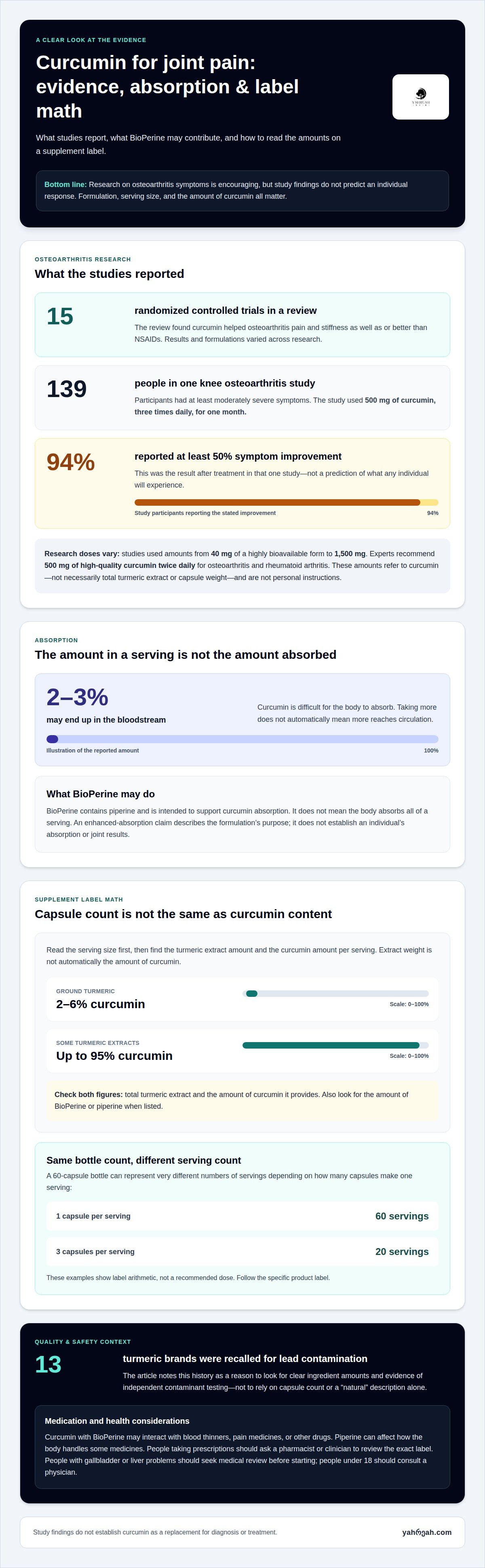
Capsule count alone doesn’t show how much curcumin you get each day. Read the serving size first, then find the amount of turmeric extract and curcumin per serving. Ground turmeric contains about 2 to 6% curcumin, while some extracts contain up to 95%. These are different measures: the extract’s total weight isn’t automatically the curcumin amount. Look for both figures, plus the amount of BioPerine or piperine, when listed.
Next, use the serving size to interpret the bottle’s serving count. Containers may hold 60 or 120 capsules, but servings depend on how many capsules make one serving. For example, a 60-capsule bottle contains 60 servings at one capsule per serving, or 20 servings at three capsules per serving. These examples explain label arithmetic, not a recommended dose. Follow the specific product label rather than assuming that every formula uses the same serving.
Quality matters alongside quantity. Choose a label that clearly identifies the ingredients and amounts per serving, and look for evidence of independent testing for contaminants. Turmeric can be affected by contamination, including lead. In recent years, 13 turmeric brands were recalled for lead contamination. That history makes transparent testing information a useful part of evaluating a supplement, rather than relying on capsule count or a “natural” description alone.
In the United States, there isn’t one typical price for turmeric curcumin with BioPerine supplements. Capsule count, extract strength, and formulation affect comparisons, so assess the labeled servings and curcumin amount rather than judging by bottle size alone. A larger container doesn’t necessarily provide more curcumin per serving. Check that the serving information gives a clear breakdown, and distinguish turmeric extract from its curcumin content before comparing options.
Curcumin has been studied for osteoarthritis, especially knee pain and stiffness. A review of 15 randomized controlled trials found symptom relief comparable to or greater than NSAIDs. In one knee osteoarthritis study, 139 people with at least moderately severe symptoms took curcumin. The study used 500 mg three times daily for one month. After treatment, 94% reported at least 50% symptom improvement. These findings are encouraging, but they describe one study and do not predict an individual response.
Research doses vary, which makes comparisons between supplements difficult. Studies used doses from 40 mg of a highly bioavailable form to 1,500 mg. Experts recommend 500 mg of high-quality curcumin twice daily for osteoarthritis and rheumatoid arthritis. Those amounts refer to curcumin, not necessarily the total turmeric extract or capsule weight. Study findings also depend on the formulation and duration, so don’t treat one trial’s dose as a personal instruction.
Curcumin with BioPerine may interact with blood thinners, pain medicines, or other drugs. Because piperine can affect how the body handles some medicines, people taking prescriptions should ask a pharmacist or clinician to review the exact supplement label before use.
People with gallbladder or liver problems should not start curcumin or piperine without medical review. A clinician can consider the condition, current medicines, and supplement ingredients together. People under 18 years of age should consult a physician before use.
Seek medical care instead of relying on a supplement if joint pain is severe, follows an injury, or comes with a hot, swollen joint or fever. Get prompt assessment if pain makes bearing weight difficult. For ongoing symptoms, a clinician can assess the cause and discuss suitable care. Curcumin research does not establish it as a replacement for diagnosis or treatment.
Curcumin is difficult for the body to absorb, so taking more doesn’t automatically mean more reaches circulation. Only about 2 to 3% may end up in the bloodstream. This is why supplement labels sometimes pair curcumin with BioPerine, a piperine ingredient intended to support absorption. BioPerine may improve curcumin absorption, but it doesn’t mean the body absorbs all of a serving. The amount listed on a label and the amount absorbed are different measures.
Start with the Supplement Facts panel. Find the curcumin amount per serving, then check whether BioPerine or piperine is listed separately. Capsule count alone cannot show how much of either ingredient a serving contains. For example, two bottles with the same capsule count may have different serving sizes and formulas. Read each panel as a whole, and follow that product’s directions rather than transferring instructions between brands.
Formulation matters, too. Curcumin extracts, turmeric powders, and combinations with piperine aren’t interchangeable just because each label mentions turmeric. Look for clear ingredient names and amounts, then compare servings on the same basis. A claim about enhanced absorption describes the formulation’s purpose; it doesn’t establish how much curcumin an individual will absorb or what joint results they’ll experience. Keep these distinctions in mind when comparing a supplement label with study findings.
Let the label guide your routine. Take the stated serving as directed, and don’t add capsules to compensate for curcumin’s low absorption. If a label says to take a serving with a meal, follow that direction; otherwise, don’t assume another product’s timing applies. Record the product name, serving, and routine so changes are easy to track. BioPerine is an absorption aid, not a substitute for understanding the curcumin amount, serving instructions, and full ingredient list.
Evidence on curcumin’s safety has limits. In one study, none of the participants taking curcumin needed treatment for stomach trouble during the study. That finding is reassuring only under the conditions studied. It doesn’t prove that everyone will tolerate every dose or formulation, including products that combine curcumin with piperine.
Supplement formulas differ, so read the full label before use. Note the serving size, curcumin amount, piperine amount, and any additional ingredients. Don’t treat “natural” as a substitute for checking what’s in a capsule. If you notice an unexpected reaction after starting a supplement, stop taking it and seek medical advice, especially if symptoms are severe.
Curcumin and piperine can also raise questions about medication interactions. Piperine is included to support curcumin absorption, which can matter for people taking prescription medicines. Share the complete product label and medication list with a pharmacist or clinician before combining them. People with ongoing health conditions, including gallbladder or liver problems, should get medical guidance before starting these supplements.
Quality is another consideration. In the United States, dietary supplements such as curcumin aren’t tested or regulated in the same way as prescription drugs. A clear label helps, but it doesn’t establish the contents or purity of every product. Look for transparent ingredient amounts and available quality-testing information, and avoid relying on broad claims alone. People under 18 years of age should consult a physician before use.
For a more considered routine, review supplement information and use the label to guide your questions. This is especially useful when comparing a curcumin-only formula with one containing piperine. Keep the product details accessible, and bring them to a pharmacist or clinician when discussing medications, health conditions, or a new symptom.
Yahreah Skin offers health supplements and natural skincare for readers building a thoughtful wellness routine. If you’re considering turmeric or curcumin, use the label details discussed above to guide questions about ingredients, serving information, and quality. Supplements are one part of a broader approach, not a replacement for medical care or advice about medicines and health conditions.
Yahreah Skin’s range includes women’s health supplements, men’s health supplements, premium supplements, and natural skincare products. Explore these options when looking for wellness products that fit your routine, while keeping supplement decisions grounded in clear information and your healthcare needs.
For questions about Yahreah Skin’s offerings, contact Yahreah Skin.
Let the details that matter to your health, not a promise on a label, guide your next choice. If you’re considering turmeric curcumin with BioPerine for joint pain, take the product information and your questions to a healthcare professional, especially if you use medication or manage a health condition. A supplement can be one part of a broader wellness routine, but it shouldn’t replace care when symptoms need medical attention.
For readers exploring wellness products, Yahreah Skin offers women’s health supplements, men’s health supplements, and premium supplements. Choose an option that feels informed and comfortable for you. There’s no need to rush; clarity is a worthwhile first step.
Contact Yahreah Skin for help as you consider your next step. Keep listening to your body, stay curious about the details, and move forward with care.
Curcumin may help ease osteoarthritis pain and stiffness, and BioPerine is added to support curcumin absorption. Research findings concern curcumin formulations, though, and don’t establish that every product containing both ingredients will produce the same effect. For a practical comparison, note the curcumin amount per serving and the form used, rather than relying on the combination name alone.
Clinical findings are promising but vary by study and formulation. A review of 15 randomized controlled trials reported that curcumin relieved osteoarthritis pain and stiffness as well as or better than NSAIDs. Studies have also measured symptom changes, not just pain, so read the outcomes carefully. Differences in dose, product form, and study design make broad comparisons difficult.
Osteoarthritis studies have used doses ranging from 40 mg of a highly bioavailable form to 1,500 mg. One knee osteoarthritis study used 500 mg three times daily for one month, while expert recommendations cited for arthritis use 500 mg twice daily. These are research and expert-recommendation examples, not a universal personal dose. Follow the specific product label and discuss use with a healthcare professional.
There isn’t a single piperine amount that applies to every curcumin supplement. Formulas and serving sizes differ, so look for BioPerine or piperine and its amount on the Supplement Facts panel. If the label gives only a blend total, it may be harder to tell how much piperine a serving contains. Compare products by their disclosed ingredient amounts, not capsule count alone.
Turmeric powder and concentrated curcumin extracts differ in curcumin content: ground turmeric contains about 2 to 6% curcumin, while some extracts contain up to 95%. BioPerine adds piperine to support absorption, but that doesn’t make every combination equivalent. Compare the form, curcumin amount, serving directions, and listed piperine. Research results for one formulation may not apply directly to another.
There isn’t one typical price in the United States. Capsule counts, extract strengths, and formulations vary, so compare labeled servings and curcumin amounts rather than bottle size alone.


