
 USD
 EUR
 AUD
 GBP
 JPY
 INR
 MXN
 CAD
 JMD
Total: $0.00
Taxes and shipping calculated at checkout


Rosehip seed oil may soften the appearance of some scars, particularly discoloration, but it is unlikely to change depressed acne scars. Evidence for rosehip seed oil for facial scars is encouraging in some post-surgical settings, but it is not strong enough to consider the oil a reliable fix for every scar.
It makes sense to look for a gentle addition to your skincare routine when acne marks or a healing surgical scar remain visible. The key question is what the evidence supports and where its limits lie.
Here, you’ll learn what studies suggest about acne marks and post-surgical scars, how rosehip oil’s fatty acids may support skin, and how vitamin C fits into the discussion. You’ll also see why the type of scar matters and why scar care should begin only when the skin is fully closed.
Rosehip oil may improve the appearance of discoloration, but evidence for acne scarring remains limited. See a dermatologist about deep or depressed scars, raised scars, or inflammatory acne that continues to form lesions. Topical oil is unlikely to remodel depressed scars, and raised scars may need clinician-led care.
Acne marks are flat color changes left after a breakout, while atrophic scars create indentations and raised scars sit above the surrounding skin. That distinction matters: a brown or red mark is a change in color, not skin contour. Inflammatory acne, such as tender pimples, can leave marks or scars; noninflammatory blackheads and whiteheads do not produce the same inflamed lesions.
Rosehip oil may support the appearance of flat discoloration, but it shouldn’t be presented as a proven scar treatment. Research is still needed to establish its effect on acne scars and compare it with options such as hydroquinone. A comedogenic rating of 1 out of 5 suggests a lower likelihood of pore blockage, but doesn’t guarantee the oil won’t trigger breakouts or fade hyperpigmentation.
For acne-prone skin, introduce rosehip oil gradually rather than applying it across the face immediately; sensitive skin can begin on alternate nights. Patch-test a small area and leave the product on for 24 hours, watching for irritation. A certified label can’t predict your individual skin response. People allergic to rose hips or other Rosaceae plants should avoid topical rosehip oil.
If sensitivity develops, stop using the oil. For sensitive skin, diluting it with another carrier oil in a 1:1 ratio may help reduce discomfort. These precautions matter even when a product is marketed for facial care.
Rosehip oil can be used on its own or included in a broader skincare formula. When considering rosehip seed oil for facial scars, distinguish a product’s ingredients from evidence that it changes a scar’s appearance.
Rosehip-containing skincare products combine the oil with other ingredients, while a single-ingredient oil has a simpler formula. Additional ingredients can affect how a product feels and fits your routine. For example, a moisturizer containing rosehip is not the same as pure rosehip seed oil. Check the full ingredient list to see what you’re applying.
For an oil-focused routine, use a small amount on fully healed skin and apply it consistently. Research-based guidance suggests daily use for 8 to 12 weeks to assess changes, though progress depends on the scar’s type and age. A product’s price doesn’t establish that it will fade scars more effectively; compare its ingredients and intended use instead.
Pure, cold-pressed rosehip seed oil is a single-ingredient facial oil processed using pressure rather than heat. To choose one, look for “rosehip seed oil” as the sole ingredient and “cold-pressed” on the label. These details help distinguish a straightforward oil from a blend, but they don’t establish that rosehip seed oil for facial scars will improve every scar.
For facial use, follow the product directions and start with a modest amount. Guidance for scar appearance commonly describes applying 2-3 drops, then gently massaging the area for 1-2 minutes. Don’t treat the label or extraction method as proof of a scar-fading effect.
Rosehip oil’s role in skincare also has realistic limits. Applying an oil does not mean your skin’s natural oil production will decrease; it adds an oil-based layer to your routine. Vitamin A is associated with skin biology, but that alone does not show that rosehip oil increases collagen or changes a scar through vitamin A. Consider the product’s listed ingredients and purpose rather than assuming a vitamin claim guarantees results.
For acne-prone skin, a simple formula can make it easier to identify what suits your routine. Keep the rest of your skincare consistent while assessing a new oil, so changes in your skin are easier to interpret. This careful approach is more useful than choosing by price or adding several new products at once.
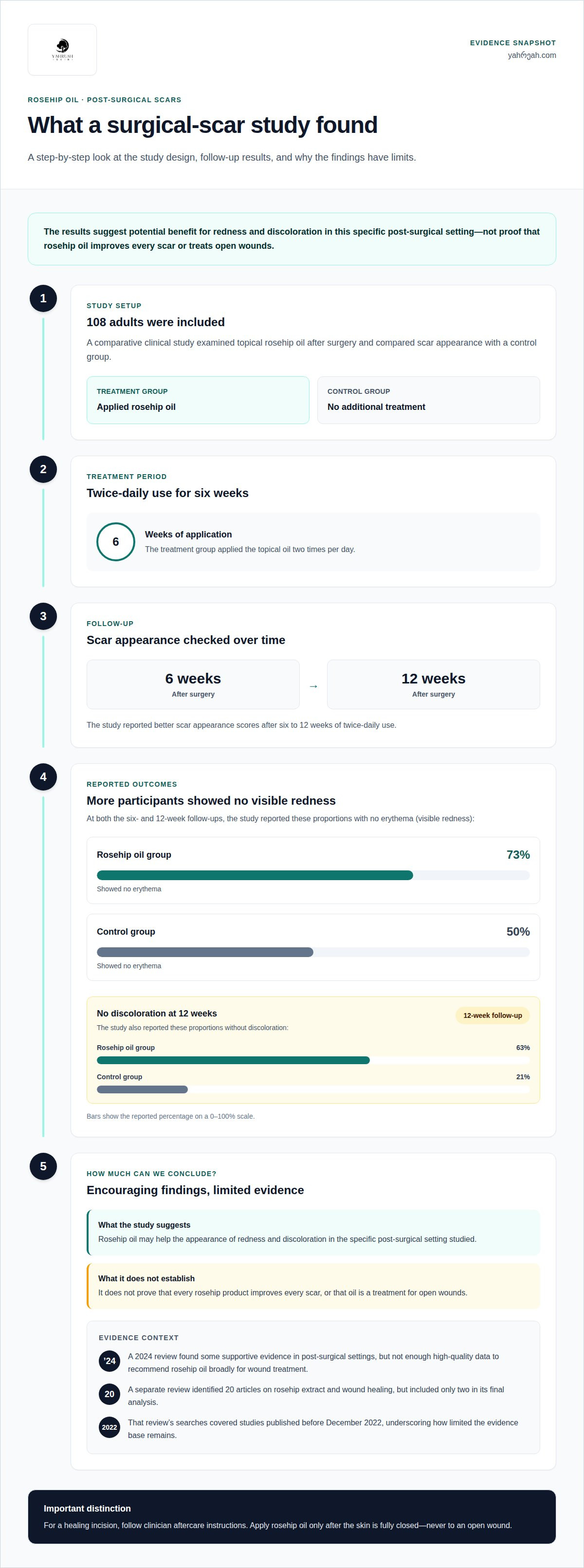
Human research offers a useful, though limited, look at rosehip oil and surgical scars. A comparative clinical study included 108 adults and examined topical rosehip oil after surgery. The treatment group applied oil twice daily for six weeks. Researchers compared scar appearance with a control group receiving no additional treatment.
At six and 12 weeks after surgery, 73% of the rosehip group showed no erythema, meaning visible redness. In the control group, 50% showed no erythema at those same follow-ups. At 12 weeks, 63% of the rosehip group showed no discoloration, compared with 21% of controls. The study also reported better scar appearance scores after six to 12 weeks of twice-daily use.
These findings suggest potential benefit for redness and discoloration in this specific post-surgical setting. They don’t establish that every rosehip product improves every scar. The study tested rosehip oil, not all rosehip-containing skincare, and its results shouldn’t be treated as proof of improved healing for open wounds. A 2024 review found some supportive evidence in post-surgical settings, but insufficient high-quality data to recommend rosehip oil broadly for wound treatment.
A separate review identified 20 articles on rosehip extract and wound healing, but included only two in its final analysis. Its searches covered studies published before December 2022, highlighting how limited the evidence base remains. Organic sourcing may describe how an ingredient was produced, but it doesn’t establish scar-treatment effectiveness. Nor should a study of a topical oil be assumed to apply to every formulation or surgical procedure.
For a healing incision, follow your clinician’s aftercare instructions before adding rosehip oil. Apply it only after the skin is fully closed, never to an open wound. This distinction matters: post-surgical findings concern scar appearance during follow-up, not replacing wound care with oil.
Rosehip seed oil contains several fatty acids and antioxidants. Knowing what these components describe helps separate ingredient facts from claims about scar results.
Rosehip seed oil’s fatty-acid profile is made up largely of linoleic, linolenic, and oleic acids. Linoleic acid accounts for around 47%, linolenic acid around 19%, and oleic acid around 20%.
Linoleic and alpha-linolenic acids are essential fatty acids, meaning the body needs them. In a topical oil, these components describe its composition, not a proven effect on a particular scar. They can help you understand the ingredient you’re applying, but shouldn’t be read as a measure of scar-fading strength.
Vitamin C and linoleic acid are different components, so their roles shouldn’t be combined in one claim. Linoleic acid is a fatty acid in rosehip seed oil; vitamin C is a separate nutrient.
If a skincare formula contains vitamin C, check its ingredient list to see whether it is included alongside rosehip oil. The oil’s fatty-acid percentages don’t indicate its vitamin C content. This distinction matters when comparing rosehip oil with a blend that lists vitamin C as an additional ingredient.
Rosehip seed oil also naturally contains antioxidants, alongside linoleic and alpha-linolenic acids. Antioxidants are part of its composition, but their presence alone doesn’t show that the oil will alter scar tissue or fade discoloration.
Read the label to see which ingredients are actually included. A single-ingredient rosehip oil and a multi-ingredient skincare blend may have different compositions, even when both feature rosehip. Composition can inform your choice, but it does not replace evidence about a product’s effect on scars.
Explore natural skincare products as part of a considered routine, and choose formulas with ingredients that suit your skin.
Yahreah Skin offers natural skincare products for readers building a thoughtful routine around their skin’s needs. Evidence on rosehip oil can help set realistic expectations: ingredient composition and product claims matter, but neither guarantees a change in scar appearance. Choose skincare as a considered part of daily care, not as a substitute for clinical attention when scars are raised, deeply indented, or linked to ongoing acne.
Yahreah Skin’s range also includes women’s health supplements, men’s health supplements, and premium supplements, supporting a broader approach to personal care. For facial skincare, focus on formulas and ingredients that suit your routine, and introduce new products mindfully.
Explore Yahreah Skin’s natural skincare products to find options for your routine.
Let your next skincare decision begin with the kind of change you want to support. If your concern is uneven tone, focus on a gentle routine you can maintain. If texture or raised areas trouble you, consider whether topical skincare alone suits that concern. Choosing rosehip seed oil for facial scars is less about chasing a quick transformation and more about selecting care that fits your skin and expectations.
Keep your routine simple as you decide what feels right. Introducing one product at a time can make it easier to notice how your skin responds, while patience gives you a clearer basis for assessing your choice. For an approachable next step, contact Yahreah Skin for guidance on exploring skincare options. Your skin deserves care that feels considered, steady, and kind.
Rosehip seed oil contains fatty acids and antioxidants, making it a popular ingredient in topical skincare. It is an oil, not automatically a vitamin C treatment. If you’re choosing a product for vitamin C, look for it in the ingredient list rather than assuming rosehip oil supplies it. This distinction helps match the formula to the ingredient you want.
Applied topically, rosehip oil adds an oil layer to the skin’s surface. Its fatty-acid content describes the ingredient but does not prove that it rebuilds scar tissue or changes skin structure. For example, a facial oil can be part of a moisturizing routine while serving a different purpose from treatments aimed at indented or raised scars. Keep these roles distinct.
No. Skin can react differently, and people allergic to rose hips or other plants in the Rosaceae family should avoid topical rosehip oil. If you’re considering it for sensitive skin, patch-test first by leaving a small amount on the skin for 24 hours, then checking for irritation. Stop using it if irritation occurs, rather than applying more to the area.
Research offers some support for rosehip preparations in wound-related settings, but it doesn’t establish them as a proven way to fade facial scars. One burn study compared a rosehip-extract ointment with silver sulfadiazine in 60 patients and reported faster healing in the rosehip group. That result concerns burn wounds, not proof that seed oil fades facial marks or changes scar texture.
Rosehip oil may be more relevant to flat discoloration than to a scar with a changed surface contour. Acne-related dark marks, indented scars, and raised surgical scars are different concerns, so don’t assume one topical oil addresses them equally. For a new surgical incision, wait until the skin is fully closed and follow aftercare instructions before adding facial oils.
Rosehip oil vs silicone gel, retinoids, and vitamin C for facial scars
Rosehip oil may improve flat discoloration, but evidence for acne scars is limited, and it is unlikely to remodel depressed scars. Vitamin C is a separate ingredient, so check the product label to see whether it is included.


