

 USD
USD EUR
EUR
 AUD
AUD
 GBP
GBP
 JPY
JPY
 INR
INR
 MXN
MXN
 CAD
CAD
 JMD
JMD
Total: $0.00
Taxes and shipping calculated at checkout


Apple cider vinegar capsules are a convenient format, not a proven remedy for bloating. If you’re considering apple cider vinegar capsules for bloating and digestion, it’s understandable to hope they’ll bring relief from uncomfortable, unpredictable symptoms. But convenience and confident supplement claims aren’t the same as evidence, and capsules may not work like liquid vinegar.
Research specifically on apple cider vinegar for gas and bloating is limited. Well-designed human trials have not shown that it reliably eases these symptoms, and evidence for capsules is even thinner. Keep expectations measured, and consider whether a supplement could cause discomfort or interact with medication.
This guide covers what research can and can’t tell us, how capsules differ from liquid vinegar, and which label details can help you compare products. It also explains potential safety concerns and when persistent or worrying digestive symptoms deserve medical attention. A clearer view of the evidence can help you make an informed choice without expecting a capsule to solve symptoms that may have several causes.
Apple cider vinegar capsules contain dried or powdered vinegar ingredients in a supplement format. They avoid the sharp taste of liquid vinegar and can seem easy to add to a daily routine. But convenience doesn’t establish a digestive benefit. People may search for apple cider vinegar capsules for bloating and digestion because they hope to feel less full, gassy, or uncomfortable after meals. That interest reflects a common concern, not proof that the capsules relieve it.
Bloating is a sensation of fullness, pressure, or swelling. It’s a symptom, not a single cause or diagnosis, and it can have different explanations. A product that promises “digestive support” doesn’t tell you which cause it addresses or whether its ingredients have been shown to ease the symptom. The Apple cider vinegar overview discusses how vinegar is made and summarizes purported health uses. Those claims should be distinguished from results demonstrated in relevant human research.
Supplement marketing describes a hoped-for benefit; evidence of symptom relief requires research that directly measures whether people feel better. Keep that distinction in mind when a front label uses broad language such as “gut support” or “bloat relief.”
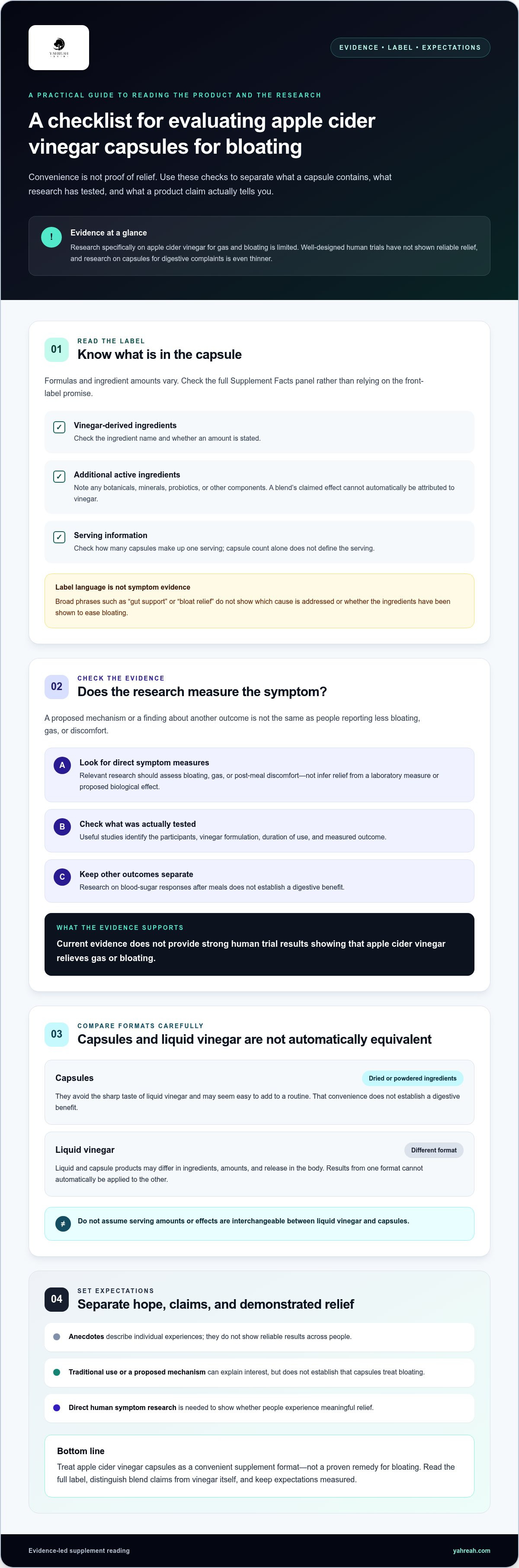
Formulas and ingredient amounts vary. One capsule might contain vinegar-derived powder, while another may combine it with botanicals, minerals, or probiotics. These additions are separate ingredients, and any claimed effect of a blend can’t automatically be attributed to vinegar. Read the full Supplement Facts panel to see what a product contains and how it defines a serving.
People may hope for less post-meal fullness, gas, or digestive discomfort. Those hopes are understandable, especially when symptoms feel unpredictable and product claims sound reassuring. But testimonials describe individual experiences, not reliable results across people. Traditional use can explain why an ingredient attracts interest, but it doesn’t establish that a capsule treats bloating.
Check what a product contains before interpreting its promise. If a formula combines apple cider vinegar with probiotics or herbs, a digestion claim may refer to the blend, not vinegar alone. Separating ingredients from claims helps set realistic expectations and makes comparisons more useful. The next step is to consider what research has directly tested and how capsules compare with liquid vinegar.
To judge a digestion claim, look for studies that measure digestive symptoms such as bloating, gas, or post-meal discomfort. A change in a laboratory measure or a proposed biological effect isn’t the same as people reporting meaningful relief. Apple cider vinegar research has explored outcomes beyond digestion, including blood-sugar responses after meals. Results for one outcome can’t establish an effect on another.
For people searching for apple cider vinegar capsules for bloating and digestion, direct evidence is limited. Available research doesn’t establish that vinegar reliably eases bloating or gas, and well-designed human trials focused on these symptoms are lacking. Research testing capsules for digestive complaints is even scarcer. This leaves a meaningful gap between popular claims and demonstrated symptom relief.
Useful studies clearly identify who took part, which vinegar formulation they used, how long they used it, and what outcome researchers measured. For bloating, that means assessing the symptom directly, not treating a finding about blood sugar or another marker as proof of digestive benefit. Current evidence doesn’t provide strong human trial results showing that apple cider vinegar relieves gas or bloating.
Anecdotes may explain why someone chooses to try a supplement, but they can’t show whether vinegar caused a change. Symptoms naturally vary, and people may change meals or routines at the same time. Without controlled research focused on digestive symptoms, it’s difficult to separate a treatment effect from coincidence, expectation, or other changes.
Acetic acid is a component of vinegar. One proposed explanation is that vinegar may increase stomach acidity and thereby affect digestion. That’s a possible mechanism, not proof that people experience less bloating. The idea needs to be tested in people with symptoms measured before it can support a claim of relief.
Formulation matters, too. Liquid vinegar and capsules aren’t automatically interchangeable: their ingredients, amounts, and release in the body may differ. Even if research on liquid vinegar finds a change in a measured outcome, that result can’t be assumed to apply to every capsule or to digestive symptoms. A blood-sugar measurement, for example, doesn’t tell us whether participants felt less gas or discomfort.
The evidence summary is straightforward: human research hasn’t established apple cider vinegar as a reliable remedy for bloating, and capsule-specific evidence for digestive relief is especially limited. That doesn’t prove no one ever notices a difference. It means the benefit hasn’t been demonstrated well enough to promise a predictable result.
When evaluating supplements, clear ingredient information and realistic claims matter. Yahreah Skin offers supplements and emphasizes clean ingredients. Explore its supplement range as you consider the ingredients and claims that matter to you.
The practical difference is clear: capsules are portable and avoid vinegar’s sharp taste, while liquid vinegar is easy to see and measure. Neither format has been shown to be more effective for bloating simply because it’s easier to take. When comparing apple cider vinegar capsules for bloating and digestion, focus on what each label tells you, not just the format or front-of-package claims.
| What to compare | Capsules | Liquid vinegar |
|---|---|---|
| Format | Dried or powdered vinegar-derived ingredients in a capsule | Vinegar in liquid form |
| Serving information | Check the Supplement Facts panel for amount per serving and capsules per serving | Check the label for the suggested serving volume |
| Convenience | Portable and avoids the liquid’s strong taste | Requires measuring and has a pronounced taste |
| Formulation transparency | May include other active ingredients; review the full panel | Ingredient list may be simpler, but still check the label |
This table compares practical features, not outcomes. A capsule’s listed strength and any stated vinegar-equivalent amount may not be directly comparable with a measured serving of liquid vinegar. Products can use different ingredients and serving definitions, and a claimed equivalence doesn’t show that the body responds to both forms in the same way. Convenience is not evidence of effectiveness.
Start with serving size, then read the ingredient amounts for that serving. For capsules, check whether the amount refers to vinegar powder, another vinegar-derived ingredient, or the whole blend. For liquid products, note the suggested serving volume and listed ingredients. If a proprietary blend or unclear description makes individual amounts hard to identify, meaningful comparison becomes more difficult. Compare like with like, and don’t assume similar-looking numbers mean equivalent formulas.
Some capsules combine vinegar-derived ingredients with probiotics, botanicals, or other additions. Treat each as a distinct ingredient. A study of a multi-ingredient formula, if one exists, can’t establish that vinegar alone caused an outcome or that each ingredient works independently. That’s why broad “digestive support” claims deserve a closer look at both the label and the evidence for the specific combination.
Different supplements also serve different purposes, so don’t treat them as interchangeable. A plant-based digestive enzyme capsules buying guide can explain that separate category, while an article on L-glutamine powder and gut barrier integrity offers broader gut-health context. Neither category should be assumed to work like vinegar or address the same symptoms.
For a useful comparison, keep three questions in view: What are the active ingredients? How much is provided per serving? Does research support the claimed outcome for that specific formula? Taste and portability may guide your format preference, but they can’t tell you whether a product will ease digestive symptoms.
Apple cider vinegar capsules may cause digestive discomfort in some people, and “natural” doesn’t mean suitable for everyone. Formulas vary, so check the full label for serving directions, vinegar-derived ingredients, and added components. Don’t assume a capsule is harmless simply because it avoids the sharp taste of liquid vinegar.
Acidity is one consideration. Apple cider vinegar can irritate the throat and digestive tract, and liquid vinegar may contribute to tooth-enamel erosion. Capsules don’t expose teeth in the same way, but they may still cause discomfort. The risk may depend on the formula and how a person responds. If you notice an unwanted effect after starting a supplement, pause and seek advice from a health professional rather than increasing the amount.
Discuss a supplement with a clinician or pharmacist before use if you’re pregnant, managing a chronic condition, or taking prescription medication. Apple cider vinegar may interact with medicines such as insulin and diuretics, and it may affect potassium levels. This matters even if a product is sold without a prescription. Don’t stop or change prescribed medication on your own; ask a qualified professional how a supplement could fit with your care.
Review the entire label, including serving size, directions, warnings, and additional active ingredients. A capsule that combines vinegar with herbs, minerals, or probiotics brings those ingredients into the safety picture, too. If a label is unclear, seek professional guidance before use, especially when health conditions or medicines are involved.
Occasional bloating can happen, but recurring, persistent, or worsening symptoms deserve attention rather than indefinite management with supplements. Note when symptoms occur, how long they last, and whether they’re changing. This information can help a clinician assess the concern without assuming a cause.
Seek urgent medical care for severe abdominal pain, repeated vomiting, blood in your stool, or a swollen abdomen with inability to pass stool or gas. These signs need prompt assessment, not a trial of apple cider vinegar capsules for bloating and digestion. If symptoms are unusual for you or feel severe, err on the side of getting medical advice.
Noticing whether symptoms follow particular meals may help you describe a pattern. It shouldn’t replace evaluation when symptoms persist or alarm you. A supplement is not a substitute for finding out what may be contributing to ongoing discomfort.
For a considered approach to supplements, explore Yahreah Skin’s supplement range, and pay attention to clear ingredient information and careful label reading.
A thoughtful choice begins with the label, not the boldest promise on the front. Research hasn’t established apple cider vinegar capsules as a reliable answer to bloating, so treat claims as claims and look for enough detail to understand what you’d be taking. Clear information won’t guarantee a result, but it can help you compare formulas and avoid assumptions.
Read the complete label before comparing products. Review the Supplement Facts panel, serving directions, and other ingredients together. The amount listed per serving may require more than one capsule, and a blend can make it harder to identify the amount of each ingredient. A front-label phrase such as “digestive support” doesn’t replace clear ingredient information.
Also distinguish manufacturing information from evidence of benefit. In the United States, dietary supplements are regulated under the Dietary Supplement Health and Education Act, but they aren’t approved by the FDA for effectiveness before sale. A facility’s FDA registration does not mean the FDA has approved a supplement, its ingredients, or its claims. It isn’t proof that a product will relieve symptoms.
If you’re weighing apple cider vinegar capsules for bloating and digestion, consider noting when symptoms occur, what you ate, and any relevant routine changes. A brief record may help you notice patterns and describe them clearly to a clinician. It won’t prove that a supplement caused a change, especially if several habits shift at once.
Keep expectations grounded. A supplement shouldn’t replace assessment of persistent, worsening, or unusual symptoms. If you take prescription medication, have a chronic condition, or are pregnant, discuss supplement use with a clinician or pharmacist first. Don’t change prescribed treatment based on a product claim.
Yahreah Skin offers supplements and skincare with an emphasis on clean ingredients and cruelty-free formulations. These values can be part of how you assess a wellness brand, alongside clear labels and realistic claims. If that considered approach resonates with you, explore Yahreah Skin’s wellness approach.
Your next step doesn’t have to be another supplement. If you’re considering apple cider vinegar capsules for bloating and digestion, weigh the evidence, your health circumstances, and what matters to you in a product. A pause can be a thoughtful choice, especially if symptoms are ongoing or you’re unsure whether a supplement fits your routine.
For any supplement, clear ingredient information and careful expectations matter. Yahreah Skin emphasizes clean ingredients and cruelty-free formulations, and states that its products are made in FDA-registered manufacturing facilities in the United States. Facility registration is not FDA approval of a supplement or proof that it works, so keep the focus on transparency and evidence as you decide what feels right for you.
Wellness is personal, and informed choices can begin with small, considered steps. Explore Yahreah Skin’s wellness approach, and seek medical guidance when symptoms call for it.
Some products describe their vinegar ingredient as containing the mother, while others don’t. The phrase alone doesn’t tell you how much vinegar-derived ingredient is in a capsule, how potent it is, or whether it affects digestion. Check the ingredient list and Supplement Facts panel for details. “With the mother” is a label description, not evidence that a product will relieve bloating.
Don’t assume capsules meaningfully change stomach acid or improve digestion. A proposed effect on acidity is different from evidence that people experience symptom relief in human studies. If you have reflux, a diagnosed digestive condition, or ongoing discomfort, discuss supplement use with a qualified healthcare professional instead of trying to self-treat. This is especially relevant if symptoms are new, recurring, or affecting your daily routine.
There’s no reliable timeline for bloating relief from apple cider vinegar capsules, and evidence doesn’t establish that they provide such relief. Research may not test the same capsule formula or measure the symptom mentioned in a product claim. If you’re considering apple cider vinegar capsules for bloating and digestion, don’t increase the serving or wait for a promised effect if discomfort continues, worsens, or keeps returning. Seek medical guidance instead.
Some products combine vinegar-derived ingredients with probiotics, but that doesn’t establish that every combination is suitable or more effective. Check the full formula and serving directions, including other active ingredients. Your health circumstances and medicines may also matter. If you have a medical condition or take prescription medication, ask a clinician or pharmacist for advice based on your situation rather than assuming a combination supplement is appropriate.
Capsules avoid the taste of liquid vinegar, but that doesn’t mean they’re gentler for everyone or free of digestive effects. Formulas differ, and capsule format alone doesn’t establish a safer or more effective amount. If a product causes discomfort, don’t dismiss it simply because it’s a capsule. Review the ingredients and seek advice if symptoms are persistent or concerning rather than relying on continued self-treatment.
The amount varies by product, and labels may describe vinegar powder, extract, or another vinegar-derived ingredient in different ways. Check the Supplement Facts panel and serving directions, since one serving may include multiple capsules. Don’t estimate the amount from the capsule count or a front-label claim. Compare a capsule serving with liquid vinegar only if the manufacturer provides a clear measure that makes the comparison meaningful.
Digestive responses vary, and a capsule may not suit everyone. If discomfort starts after you begin a supplement, review the full formula, since added ingredients may also be relevant. Consider pausing the product and seek professional advice if symptoms are severe, persistent, or worsening. Don’t assume the reaction is harmless or try to manage concerning symptoms by taking more of the supplement.


