

 USD
USD EUR
EUR
 AUD
AUD
 GBP
GBP
 JPY
JPY
 INR
INR
 MXN
MXN
 CAD
CAD
 JMD
JMD
Total: $0.00
Taxes and shipping calculated at checkout


What if the label’s most appealing promise is the one that deserves the closest look? Fulvic acid trace mineral liquid drops combine two terms that are often blurred together: fulvic acid, a naturally occurring compound, and trace minerals, elements the body needs in small amounts. It’s understandable to want a straightforward way to assess wellness claims, especially when labels don’t clearly explain amounts, sourcing, or quality information.
Before considering a supplement, separate what’s known from what’s still being studied. Fulvic acid may bind to minerals, but claims about improved absorption and broader health effects shouldn’t be treated as proven benefits. Evidence in people remains limited, and fulvic acid itself has no established daily reference intake.
This guide explains the ingredient terminology, how to read labels for composition and quality information, and how to assess claims without relying on sweeping promises. It also outlines practical questions to discuss with a qualified healthcare professional, so you can make an informed choice based on clear details.
Fulvic acid trace mineral liquid drops are liquid supplements containing fulvic acid, trace minerals, or both. These terms describe different ingredients: fulvic acid is an organic compound, while trace minerals are elements found in the body in small quantities. A product may contain both, but one term doesn’t tell you exactly what the other ingredient is or how much is present.
Fulvic acid is a naturally occurring class of organic compounds produced as plant matter breaks down over time. It isn’t a mineral, and its presence on a label doesn’t by itself show that a finished supplement delivers a particular health benefit. Formulas can differ in their sources, processing methods, and ingredient combinations, so the name alone isn’t a complete description.
On a label, “fulvic acid” identifies an ingredient or ingredient component, not a guaranteed outcome. The material may come from different natural sources, and processing can affect what is present in the finished formula. Look for information that distinguishes the source material from the amount of fulvic acid per serving. A broad ingredient name may not answer both questions.
Labels may also describe a fulvic-acid-containing complex or solution. That wording isn’t necessarily the same as stating the amount of fulvic acid itself. Read the serving information carefully, and don’t assume that products with similar names have equivalent compositions.
Trace minerals are minerals present in small amounts in the body. Examples include iron, zinc, copper, selenium, and manganese. Liquid trace mineral supplements provide one or more minerals in a liquid serving, but there’s no single mineral blend shared by every product. The ingredient list should identify which minerals the formula contains.
Check whether the label gives an amount for each mineral or only describes a combined blend. These details aren’t interchangeable: a list of minerals shows which are included, while serving information indicates how much the product provides. A “trace mineral” description alone doesn’t establish the amount of any particular mineral.
Keep three label details distinct: the ingredient source, the minerals included, and the concentration or amount per serving. Naming a natural source, for example, doesn’t tell you the mineral quantities. Likewise, listing several minerals doesn’t explain how much fulvic acid is present. If a label uses a broad phrase such as “mineral complex,” look for a specific ingredient list and serving details before drawing conclusions.
This distinction makes comparisons more useful. Two fulvic acid trace mineral liquid drops may use similar language while differing in ingredients and declared amounts. Treat each label as its own formula rather than assuming a shared standard for the product category.
Fulvic acid and trace minerals may appear together in a supplement, but they describe different things. Fulvic acid is part of a group of organic substances formed as plant and other organic matter decomposes. Minerals are elements, such as zinc or selenium. A formula may combine them, but that pairing doesn’t establish how much of each ingredient it contains or what effect it has in the body.
Fulvic acid is a naturally occurring component of humic substances, a varied group of organic materials formed through the decomposition of plant and other organic matter. In natural environments, fulvic substances can interact with minerals. That relationship helps explain why some supplements feature both ingredient categories, but it doesn’t demonstrate that a supplement transports minerals or changes nutrient absorption in people.
Humic substances are a broad category of organic materials. Fulvic acid and humic acid are distinct components within that category, while minerals are inorganic elements. A product may name fulvic acid, humic substances, minerals, or a combination, so check the ingredient list rather than assuming that one term includes the others.
These distinctions also put label language in perspective. A product’s description of fulvic or humic ingredients identifies composition, not evidence of detoxification, improved absorption, or another bodily effect. Those outcomes require appropriate research on the finished product and in people, not an inference based only on how ingredients interact outside the body.
Ingredient source, mineral content, and finished-product concentration are separate label details. Source describes where an ingredient comes from; mineral content identifies which elements are present; concentration or serving amounts describe how much the product provides. Ingredient composition varies by formulation, including the source materials, processing, and amounts of fulvic substances and minerals in the finished product.
Look closely at what each quantity refers to. A total blend weight may cover several ingredients and won’t necessarily reveal the amount of each mineral. A list of minerals is useful, but it isn’t the same as a table stating individual amounts per serving. For minerals such as iron, zinc, copper, selenium, and manganese, the specific quantity matters because each is a distinct nutrient with its own reference values.
Terms such as ionic, full spectrum, and concentrated need product-specific context. “Ionic” refers to minerals in charged forms, but the word alone doesn’t identify which minerals or their quantities. “Full spectrum” doesn’t name a universal set of minerals, and “concentrated” doesn’t explain the concentration unless the label gives a clear amount and serving basis. These phrases can sound precise while leaving important details unstated.
For a practical comparison, separate the label into three questions: What is the source? Which minerals are identified? What amount of each is provided per serving? Reviewing wellness supplements with ingredient transparency in mind can support a more considered approach to supplement research.
A proposed mechanism isn’t the same as a demonstrated benefit. Fulvic acid may interact with minerals in laboratory settings, but that alone doesn’t establish that taking a supplement improves mineral absorption or produces a particular wellness outcome in people. The presence of an ingredient isn’t proof of a promised result.
Research on fulvic acid is developing. Available evidence includes laboratory and animal research, while human studies are more limited. Before relying on a claim, look for evidence in people that tests the specific outcome and a formula comparable to the one being described.
Start by asking what a claim actually promises. “Supports energy” is broad; a measurable claim would identify the outcome and how it was assessed. Check whether research involved people, whether the ingredient and dose match the product, and whether the study tested fulvic acid alone or a multi-ingredient formula. General research on an ingredient doesn’t automatically apply to a finished supplement.
Words such as “detox,” “pH balance,” and “energy” deserve particular care because they can suggest effects without defining a measurable result. Ask what was measured and in whom. The FTC’s guidance for health-product advertising says claims should be truthful, not misleading, and supported by competent and reliable scientific evidence.
A useful study appraisal looks beyond the headline. Note the number of participants, study duration, comparison group, dose, and whether other researchers have replicated the result. Lab findings can suggest questions for future research, but they can’t establish that the same effect occurs after people take a supplement.
Use this framework to interpret common claim types:
| Claim type | Evidence needed | Reasonable conclusion |
|---|---|---|
| Mineral interaction or “carrier” mechanism | Human research measuring the relevant mineral and outcome | A proposed mechanism is not proof of improved absorption in people. |
| Energy, hydration, or general wellness support | Well-designed human studies measuring a clearly defined outcome | Broad wording alone doesn’t show that a product delivers a meaningful effect. |
| Detoxification or pH balance | A precise definition of the claim and relevant clinical evidence | Ask what is being measured; don’t treat these phrases as established benefits. |
For fulvic acid trace mineral liquid drops, evidence about a single ingredient may not reflect the finished formula, its amounts, or how its ingredients are combined. The careful conclusion isn’t that fulvic acid is effective or ineffective across the board. Rather, each claim needs evidence suited to the outcome, population, and product being discussed. Check current studies and their limitations before drawing a firmer conclusion.
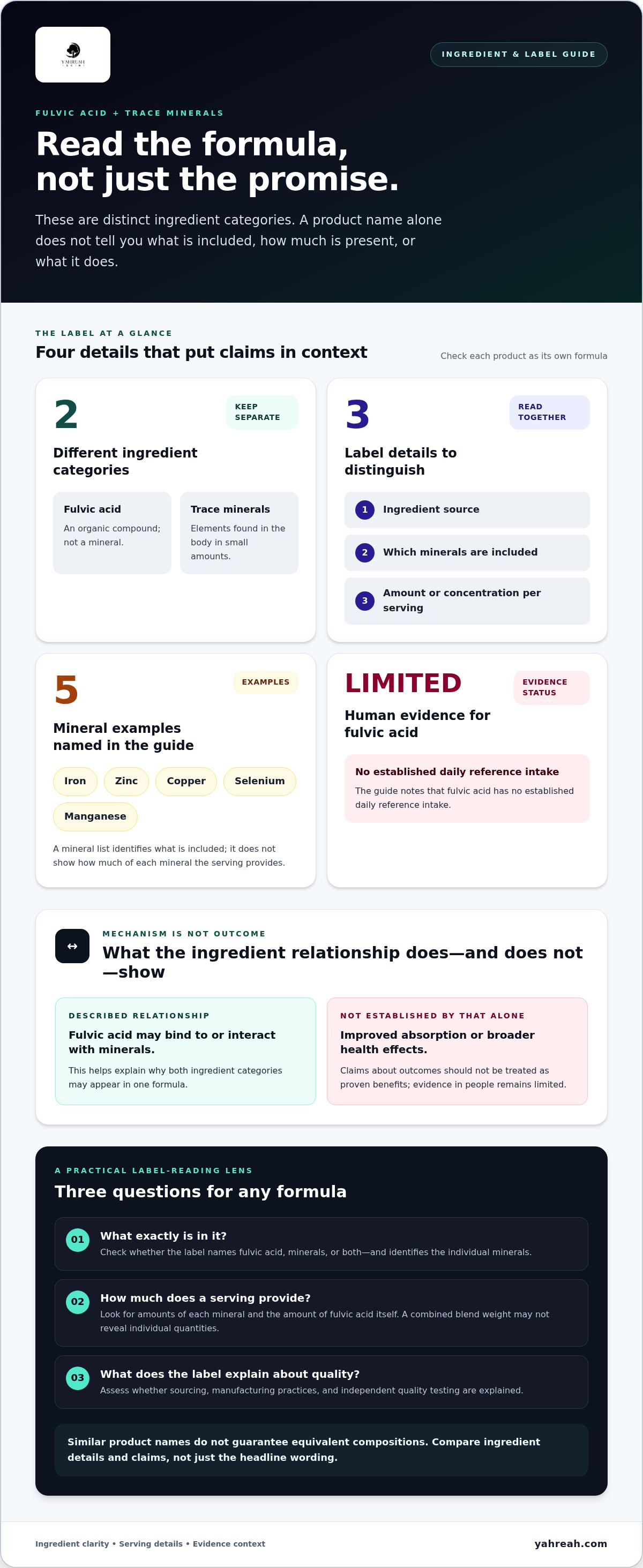
A clear label helps you understand what a supplement contains, how a serving is defined, and what quality information the manufacturer shares. For fulvic acid trace mineral liquid drops, read the ingredient panel alongside the directions and any supporting product information. A polished front label isn’t a substitute for specific details.
Start with the full ingredient list. Look for named minerals and fulvic-related ingredients rather than relying only on broad phrases such as “mineral complex.” If a blend is listed without amounts for its individual minerals, the blend weight won’t tell you how much of each mineral a serving provides. Missing detail isn’t proof that a product is unsafe, but it limits what you can confidently compare.
Then distinguish the serving size from the total bottle quantity. The serving size tells you how much the label defines as one use; the bottle quantity tells you how much liquid the container holds. Neither alone shows the amount of each mineral. Check the supplement facts panel for mineral amounts per serving, units, and the number of servings stated for the container.
Use this checklist as you read:
Look for accessible information about ingredient sourcing, manufacturing, and any independent testing. If a company refers to testing, useful context may include what is tested and whether the results relate to the finished product or a particular batch. Don’t assume that words such as “pure” or “premium” explain a testing process; they aren’t a substitute for specific disclosures.
FDA wording also deserves a careful read. A facility’s FDA registration is not FDA approval of a supplement, its ingredients, or its claims. In the United States, the FDA does not approve dietary supplements or their claims before they reach the market. Registration language should therefore be understood as a facility detail, not proof that the agency has verified a product’s benefits.
Follow the product label rather than creating your own serving schedule. If you take medication, are pregnant, or have a health concern, discuss the specific ingredient list and serving directions with a qualified healthcare professional before considering a supplement. This conversation can help account for your circumstances without assuming a general product claim applies to you.
Thoughtful choices begin with clear information. Explore Yahreah Skin’s wellness supplements with the same attention to ingredient transparency and quality.
Good supplement research doesn’t have to end with an immediate decision. If you’re considering fulvic acid trace mineral liquid drops, first identify what prompted your search. Are you trying to understand a particular ingredient, address a specific concern, or compare options already in your routine? A clear question can help you focus on useful information instead of broad promises.
Review your current routine, including other supplements and medications. Consider whether you already get the minerals named on a label from other products or sources. The goal isn’t to diagnose a need on your own, but to gather relevant details and avoid treating a general product description as personal guidance.
If you have a health concern, take medication, are pregnant, or are unsure how an ingredient fits your circumstances, discuss the label with a qualified healthcare professional. Bring the ingredient list, serving directions, and any specific claims you’re trying to evaluate. Supplements don’t replace individualized healthcare, and professional advice can help put general information in context.
Before deciding, ask yourself:
Give yourself room to compare. Review the label, the source and amount of each ingredient, the quality information provided, and whether claims are supported by relevant evidence. If details are missing, note what you can’t determine rather than filling gaps with assumptions. A broad promise may sound compelling, but it isn’t a substitute for clear composition and useful evidence.
Yahreah Skin’s approach to wellness emphasizes quality and thoughtful ingredient choices. The brand states that its products are made in the USA in an FDA-registered facility. That facility status should not be confused with FDA approval of a supplement or its claims. Ingredient literacy is useful across wellness choices: it helps you assess what a label says without assuming every product contains the same ingredients or offers the same benefits.
If you’re continuing your research, explore Yahreah Skin’s broader wellness supplement range with a focus on clear product details and ingredients that align with your needs. Take your time: define your question, compare labels and evidence, and discuss personal concerns with a qualified professional before making a choice.
Let curiosity guide your next step, not pressure to act quickly. If fulvic acid trace mineral liquid drops remain on your list, take time to connect the label’s details with your needs and the strength of the evidence. A qualified healthcare professional can help you consider personal factors that a general product description can’t address.
Thoughtful wellness is built through informed choices, one at a time. Yahreah Skin describes its formulations as cruelty-free and not tested on animals, reflecting a commitment to care and quality in wellness products.
Explore Yahreah Skin’s wellness range and continue discovering options with care. Your next choice can be calm, considered, and uniquely your own.
Not necessarily. Formulas differ, and a product’s mineral list doesn’t show that it provides a complete range or amounts suited to your needs. Compare the named minerals and their stated amounts with your individual circumstances, including other supplements you use. A long list or “full spectrum” description alone can’t establish nutritional completeness. If you’re unsure what’s appropriate for you, discuss the label with a qualified healthcare professional.
Follow the serving directions on the specific product label, because formulas and concentrations vary. Don’t use another product’s serving as a guide or assume that a similar name means a similar amount. Check that you understand the label’s serving size and measurement before use. If you have questions about personal use, take the full label to a qualified healthcare professional, particularly if you have health concerns or use other supplements.
Interactions can depend on a supplement’s ingredients, amounts, and your personal circumstances, so the ingredient name alone can’t establish whether a particular product is suitable alongside medication. Before use, show the full label, including other ingredients and serving directions, to a pharmacist or qualified healthcare professional. Don’t stop or change prescribed treatment based on a supplement’s marketing claims or general information about fulvic acid.
There isn’t a blanket safety answer that applies to every formula or person. Ingredients and amounts differ, and available evidence may not resolve every question about use during pregnancy or breastfeeding. Before taking any supplement in these circumstances, ask a qualified healthcare professional to review the specific product and your situation. Follow their guidance rather than relying on broad marketing statements or another person’s experience.
Look for a clear statement that testing is independent, details about what the testing covers, and accessible supporting information. For example, check whether the disclosure names the qualities assessed and identifies the product or material tested. A phrase such as “quality tested” doesn’t explain the scope on its own. Don’t assume a supplement has independent testing or a certification unless its current materials say so clearly.
There’s no reliable universal timeline to promise, and people may perceive effects differently. A change noticed after starting a supplement doesn’t by itself show that the ingredient caused it; other factors may also be involved. Follow the product label, and don’t increase use to chase a result. If a health concern persists or worsens, seek guidance from a qualified healthcare professional rather than relying on a supplement to address it.


