

 USD
 EUR
 AUD
 GBP
 JPY
 INR
 MXN
 CAD
 JMD
Total: $0.00
Taxes and shipping calculated at checkout


What if a hair supplement’s most convincing claim still doesn’t tell you whether it fits your concern? If you’re weighing biotin and silica supplements for thinning hair, conflicting promises can make a simple choice feel complicated. It’s reasonable to want stronger, fuller-looking hair, but an ingredient’s reputation doesn’t prove it will address the cause of your thinning.
This guide takes an evidence-first look at what biotin and silica do in the body and what research can say about using them for hair. You’ll learn why potential benefits may depend on nutritional status, how to interpret a small clinical study without treating it as a guarantee, and what to consider before adding a supplement. We’ll also cover biotin’s potential to interfere with certain lab tests, along with practical questions for assessing a supplement label and discussing next steps with a healthcare professional. The aim is clarity, not another promise: a more informed way to decide whether a supplement belongs in your routine.
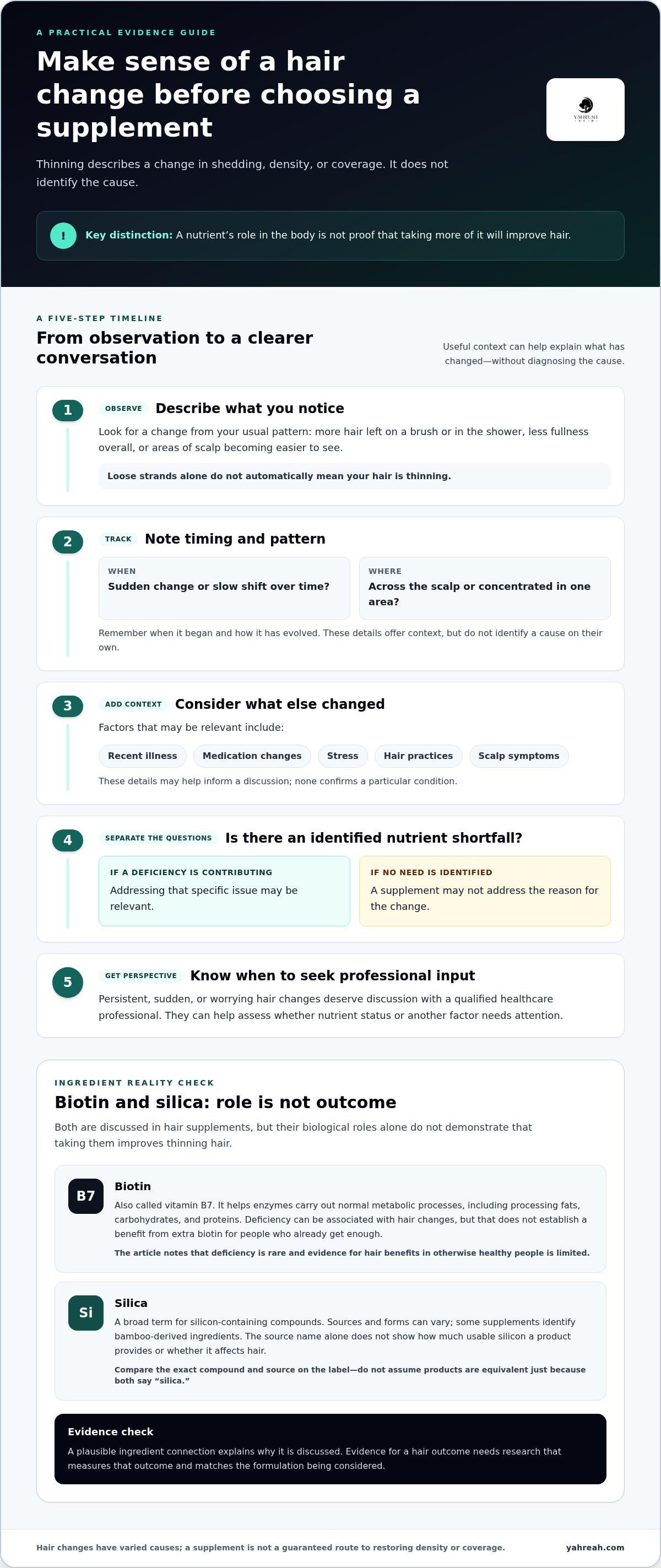
Thinning hair is a noticeable change in hair density, shedding, or visible coverage; it describes an observation, not a diagnosis. The term can refer to more hair coming out, less fullness overall, or areas of the scalp becoming easier to see. It doesn’t, by itself, explain why the change is happening.
Hair naturally sheds as part of its growth cycle, so noticing loose strands doesn’t automatically mean your hair is thinning. The concern may be a change from your usual pattern, such as more hair left on a brush or in the shower, a gradual reduction in fullness, or a part that appears wider than before. These observations can help you explain what you’ve noticed, but they can’t identify a cause on their own.
Timing and pattern offer useful context. A change that seems sudden may call for a different conversation than a slow shift over time. Changes across the scalp may also look different from changes concentrated in one area. Other factors, such as recent illness, medication changes, stress, hair practices, or scalp symptoms, may be relevant. None of these details confirms a particular condition, but noting when the change began and how it has evolved can make a healthcare discussion more informative.
Nutrients support ordinary functions throughout the body. Biotin, also known as vitamin B7, is involved in metabolic processes, as outlined in Biotin (Vitamin B7). Silica is a broad term for silicon-containing compounds, and supplement sources and forms can differ. Their roles in the body, however, don’t establish that taking either ingredient will improve hair for everyone.
There’s a meaningful difference between correcting an identified nutrient shortfall and adding a supplement without knowing whether you need it. If a deficiency is contributing to a hair concern, addressing that specific issue may be relevant. Without an identified need, a supplement may not address the reason for the change. Hair changes can have varied causes, including factors unrelated to nutrient intake, so biotin and silica supplements for thinning hair shouldn’t be treated as a guaranteed route to restoring density or coverage.
Focus on understanding the change before choosing an ingredient. Consider what has shifted, when it started, and whether anything else changed around the same time. If hair loss is persistent, sudden, or worrying, discuss it with a qualified healthcare professional. They can help assess the concern and whether nutrient status or another factor deserves attention. A thoughtful assessment is a more grounded starting point than assuming every case of thinning hair calls for the same supplement.
Biotin and silica are often grouped with hair-support ingredients, but their biological roles shouldn’t be confused with proof that a supplement changes hair outcomes. Biotin helps enzymes carry out normal metabolic processes, while silica supplements provide silicon-containing compounds in varying forms; neither function, on its own, demonstrates that supplementation improves thinning hair. That distinction is central to assessing claims about biotin and silica supplements for thinning hair.
Hair is made largely of keratin, a structural protein also found in skin and nails. Because biotin participates in normal metabolism, it’s sometimes linked in marketing to keratin and hair. But being involved in body processes that support health doesn’t mean taking extra biotin makes hair thicker. The body’s need for a nutrient and the effects of supplementing beyond that need are different questions.
Biotin acts as a helper for enzymes involved in processing nutrients, including fats, carbohydrates, and proteins. A deficiency can be associated with hair changes, but that doesn’t establish a benefit from supplementation for people who already get enough. The Mayo Clinic’s guidance on biotin and hair growth notes that deficiency is rare and evidence for hair benefits in otherwise healthy people is limited. The relevance of biotin may therefore differ depending on whether a shortfall is present.
This is why a product’s ingredient story deserves a closer look than a simple “supports keratin” message. A plausible connection explains why an ingredient is discussed; it doesn’t establish that a supplement can change hair density or shedding. Evidence for an actual hair outcome must come from research measuring that outcome, not from the ingredient’s role in metabolism alone.
Silica is a broad label for silicon-containing compounds, and supplement formulations can vary in both form and source. Some products may identify bamboo-derived ingredients, while others use different silicon compounds. The source name alone doesn’t show how much usable silicon a product provides or whether it affects hair. Don’t assume two products are equivalent simply because both use the word “silica.”
For a practical comparison, note the exact compound and source named on the label, then separate those details from the product’s promised result. A botanical source such as bamboo may describe where an ingredient comes from, but it isn’t, by itself, evidence that the ingredient improves hair. Ingredient-specific research would need to match the form and formulation being discussed and show relevant outcomes.
Biotin and silica may have biological roles, but that’s only one part of the evidence question. The next step is to examine what studies actually tested and whether their findings can be applied to a particular ingredient or product. For a broader look at everyday wellness options, explore Yahreah Skin’s supplement range.
Research on a particular hair supplement can offer a useful signal, but it doesn’t automatically prove that every ingredient in the formula works or that the same result will apply to every person. This distinction matters when assessing biotin and silica supplements for thinning hair: product claims may sound broad, while a clinical study tests a specific formulation in a specific group over a defined period.
The study highlighted in search results followed 15 women at a single clinical site in the United States for 180 days. Ten received the study supplement and five received a placebo. That small sample can offer preliminary information about the tested product and participants, but it limits how confidently the findings can be generalized. The study examined a particular formula, not biotin or silica as isolated ingredients.
Even if participants’ hair measures changed during the study, that wouldn’t establish that biotin alone, silica alone, or any unrelated product caused the change. The result belongs to the intervention as tested. Different ingredients, amounts, formulations, or participant characteristics can affect whether findings apply elsewhere.
Evidence about people with a confirmed nutrient deficiency may not apply to people whose nutrient status is already adequate. A study’s participant group also matters: results in a small group of women with self-perceived thinning can’t establish lasting or universal benefits for people with different hair concerns. A measured change over 180 days is not, by itself, proof of long-term results or a guarantee for an individual.
| Ingredient or evidence | What it may tell you | What remains uncertain |
|---|---|---|
| Biotin’s biological role | Biotin participates in normal body processes, and correcting a confirmed deficiency may be relevant to health. | That role doesn’t show that extra biotin improves hair in people without a deficiency. |
| Silica’s proposed rationale | Silica refers to silicon-containing compounds used in different forms and sources. | Evidence for one form or source can’t automatically be applied to another or taken as proof of a hair benefit. |
| The 15-person study | It offers a preliminary look at one supplement formula in a small participant group over six months. | It can’t isolate the effect of biotin or silica or establish broad, lasting results. |
Read claims with the same care you’d give the study itself. Ask what exact formula was tested, who took part, how long it was used, and which hair outcomes were measured. A phrase such as “supports hair” may describe a product’s positioning, but it doesn’t answer whether the evidence applies to your situation. The available findings leave open important questions about ingredient-specific effects, different silica forms, and who may benefit. That’s uncertainty, not proof that the ingredients are ineffective or unsafe. It’s a reason to weigh the evidence carefully rather than treating a small study as a promise.
A thoughtful review starts with the claim, then moves from the label to the research and finally to personal safety. This sequence helps separate clear ingredient information from persuasive language that may not answer whether a supplement is relevant to your hair concern.
Use these checks to examine a product without assuming that a polished label or familiar ingredient proves effectiveness. Compare what the product says with what its evidence actually studied.
In brief: identify the claim, check the full label and serving amounts, match the evidence to the exact formula, and consider safety before deciding.
In the United States, dietary supplements aren’t approved by the FDA for safety or effectiveness before they’re sold. Careful label reading can help you understand what’s in a product, but ingredient transparency isn’t proof that the product will deliver a particular hair outcome. For biotin and silica supplements for thinning hair, look beyond the front-of-package message to the precise ingredients and the evidence behind the specific formula.
Biotin deserves particular attention if you have blood tests scheduled. High-dose biotin can interfere with some laboratory tests, including certain thyroid tests and tests used to assess troponin, a marker relevant to heart attacks. The interference may affect how a result is interpreted. Tell your healthcare professional and testing team that you take biotin, including the product and serving amount, before testing; they can advise you on appropriate next steps. Don’t change or stop a supplement solely on the basis of this article.
For silica, forms and sources vary, so don’t assume that safety information for one compound applies to every product. Share the complete label with a qualified healthcare professional, especially if you use other supplements or medicines, have a health concern, or are pregnant or breastfeeding. Suitability can depend on individual circumstances, and a general label claim can’t resolve those questions.
For a broader look at wellness products, browse Yahreah Skin’s supplement range with these label and evidence checks in mind.
A considered next step doesn’t begin with assuming one ingredient can explain or resolve every change in your hair. Start by describing what you’ve noticed, then weigh any supplement claim against the evidence for its ingredients and formulation. Biotin and silica supplements for thinning hair may sound like a focused solution, but an ingredient’s role in the body isn’t a promise of a particular result.
Make a simple note of when the change began, whether it has shifted over time, and what else was happening around then, such as a recent illness, medication change, or new hair-care practice. This isn’t a way to diagnose yourself. It gives you a clearer account to share if you speak with a qualified healthcare professional.
If the change is persistent, sudden, or worrying, professional input can help you consider possible causes and decide whether further assessment is appropriate. No single test or approach is right for every person, and the next step depends on individual circumstances. Avoid delaying a conversation because you’re trying another supplement, or expecting a supplement to address a cause it hasn’t been shown to address.
Beauty supplements can raise related questions about how ingredient claims are framed. For another perspective, explore this collagen peptides for skin guide, keeping the same distinction in mind: a plausible role or appealing claim isn’t the same as a demonstrated benefit for everyone.
A steady routine is built on clear information, not a crowded shelf. Look for labels that identify ingredients and serving amounts, and claims that stay proportionate to the evidence. Consider your overall supplement use, too, since overlapping ingredients across products can make it harder to understand what you’re taking. For wider lifestyle context, Yahreah Skin’s inside-out clean beauty routine offers a related way to think about beauty and everyday wellness.
Yahreah Skin emphasizes premium ingredients and quality. Its products are made in the USA in an FDA-registered facility, and the brand describes its formulations as cruelty-free and not tested on animals. Facility registration is not the same as FDA approval of a product or a guarantee of results. These details can inform how you think about sourcing and standards, while ingredient evidence and personal suitability remain separate questions.
Take your time, stay curious, and choose based on what you’ve learned rather than a promise of a quick fix. Yahreah Skin offers natural skincare products and supplements for everyday wellness.
Your hair concern doesn’t have to become a search for a single perfect ingredient. A more useful next step is to stay curious, pay attention to what changes, and make decisions at a pace that feels considered rather than pressured. The evidence on biotin and silica supplements for thinning hair can help you ask better questions, but it can’t determine what’s right for every person.
If a hair change continues or feels concerning, bring your observations and supplement questions to a qualified healthcare professional. For everyday wellness, Yahreah Skin offers natural skincare products and supplements made in the USA in an FDA-registered facility, with cruelty-free formulations that are not tested on animals.
Explore Yahreah Skin’s wellness range and choose products that fit your informed, intentional approach to wellness.
There’s limited evidence that extra biotin improves hair in people who aren’t deficient. If you’re considering biotin and silica supplements for thinning hair, remember that a biological role or deficiency-related benefit doesn’t establish a benefit for everyone. Biotin is found in many foods, and deficiency is uncommon. A healthcare professional can help determine whether assessing your nutrient status makes sense before you add a supplement.
Yes. High-dose biotin can interfere with certain lab tests, including some thyroid tests and troponin tests used in evaluating heart concerns. The interference may lead to results that don’t accurately reflect your health. Tell your healthcare professional and testing team that you take biotin, including the product and serving amount, before blood work. They can advise you about the test and whether any steps are needed.
Biotin occurs naturally in foods such as cooked eggs, salmon, meat, nuts, seeds, and sweet potatoes. Legumes and some vegetables also contribute to dietary intake. Including a variety of foods can help support overall nutrition, but no single food guarantees a change in hair thickness. If you’re tracking intake, remember to include fortified foods and supplements as well, and discuss concerns about diet or deficiency with a qualified professional.
Bamboo describes a plant source, while “silica” may refer to different silicon-containing compounds used in supplements. The source and the specific compound are separate label details, and products aren’t necessarily equivalent just because both mention silica. Check the full ingredient name and serving information, rather than relying only on “bamboo silica” on the front label. Evidence about one form shouldn’t automatically be assumed to apply to another.
Whether a combination suits you depends on the full products, your health circumstances, and what else you take; there isn’t a blanket answer for every person. Compare labels for overlapping ingredients, especially if a multivitamin or beauty formula already contains biotin or silicon compounds. Keep the packages or ingredient lists handy and review them with a qualified healthcare professional, particularly if you take medicines or have laboratory testing planned.
There’s no established waiting period that can predict whether a supplement will help you. Hair changes are gradual, and a short-term impression can be difficult to interpret. If you and a healthcare professional decide to monitor a change, use consistent observations, such as monthly photographs taken in similar lighting and from the same angle. Don’t extend use solely to reach an arbitrary deadline if you have concerns or unwanted effects.
Arrange a discussion if hair changes are sudden, persistent, or worrying, or if you notice scalp discomfort or other new symptoms. Before the appointment, jot down when you first noticed the change, any recent health or medication changes, and the supplements you use. This context can help guide the conversation without assuming a cause. Seek prompt advice if the change is severe or accompanied by symptoms that concern you.


