

 USD
 EUR
 AUD
 GBP
 JPY
 INR
 MXN
 CAD
 JMD
Total: $0.00
Taxes and shipping calculated at checkout


Could a collagen product be praised for skin support and still be the wrong fit for your routine? Conflicting claims, unfamiliar labels, and the word “peptide” across both supplements and skincare can make collagen peptides for skin difficult to assess. Before choosing, it helps to know what the label actually tells you and what it doesn’t.
Oral collagen peptides and topical peptide skincare are different formats. Their ingredients, use, and evidence are not interchangeable. This guide explains what each format is, what research on oral collagen has measured, and why a product label alone can’t promise a result.
You’ll also find practical ways to compare a supplement’s collagen source, serving information, and other ingredients, while keeping expectations grounded. At Yahreah Skin, natural skincare and supplements sit within a broader approach to wellness. Use this guide to decide whether oral collagen belongs in your routine and to assess your options with greater confidence.
Start by separating the two routes: oral collagen peptides are consumed as supplements, while topical peptide skincare is applied to the skin. The terms may look similar on a label, but they describe different product formats. Evidence about one route doesn’t automatically show what the other can do.
Collagen is a structural protein in the body. Collagen peptides are smaller fragments produced by breaking collagen down into shorter chains of amino acids. The broader Collagen overview explains its types and roles in the body. For shoppers, the practical point is that a peptide ingredient isn’t the same as a finished supplement or skincare formula. Products can differ in source, ingredients, and formulation.
An oral supplement is swallowed, so research on it examines ingestion and outcomes measured in the body. A topical formula is applied to the skin, and its effects depend on the complete formula and how it’s used. A skincare product containing a peptide shouldn’t be assumed to rebuild collagen throughout the body. A shared ingredient term doesn’t establish equivalent effects for oral and topical products.
“Peptide” describes a short chain of amino acids, but it doesn’t mean every collagen supplement has the same source, peptide profile, serving, or added ingredients. The collagen ingredient is only one part of the finished product. Read the full label to understand what else is included and how the product is presented for use. Compare complete formulas rather than relying on a familiar term.
A useful definition: Collagen peptides are smaller fragments of collagen protein used as an ingredient in oral supplements. The term doesn’t describe every detail of a finished product or make it interchangeable with topical peptide skincare.
Keep skin claims in perspective, too. “Supports firmness” or “improves appearance” refers to an appearance-related outcome that may be hoped for or studied, not a guaranteed change. What a study measures depends on the route and product tested. A result from an oral supplement study can’t simply be assigned to a topical formula, or vice versa.
Oral route
Format: a supplement, such as a powder or capsule. Evidence can address outcomes studied after ingestion of that particular type of product.
Topical route
Format: skincare applied to the skin. Evidence can address the formula’s effects on the skin where it is used.
How to compare
Keep each route in its own lane. A matching ingredient name doesn’t establish matching formulation, use, or evidence.
If you’re considering collagen peptides for skin, first decide whether you’re assessing a supplement or skincare product. Then interpret its label and claims within that format. This simple distinction makes the evidence easier to read without turning a beauty goal into a promise.
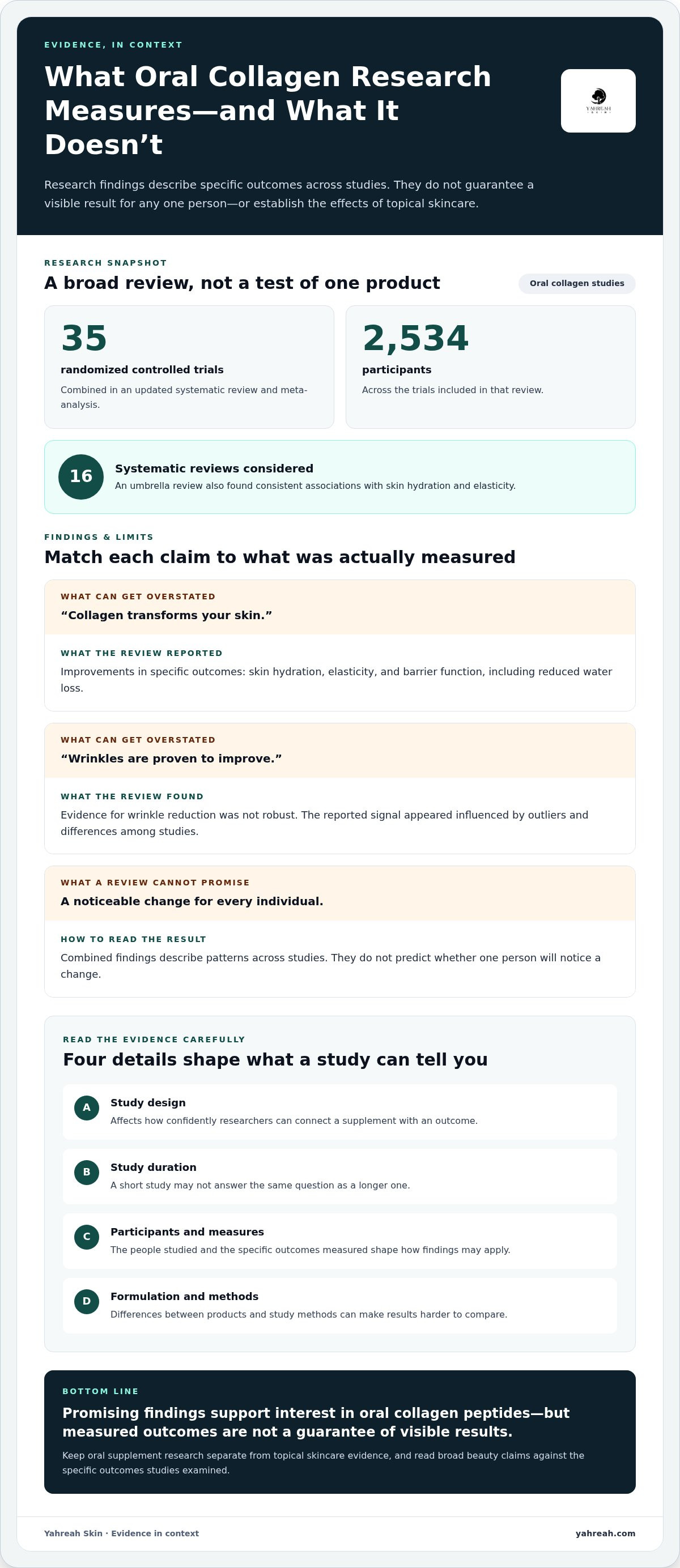
Research on oral collagen has reported encouraging findings in some areas, but the results are more measured than many beauty claims suggest. An updated systematic review and meta-analysis searched studies through November 2025 and combined findings from 35 randomized controlled trials involving 2,534 participants. It reviewed existing trials rather than testing one specific supplement.
The review reported improvements in skin hydration, elasticity, and barrier function, including reduced water loss. An umbrella review published in January 2026, which considered 16 systematic reviews, also found consistent associations with hydration and elasticity. These findings describe averages and outcomes across studies. They don’t promise that an individual will notice a change.
Researchers assess specific features, including hydration, elasticity, barrier function, and wrinkle appearance. These measures are distinct and don’t amount to interchangeable proof of “younger-looking” or transformed skin. In the updated review, evidence for wrinkle reduction was not robust. The reported signal appeared influenced by outliers and differences among studies. Broad marketing language can go further than these measured outcomes.
Look beyond a headline result. Study design affects how confidently researchers can connect a supplement with an outcome. Duration matters, too: a short study may not answer the same question as a longer one. Participant groups and the specific measures used also shape what findings can reasonably apply to.
A systematic review can reveal patterns across trials, but its conclusions depend on which studies it includes and how comparable they are. Differences in supplement formulations, methods, participants, and outcome measures can make combined results harder to interpret. The review’s finding on wrinkles is a useful reminder: a result may appear in pooled data without amounting to robust evidence.
Promising research can support further interest in collagen peptides for skin, but it can’t guarantee a visible result for any one person.
For a careful read, separate three things:
Before treating a product claim as settled science, look for the underlying study. Check whether its format, participants, and measured outcome match the claim. Yahreah Skin offers natural skincare and wellness products as part of a broader approach to personal care, without assuming every product contains collagen.
Start with the label, not the promise on the front of the package. Compare oral collagen supplements with other oral supplements, and keep topical skincare in a separate category. Products with similar claims may differ in collagen source, serving details, added ingredients, and the evidence available for their formulas.
Look for a clearly named collagen ingredient, such as hydrolyzed collagen or collagen peptides, and note the amount provided per serving. That amount helps you compare products; it isn’t a personalized dosage recommendation. Check whether the source is identified, for example bovine or marine, and review the full ingredient list and allergen statements. If the label specifies collagen types, note those details as well.
Transparency matters. Specific sourcing and manufacturing information tells you more than broad words such as “pure.” If a product states that it has independent testing or a certification, check what the claim actually covers. Don’t assume a seal proves every quality or effectiveness claim.
Separate concrete product facts from promotional wording. An ingredient list or serving amount is a label detail. A phrase about youthful-looking skin is an appearance-focused claim to consider alongside relevant research. Words such as “natural,” “premium,” or “clean” may express a brand’s positioning, but they don’t establish clinical effectiveness.
Likewise, “made in an FDA-registered facility” describes facility registration, not FDA approval of the product or proof of its effectiveness. Consider whether a product claim is supported by evidence that matches the oral format and the specific outcome described. For broader label-reading context, the clean supplement brands guide offers another lens for assessing supplement transparency.
Use this table to compare labels side by side. Record what each product states, then separate those details from claims that need evidence.
| What to compare | Transparent label detail | Evidence or claim check |
|---|---|---|
| Ingredient identity | Names collagen peptides or hydrolyzed collagen; lists other ingredients | Does the research relate to oral collagen and a comparable formula? |
| Serving information | States the collagen amount per serving and suggested serving directions | Use this to compare labels, not to set an individual dose |
| Source and allergens | Identifies the collagen source and provides allergen information | Does the claim reflect the source and formula actually studied? |
| Quality and claims | Gives specific sourcing, manufacturing, or testing details | Distinguish verifiable product facts from appearance promises |
A consistent checklist makes comparisons clearer. You don’t need the most elaborate label; you need enough detail to understand what’s in the product and what its claims can reasonably support.
A considered decision is more useful than a rushed promise. Before adding a supplement, take these steps in order:
Follow the product label, and seek advice from a qualified health professional if you have personal health concerns, take medication, are pregnant or nursing, or are unsure whether a supplement is appropriate for you. This is a wellness choice, not a diagnosis or prescription. Consistency can help you follow a routine, but it can’t guarantee a result.
There isn’t one reliable timeline for every person or product. Research durations vary, and study findings don’t set a personal deadline. Reviews have reported that some elasticity and skin-barrier outcomes appear time-dependent, with at least 12 weeks of supplementation in the studies behind those findings. That describes the research; it doesn’t promise that an individual will see a change after 12 weeks.
Use study durations and product directions as context, not as a countdown. If you choose to try collagen peptides for skin, reassess with realistic expectations rather than responding to urgency-driven claims or anecdotes that guarantee a particular result. A visible difference may not occur.
Oral supplements and topical skincare can be considered as separate parts of a personal routine. Each has its own formula, use, and evidence. Combining them shouldn’t be assumed to improve results unless research supports that specific claim. Choose topical products for their own ingredients and intended use. For a wider perspective on how wellness and skincare can fit together, explore this inside-out clean beauty routine.
A supplement may suit someone who values a simple, consistent wellness practice, while another person may prefer to focus on skincare or other habits. Neither choice needs to be a quick fix. A thoughtful routine is one you understand, can follow comfortably, and can reassess without pressure.
For a broader approach to personal care, explore Yahreah Skin’s natural skincare and wellness products alongside other options you’re considering.
Choosing a supplement is a personal decision, not a requirement for caring for your skin. The evidence on collagen peptides for skin may interest people who want to consider an oral supplement, value transparent labels, and have realistic appearance goals. Others may prefer topical skincare or choose not to use supplements. Dietary needs, ingredient preferences, and comfort with uncertainty all matter.
Collagen may be worth exploring if you’re comfortable weighing promising but limited evidence and understand that a visible change isn’t assured. It isn’t necessary for everyone, and a supplement isn’t a substitute for skincare or a broader wellness routine. Sources, added ingredients, and allergen information vary across labels, so a product that suits one person’s preferences may not suit another’s.
A simple pros-and-cons check can help you pause before deciding:
Return to the label with your own goal in mind. Compare the collagen source, serving details, added ingredients, allergen statements, and wording of any skin claims. Then consider whether the evidence you’ve read relates to the product format and outcome being promoted. If you have personal health concerns or questions about whether a supplement is suitable for you, seek guidance from a qualified health professional.
Holistic wellness is an individual practice, not a promise of a particular appearance or outcome. Yahreah Skin’s stated brand standards include products made in the USA and cruelty-free products. Its products are manufactured in an FDA-registered facility, which should not be confused with FDA approval of a product. These standards describe the brand’s approach; they don’t establish that a product contains collagen or guarantee a health or skin result.
Let your choice reflect both the evidence and what feels right for your routine. Yahreah Skin’s natural skincare and wellness range offers another way to explore personal care beyond a single ingredient.
Your next step doesn’t need to be a purchase. Let your priorities guide you: decide what you want from a wellness routine, consider what feels comfortable to maintain, and give yourself permission to say no to an option that doesn’t fit. Interest in collagen peptides for skin can be a starting point for thoughtful research, not a measure of how well you care for yourself.
Yahreah Skin’s broader approach to wellness includes natural skincare and supplements, with stated standards that include Made in the USA products, cruelty-free practices, and manufacturing in an FDA-registered facility. These values offer context for exploring the brand, but they don’t imply that a particular product contains collagen or promise a specific skin result.
Take a thoughtful next step at your own pace. Explore Yahreah Skin’s natural skincare and wellness range and find options to consider alongside the personal care choices you’ve made with intention.
They may support changes in selected skin measures, but research reviews don’t establish a guaranteed result. Findings on hydration or elasticity, for example, are narrower than claims about reversing aging or transforming skin. Before relying on a headline, check what participants were given, what researchers measured, and whether the review combined comparable studies. These details show how closely the evidence matches the product and claim you’re considering.
No. Oral collagen peptides are consumed as a supplement; topical peptide products are applied to the skin. If a study tests a drinkable supplement and measures skin hydration, that finding doesn’t establish that a face cream with a peptide ingredient produces the same effect. Check the study’s route of use, then compare it with the product in question rather than relying on shared ingredient terminology.
There’s no universal timeline for every person or product. Studies use different durations and formulations, so an anecdote about a quick change can’t establish what to expect from another supplement. Follow the directions on the product label, and compare any timing claim with the duration of relevant studies. Be cautious of marketing that promises a precise visible result by a fixed date.
Look for a clearly named collagen ingredient, serving information, the full ingredient list, source details, and manufacturing information. For example, a source statement can help you consider whether an animal-derived ingredient fits your dietary preferences, while the ingredient list can reveal added components. Check that the claim reflects evidence on oral supplements. “Premium,” “natural,” or “clean” wording alone doesn’t prove effectiveness.
Oral supplements and topical skincare can each be considered within a personal routine, but using both doesn’t guarantee better results. Keep their claims separate: appearance-focused language for a topical peptide product isn’t evidence for an oral supplement. Follow supplement label directions. If you’re pregnant, have medication questions, follow dietary restrictions, or have personal health concerns, seek advice from a qualified health professional before starting a supplement.
No supplement should be assumed suitable for everyone. Collagen source and other ingredients may matter if you have an allergy, dietary restriction, or sensitivity. Read the complete ingredient and allergen information, not just the front label, and follow the product’s directions. If you have a health condition, are pregnant, take medication, or are uncertain about an ingredient, consult a qualified health professional before use.
No. In the United States, collagen supplements are regulated as dietary supplements, and the FDA doesn’t approve them for safety or effectiveness before they’re sold. A facility being FDA-registered is not the same as FDA approval of a product, its ingredients, or its claims. Treat registration as a facility detail, not proof of clinical effectiveness, and assess the label and evidence on their own merits.


