

 USD
 EUR
 AUD
 GBP
 JPY
 INR
 MXN
 CAD
 JMD
Total: $0.00
Taxes and shipping calculated at checkout


Black seed oil’s wellness story may reach beyond joints to skin appearance. Made from Nigella sativa seeds, it has been studied for possible effects on inflammation, joint discomfort, and skin, but it should not replace conventional care. If you’re considering black seed oil capsules for joint and skin wellness, understand both the potential and the precautions.
It’s understandable to look for a simple addition to a thoughtful wellness routine, especially when one supplement seems relevant to more than one concern. But “natural” doesn’t automatically mean suitable for everyone. Black seed oil may interact with medicines, so people taking blood thinners should be especially cautious.
This guide explains what black seed oil is, what to consider when assessing capsule quality, and why medication and bleeding risks matter before use. It also covers what research suggests about topical black seed oil and skin appearance, helping you weigh the possibilities carefully.
Black seed oil comes from Nigella sativa seeds, also called black cumin. Traditional medicine has used the plant for thousands of years. Current research focuses on seed compounds, including thymoquinone. Researchers study thymoquinone for antioxidant and anti-inflammatory activity. That proposed mechanism may explain interest in inflammatory joint pain. A biological pathway alone doesn’t show that capsules relieve arthritis.
Clinical evidence for joint and skin wellness comes from small, focused studies. A study involving 42 people with arthritis suggested black seed oil may support rheumatoid arthritis care as an add-on. In a randomized trial, 116 people with knee osteoarthritis used the oil for one month. The oil group had a 34% decrease in pain and a 28% increase in physical function. These findings don’t establish a cure or justify replacing standard care.
Skin trials tested topical products, not capsules. In one acne trial, 60 patients applied black seed oil gel twice daily for two months. The treatment group had a 70-80% reduction in acne lesions. Another study followed 33 people with vitiligo using cream twice daily. After six months, researchers reported improved pigmentation. These results don’t show that oral oil changes skin appearance.
How long might effects take? Studies assessed joint outcomes after one month. Acne researchers observed topical use for two months, while a vitiligo study measured outcomes after six months. These are study timelines, not established timelines for capsules or reliable forecasts for symptoms. Keep the route and outcome distinct: topical skin findings can’t establish capsule effects.
Thymoquinone’s potential anti-inflammatory effects remain under study; this is not evidence that it treats cancer. Black seed oil can cause side effects, including digestive discomfort, and may interact with blood pressure medicines. Discuss its use with a clinician if you take medication. Overall, the evidence is preliminary, and the oil shouldn’t replace conventional care.
Black cumin oil is available as a liquid or in capsules, but the formats don’t guarantee the same concentration. Compare the amount of oil per serving, the ingredient list, and any stated thymoquinone content. Thymoquinone is a studied compound, but a percentage on the label alone doesn’t prove clinical effects for arthritis or other conditions. Antimicrobial claims also don’t replace evidence for the intended use.
Look for independent testing and recognized verification seals, such as NSF International, USP, or ConsumerLab. These may help you assess whether a product’s contents match its label and whether it has undergone quality screening. A seal doesn’t confirm that black seed oil treats joint symptoms. Read the full label, including serving size and other ingredients, instead of relying on a front-label claim.
Thymoquinone amounts vary. One product description reports up to 1% in black cumin seed oil, while some guidance suggests lower-dose users consider products with 5% or higher. These figures describe different product-selection guidance, not a universal clinical standard. The oil’s extraction method and the testing behind a concentration claim also matter when comparing supplements.
There’s no standard dosage recommendation for black seed oil. Research has examined 1-3 grams daily for 4-12 weeks, while reviewed study doses ranged from 200 mg to 6 g per day. These study amounts aren’t a personal dosing instruction. Follow the product label, and discuss use with a healthcare professional, especially if you take medicines or have a health condition.
Are black seed oil supplements FDA-approved, and what regulations apply in the United States? According to the U.S. Food and Drug Administration, black seed oil isn’t regulated as a dietary supplement. Don’t interpret a supplement label as FDA approval of safety or effectiveness for treating a condition.
What do black seed oil capsules cost in the United States? Prices vary with serving amount, capsule count, and formulation. Compare those details and any testing claims, rather than judging by price alone.
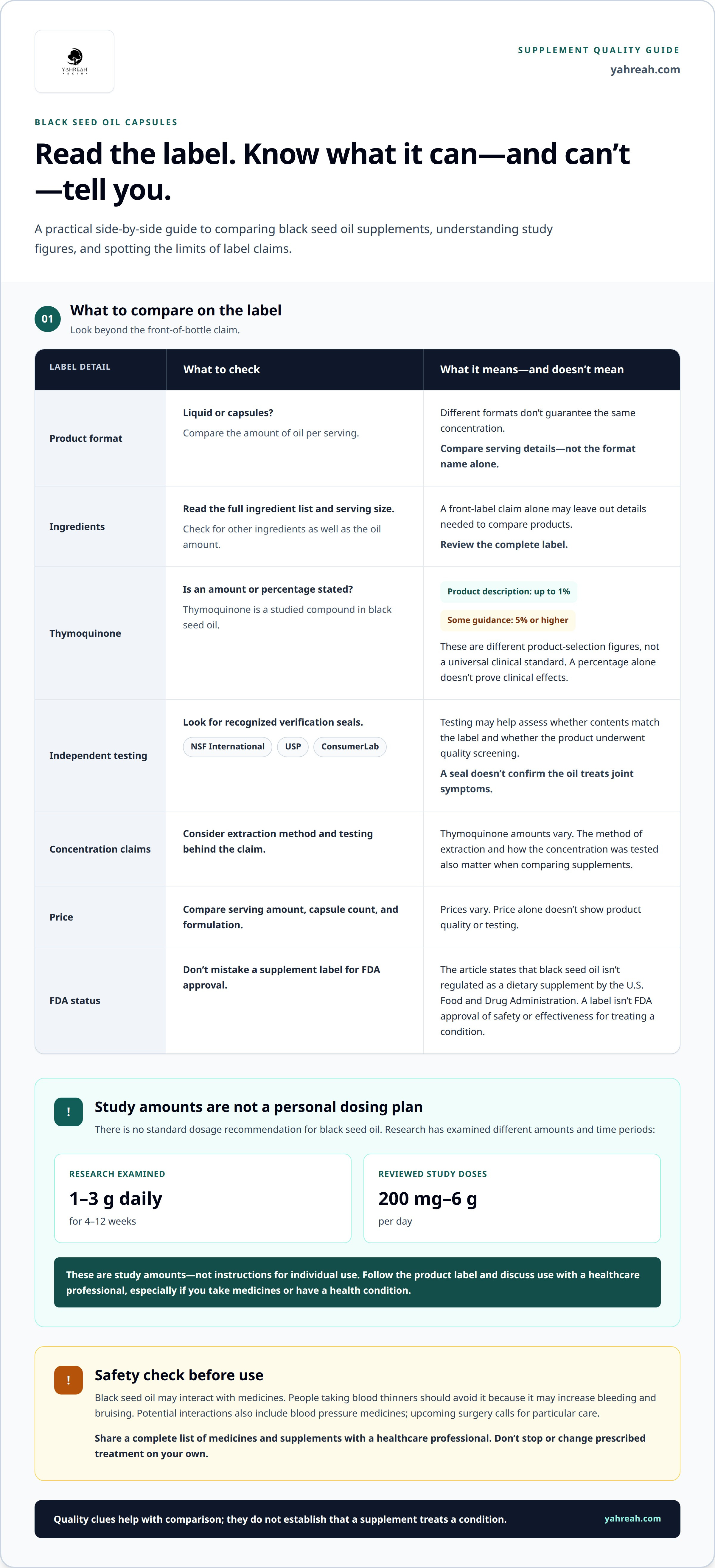
Yes. Black seed oil can interact with medicines and supplements, so discuss it with a healthcare professional before use. People taking blood thinners should avoid it because it may increase bleeding and bruising. This concern applies whether the oil is taken as a capsule or used topically.
Upcoming surgery calls for particular care. Black seed oil may affect blood clotting and reduce blood platelets. Banner Health dietitian Tiffone Powers-Parker advises stopping it at least two weeks before surgery. Tell the surgical team about all supplements you take, including black seed oil, so they can consider them alongside prescribed medicines.
Blood pressure medicines are another potential interaction. Black seed oil may interact with ACE inhibitors, ARBs, beta-blockers, calcium channel blockers, and diuretics. If you take one of these medicines, discuss the combination before adding the oil. Don’t stop or change a prescribed treatment on your own to make room for a supplement.
Blood sugar also deserves attention. People with high blood pressure or type 1 or type 2 diabetes are advised to speak with a healthcare provider before using black seed oil. Studies of black seed for blood sugar management have used different daily oil amounts, including 0.7 g, 3 g, and 5 mL. Those study doses aren’t a dosing plan for your health condition.
Other supplements matter, too. Share a complete list of medicines and supplements, not just prescriptions. Case reports have also linked black seed oil to allergic reactions and rashes after oral or topical use. Digestive effects can include abdominal pain, bloating, diarrhea, headache, or indigestion. An “antioxidant” label doesn’t remove these safety considerations. Take care before starting, especially if surgery is planned or you take medication that affects clotting, blood pressure, or blood sugar.
Research on Nigella sativa and skin largely concerns topical gels and creams, not capsules. That distinction is essential when assessing black seed oil capsules for joint and skin wellness: you can’t assume oral use will have the same effects as a preparation applied directly to skin. The route, formulation, and outcome measured all shape what a study can tell you.
Researchers have examined topical black seed oil for acne, psoriasis, eczema, and hyperpigmentation. These are different skin concerns, so findings about acne lesions don’t establish an effect on eczema or uneven pigmentation. Study results also apply to the specific gel or cream tested, not automatically to every product containing black seed oil.
Black seed’s properties, including its proposed anti-inflammatory activity, help explain why researchers study it. But a possible mechanism doesn’t prove that a skin condition will improve. More research is needed to clarify how topical preparations work for different concerns and whether oral supplements have distinct effects on skin.
For a practical decision, match the form to your intended use. If you’re considering black seed oil capsules for joint and skin wellness, don’t treat capsules as a substitute for topical care aimed at a skin concern. Likewise, findings about topical application don’t establish that taking black seed oil will change skin appearance.
Studies of black seed for asthma address a different health question and can’t demonstrate a skin benefit. Research on black seed preparations may help clarify possible effects, but it doesn’t establish that they treat a disease. Keep the evidence tied to the specific preparation and outcome studied, and seek appropriate care for persistent or worsening skin symptoms.
Yahreah Skin offers natural skincare products for people who want to make topical care part of a considered routine. The distinction matters: topical skincare and oral supplements are different approaches, and findings about black seed oil capsules don’t establish what a skincare product will do for your complexion.
For skin appearance, choose a routine that suits your needs without treating a supplement as a substitute for topical care. Yahreah Skin also offers women’s health supplements, men’s health supplements, and premium supplements for broader wellness needs. Explore Yahreah Skin’s natural skincare and supplement range to find products that fit your routine.
For questions about natural skincare products, contact Yahreah Skin.
A thoughtful wellness routine starts with matching each choice to its purpose. If you’re considering black seed oil capsules for joint and skin wellness, clarify your goals and discuss supplement use with a healthcare professional if you take medication or have an existing condition. For visible skin concerns, choose care designed for topical use rather than assuming an oral supplement will have the same effects.
There’s no need to change everything at once. A considered next step could be refining your skincare routine, reviewing a supplement label, or discussing potential interactions before adding anything new. Let your priorities guide your decision and build a routine that feels practical and personal.
Contact Yahreah Skin for support as you explore natural skincare and wellness options. Take your next step with care and confidence.
Black seed oil comes from the seeds of Nigella sativa, a plant also known as black cumin. It’s used in supplements and some topical preparations. The form matters: oil applied to skin isn’t equivalent to a capsule taken by mouth, and research on one form doesn’t establish effects for the other.
Yes. Reported side effects include abdominal pain, bloating, diarrhea, headache, and indigestion. Case reports also link oral or topical use with rashes and allergic reactions. If you notice a new rash after applying an oil or cream, stop using that topical product. If you take medication, consider potential interactions before adding black seed oil to your routine.
There’s no established amount that defines an overdose, and safety information for larger amounts or longer use is limited. Black seed oil is likely safe in small amounts for less than three months; avoid using it longer unless a doctor instructs you to. Don’t assume that an amount used in a study is safe for your circumstances.
There’s no standard recommended dose for black seed oil. Study amounts vary by product and purpose, so they don’t establish one universal routine. Follow the directions on a specific product’s label rather than combining amounts from different studies or products. If you take medication or manage a health condition, discuss an appropriate approach with a healthcare professional.
Small studies suggest black seed oil could support improvements in joint pain or physical function for some people with arthritis. The evidence doesn’t establish capsules as a cure or a replacement for conventional treatment. If you’re considering a supplement for joint concerns, keep prescribed care in place and discuss its use with a healthcare professional.
Capsules haven’t been shown to produce the same effects as topical black seed preparations. Research on gels and creams for acne or pigmentation doesn’t establish that swallowing capsules improves skin or treats eczema. For a skin concern, distinguish oral supplements from products made for topical use, and stop topical application if irritation or a rash appears.


