

 USD
USD EUR
EUR
 AUD
AUD
 GBP
GBP
 JPY
JPY
 INR
INR
 MXN
MXN
 CAD
CAD
 JMD
JMD
Total: $0.00
Taxes and shipping calculated at checkout


A label pairing two popular ingredients doesn’t automatically offer twice the evidence. If you’re weighing d-mannose and cranberry supplements for urinary tract health, conflicting claims can make it hard to tell what may help with prevention, what remains uncertain, and what a supplement can’t do.
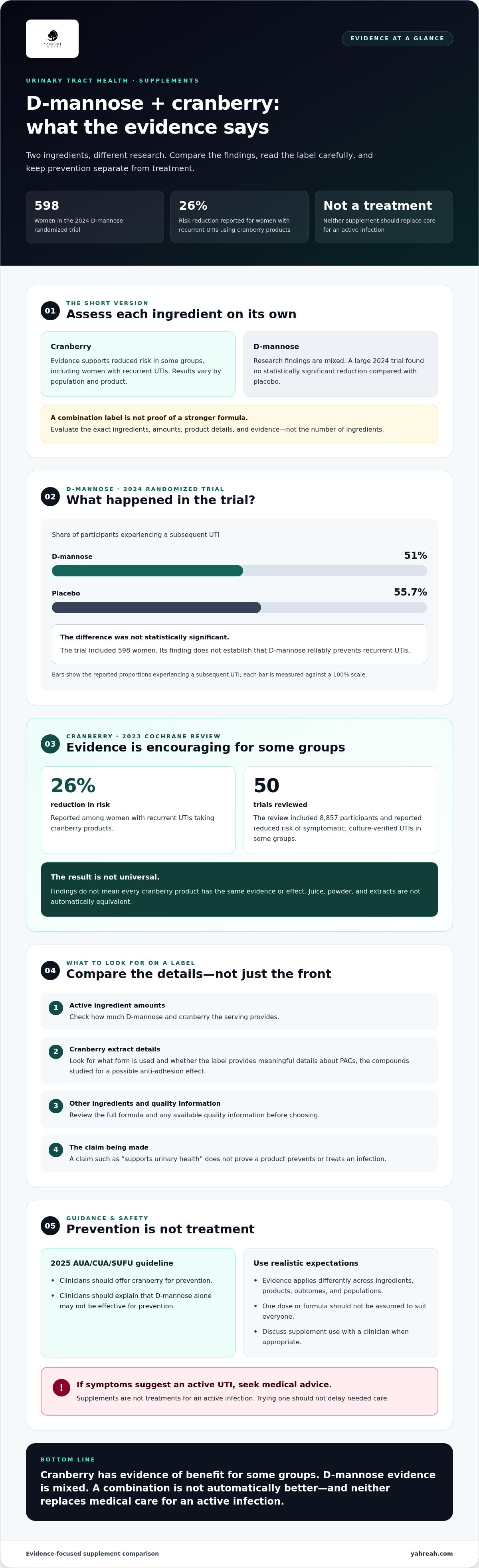
The research points in different directions. In a 2024 randomized trial of 598 women, D-mannose didn’t significantly reduce subsequent UTIs compared with placebo. A 2023 Cochrane review found cranberry products reduced the risk of symptomatic, culture-verified UTIs in some groups, including women with recurrent UTIs, but the results don’t apply equally to everyone. The 2025 AUA guideline says clinicians should offer cranberry for prevention and explain that D-mannose alone may not be effective.
This guide explains what the evidence does and doesn’t show, how to compare ingredient amounts and meaningful quality details, and which marketing claims to question. It also covers when symptoms call for prompt medical advice. Supplements aren’t treatments for an active infection, and trying one shouldn’t delay needed care.
When urinary concerns recur, supplement labels can feel like a maze: similar claims, different ingredients, and little clarity about what the evidence supports. D-mannose and cranberry are distinct ingredients studied in different ways. Neither should be treated as a remedy for an active urinary tract infection (UTI).
Featured-snippet definition: D-mannose is a simple sugar sold as a supplement and studied mainly for possible UTI prevention. Cranberry products contain plant compounds, including proanthocyanidins (PACs), that have also been studied for prevention. Evidence depends on the ingredient, product, outcome, and population. Neither ingredient is a treatment for an active infection.
D-mannose is a simple sugar found in some foods and related to glucose. For a foundational overview of what D-mannose is, see its chemical and metabolic background. That context isn’t proof that a supplement prevents UTIs.
One proposed mechanism is that D-mannose may interfere with certain E. coli bacteria attaching to cells in the urinary tract. This is a hypothesis about how it might work, not evidence that taking it produces a reliable clinical benefit. Researchers have studied D-mannose primarily for preventing recurrences, not for clearing an infection that is already causing symptoms.
Clinical findings have been mixed. In the 2024 MERIT randomized trial, published in JAMA Internal Medicine, 598 women received D-mannose or placebo. The proportion experiencing a subsequent UTI was 51% in the D-mannose group and 55.7% in the placebo group, a difference that wasn’t statistically significant. The 2025 AUA/CUA/SUFU guideline advises clinicians to tell patients that D-mannose alone may not be effective for prevention.
Cranberry may appear as juice, powder, or extract. These forms aren’t automatically equivalent because processing and formulation can affect what a serving contains. PACs are cranberry compounds studied for a possible anti-adhesion effect, but a label that mentions cranberry doesn’t show how much relevant material the product provides.
The evidence is more encouraging for some groups, but it isn’t universal. A 2023 Cochrane review of 50 trials involving 8,857 participants reported reduced risk of symptomatic, culture-verified UTIs with cranberry products overall, including a 26% reduction among women with recurrent UTIs. The FDA also permits qualified health claims for certain cranberry products, based on limited credible evidence of reduced recurrent-UTI risk in healthy women. These findings don’t mean every cranberry supplement has the same evidence or effect.
So, d-mannose and cranberry supplements for urinary tract health shouldn’t be judged by ingredient names alone. Check the formulation and the specific claim, and keep prevention separate from treatment. A suspected active infection needs medical evaluation, not a supplement in place of care.
A two-ingredient formula can look more comprehensive, but more ingredients don’t automatically mean stronger evidence. To compare d-mannose and cranberry supplements for urinary tract health, separate three questions: how an ingredient might work, what human studies have found, and what the product’s marketing claims.
Formula
Plausible mechanism
What research can tell you
What a label claim doesn’t prove
D-mannose alone
It’s hypothesized to interfere with some bacteria attaching to urinary-tract cells.
Research on recurrence prevention has been mixed. The large 2024 MERIT trial did not find a statistically significant benefit over placebo, and the 2025 AUA/CUA/SUFU guideline advises that D-mannose alone may not be effective for prevention.
“Supports urinary health” doesn’t establish that the formula prevents or treats infection.
Cranberry alone
PACs are studied for a possible anti-adhesion effect.
Evidence varies by population and product. The National Center for Complementary and Integrative Health (NCCIH) summarizes the evidence for cranberry, including its limits and safety considerations.
A cranberry mention doesn’t confirm the amount or type of extract used in a study.
D-mannose plus cranberry
The formula combines two proposed mechanisms.
Evidence for the separate ingredients doesn’t establish that taking them together adds benefit. Check whether research tested the same ingredients and quantities as the label.
“Two ingredients” is a description, not proof of a stronger effect.
Study design matters. Earlier or smaller studies may differ from larger trials in who took part, how D-mannose was formulated, and how researchers defined and measured a UTI. Findings in one group can’t automatically be applied to everyone with recurring symptoms. Consider the overall pattern of human evidence, not just a promising mechanism or one favorable result.
Cranberry juice, powder, and extracts aren’t interchangeable by name alone. Extract standardization and PAC content can affect whether a product resembles the formulation studied. The outcome measured and population enrolled matter too. Before trusting a combination claim, compare the study’s ingredients and amounts with the label. Unless the exact combination has been tested, an additive benefit remains unproven.
Bottom line: A combination formula isn’t automatically better supported than either ingredient alone. Prioritize clear amounts and extract details over a longer ingredient list. For a broader look at ingredient transparency across wellness supplements, explore Yahreah Skin’s wellness supplements. This isn’t a claim that a D-mannose or cranberry formula is available.
A clear label is more useful for comparison than a bold promise on the front of the bottle. For d-mannose and cranberry supplements for urinary tract health, focus on what each serving contains, how the cranberry ingredient is described, and what quality information the manufacturer provides. No single dose can be recommended for everyone without considering the product and personal health context.
Read the Supplement Facts panel alongside the directions and cautions. A headline claim may describe the whole formula, while the panel shows the details you need to compare products.
Clear sourcing and quality information help you ask better questions, though no single phrase on a label guarantees effectiveness. For broader criteria to consider, see this guide to clean supplement brands.
A statement that a supplement is made in an FDA-registered facility describes the facility’s registration, not FDA approval of the supplement. Keep that distinction clear when comparing labels. Transparency helps you assess a product, but it doesn’t replace medical advice when urinary symptoms need attention.
Supplements aren’t a substitute for medical evaluation or treatment if you suspect an active urinary tract infection (UTI). Burning with urination, unusual urgency or frequency, and lower abdominal discomfort can have different causes. Avoid self-diagnosing based on symptoms alone. A healthcare professional can assess what’s happening and advise whether treatment is needed.
No. D-mannose and cranberry supplements aren’t established treatments for an active infection. Don’t use them instead of prescribed treatment or delay seeking care while trying a supplement. An untreated UTI can worsen. Seek urgent medical care for fever, pain in your side or back, vomiting, or feeling seriously unwell. If symptoms are worsening or you’re unsure how urgent they are, contact a healthcare professional promptly.
Individual guidance is especially important during pregnancy, for children, and for anyone with kidney conditions, recurring urinary symptoms, or complex health concerns. A clinician or pharmacist can also review medicines and possible interactions. This is particularly relevant if you take warfarin: cranberry may interact with some medicines, and the right advice depends on your situation.
Check the full ingredient list, not just the front label. Formulas may include additional active ingredients or other components that matter for allergies, sensitivities, or existing conditions. D-mannose may cause digestive discomfort, particularly at higher amounts. Cranberry products can also cause stomach upset. Stop and seek advice if you develop a concerning reaction.
If you’re considering d-mannose and cranberry supplements for urinary tract health, the safest next step depends on why you’re considering them. A clinician can help distinguish a prevention discussion from symptoms that need prompt assessment, and advise whether a supplement is appropriate alongside your medicines and health history. Don’t stop or change prescribed treatment without discussing it with the prescriber.
After reviewing your needs with a healthcare professional, you can explore Yahreah’s wellness supplements for general wellness options. No specific D-mannose or cranberry formula is implied.
A confident choice starts with why you’re considering a supplement, not the number of ingredients on the front label. If symptoms are present or recurring, talk with a healthcare professional before shopping. A supplement shouldn’t replace assessment or treatment. If you’re exploring d-mannose and cranberry supplements for urinary tract health, use this framework to keep your decision grounded.
Choose only a formula you can understand and that aligns with a clinician-informed goal. If you can’t tell what an ingredient blend contains or how it should be used, keep comparing rather than guessing.
Bring the product label or a clear photo of it to a pharmacist or healthcare professional. Useful questions include: Is this appropriate for my health history? Could it interact with my medicines? What evidence applies to this product and its listed amounts? This is especially helpful if you’re pregnant, have a kidney condition, take regular medication, or experience recurring symptoms.
Before buying, verify the seller and manufacturer information, read the complete ingredient list and cautions, and check current product availability. A brand’s general quality statements are useful starting points, but they don’t establish that a specific formula is effective for urinary concerns.
Yahreah Skin offers women’s health supplements generally, but no specific D-mannose or cranberry formula is confirmed. If you’d like to explore the broader category, visit the women’s health supplements guide or browse the Yahreah Skin store. Take your time, and let transparency and personal suitability lead the decision.
The evidence for d-mannose and cranberry supplements for urinary tract health isn’t the same for every ingredient, formula, or person. Let research, transparent labels, and your health context guide the decision rather than assuming a combination product is automatically more effective. Compare amounts and extract details, and ask a healthcare professional about suitability or interactions when needed.
Most importantly, supplements aren’t a substitute for care if you suspect an active urinary tract infection. Seek medical advice for concerning symptoms instead of waiting to see whether a supplement helps.
Yahreah Skin emphasizes clean ingredients and cruelty-free formulations. The brand states its supplements are made in FDA-registered manufacturing facilities in the United States. Facility registration does not mean the FDA approves a supplement. No specific D-mannose or cranberry formula is confirmed. To explore the brand’s broader wellness offerings, explore Yahreah Skin’s wellness offerings.
Choose thoughtfully, stay attentive to your health, and feel confident asking questions before adding something new to your routine.
Some supplements combine D-mannose and cranberry, but that doesn’t establish that the ingredients work better together. Whether a combination is suitable for you depends on your health, medicines, and the product’s full ingredient list. Check the serving directions and cautions, and ask a pharmacist or healthcare professional if you’re pregnant, have a health condition, or take regular medication. Don’t use a combination product to manage suspected UTI symptoms.
Cranberry may reduce the risk of recurrent UTIs for some people, but benefits depend on the population and product. A 2023 Cochrane review found reduced risk in women with recurrent UTIs. D-mannose evidence is less reassuring: the 2024 MERIT trial found no statistically significant prevention benefit over placebo, and the 2025 AUA/CUA/SUFU guideline says D-mannose alone may not be effective. Neither supplement guarantees prevention.
No. D-mannose and cranberry supplements aren’t treatments for an active urinary tract infection and shouldn’t replace medical assessment or prescribed treatment. Symptoms such as burning, urgency, or frequent urination need appropriate evaluation because they can have different causes. Don’t delay care while trying a supplement or stop prescribed treatment without speaking to the prescriber. Seek urgent medical care for fever, side or back pain, vomiting, or feeling seriously unwell.
Compare the Supplement Facts panel, not just front-label claims. Check that each ingredient and its amount per serving are clear, and look for the cranberry form and any stated extract standardization or PAC content. Review serving instructions, other active ingredients, allergens, cautions, and accessible manufacturer and testing information. For d-mannose and cranberry supplements for urinary tract health, a transparent label is useful, but it doesn’t prove the product prevents or treats infection.
There’s no universally established effective dose for D-mannose or cranberry supplements. Some D-mannose trials have used 2 grams daily, but that doesn’t establish a recommended dose for everyone or every product. For cranberry, PAC content matters, yet an optimal dose and formulation haven’t been definitively established. Follow the product directions and ask a healthcare professional what may be appropriate for your circumstances, especially if you take medication.
No supplement is right for everyone. Ask a healthcare professional before use if you’re pregnant, considering a supplement for a child, have kidney problems, experience recurring symptoms, or take medicines such as warfarin. D-mannose may cause digestive discomfort, especially at higher amounts. Cranberry can also cause stomach upset. Review the complete ingredient list for allergens and additional ingredients, and seek advice if you notice a concerning reaction.
FDA-registered manufacturing means the facility is registered with the FDA. It does not mean the FDA has approved the supplement or confirmed that it works. Treat registration as one piece of information, not a substitute for reviewing the label, manufacturer details, and available quality-testing information. Yahreah Skin states that its supplements are made in FDA-registered manufacturing facilities in the United States, but this should not be interpreted as FDA product approval.


