

 USD
USD EUR
EUR
 AUD
AUD
 GBP
GBP
 JPY
JPY
 INR
INR
 MXN
MXN
 CAD
CAD
 JMD
JMD
Total: $0.00
Taxes and shipping calculated at checkout


What if the most important detail on a folate label isn’t the form, but the amount and how it fits your needs? It’s easy to see “folate,” “folic acid,” and “5-MTHF” on food and supplement labels and wonder whether they mean the same thing, or whether one is always the better choice. They’re related, but not identical, and the distinctions matter when you’re comparing sources or planning for pregnancy.
This guide explains how naturally occurring folate differs from folic acid used in fortified foods and supplements, and where other supplemental forms fit. You’ll learn how to read dietary folate equivalents (DFE) on labels, assess claims about absorption and methylation, and understand why pregnancy-related guidance can depend on timing and personal circumstances. The goal isn’t to make every label feel like a chemistry lesson. It’s to help you weigh clear information, recognize when a general recommendation may not answer your specific question, and know when to discuss folate or folic acid with a healthcare professional.
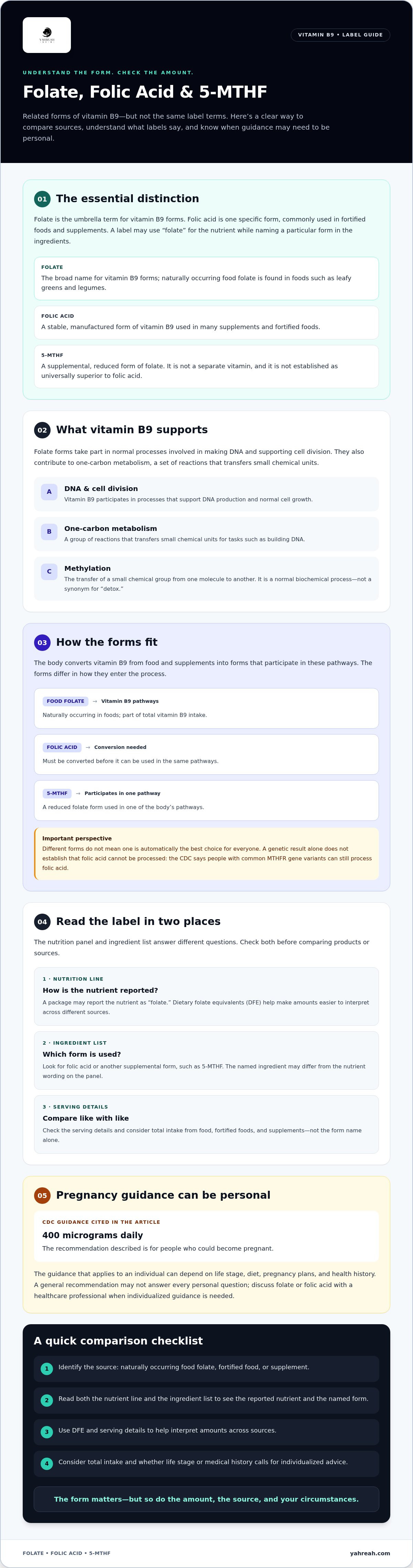
Folate is vitamin B9; folic acid is one form of it. The terms are related, but they aren’t interchangeable in every context. “Folate” can refer broadly to vitamin B9 forms, while “folic acid” names the form commonly added to fortified foods and used in supplements. Knowing that distinction makes a label easier to interpret, without assuming that one form is automatically right for everyone.
Folate: The umbrella term for vitamin B9 forms. Naturally occurring food folate is found in foods such as leafy greens and legumes; supplements may contain folic acid or other forms.
Folic acid: A specific, manufactured form of vitamin B9 used in many supplements and fortified foods.
Sources: The NIH Office of Dietary Supplements distinguishes natural food folate from folic acid added to foods and supplements. For a broader overview, see Folate (Vitamin B9).
Folate is a water-soluble B vitamin, meaning it dissolves in water, that the body needs for normal cell growth and metabolism. “Folate” can describe a family of related forms of vitamin B9, not just a single ingredient. Natural food folate occurs in foods including leafy greens and legumes. These foods can contribute to a varied diet, but no single food is a guarantee that someone’s individual needs are met.
The broader term also appears in nutrition information and health guidance because recommendations may refer to total vitamin B9 intake, rather than one specific source. That’s why the wording on a package may not match the wording in advice you’ve read.
Folic acid is the stable, synthetic form of vitamin B9 used in many supplements and in fortified foods. It is distinct from the naturally occurring folate in foods such as vegetables and legumes. The NIH Office of Dietary Supplements describes folate as naturally present in foods and folic acid as the form added to fortified foods and dietary supplements.
On a package, the nutrient may be listed as “folate,” while the ingredient list names folic acid or another supplemental form. Health guidance may also use one term specifically, depending on the context and purpose of the recommendation. Read both parts of the label: the nutrient line tells you how the product reports vitamin B9, while the ingredient list identifies the form used. In the next section, we’ll look at how the body uses these forms and why the differences matter.
Folate forms take part in the body’s normal processes for making DNA and supporting cell division. They contribute to one-carbon metabolism, a set of reactions that transfers small chemical units needed for tasks such as building DNA. These reactions also include methylation, the transfer of a small chemical group from one molecule to another. Methylation is a normal biochemical process, not a synonym for “detox.”
The body converts vitamin B9 from food and supplements into forms that can participate in these reactions. Folic acid must be converted before it can be used in the same pathways; 5-MTHF is already a reduced folate form that participates in one of them. The NIH Office of Dietary Supplements describes folate’s roles in DNA and amino-acid metabolism. How much someone needs, and which guidance applies, can depend on life stage, diet, pregnancy plans, and health history.
They’re forms of the same vitamin, not interchangeable label terms. A supplement’s ingredient list can name a form even when its nutrition panel reports the overall nutrient as folate.
| Name | Common source | Label context |
|---|---|---|
| Food folate | Naturally occurring in foods | May be described as folate in nutrition guidance |
| Folic acid | Many supplements and fortified foods | Often named in the ingredients; nutrition panels may report folate |
| 5-MTHF | Some supplements | May appear by its full name or as a folate form |
5-MTHF, short for 5-methyltetrahydrofolate, is a supplemental form of vitamin B9, not a separate vitamin. It isn’t established as universally superior to folic acid. The CDC says people with common MTHFR gene variants can still process folic acid, and recommends that people who could become pregnant get 400 micrograms daily. See the CDC folic acid guidelines for its public-health guidance. A genetic result alone doesn’t establish that folic acid won’t work for you.
For a considered supplement routine, compare the listed form and amount with your other sources, then seek clinical advice if your circumstances call for it. You can also explore wellness supplements while keeping product label review separate from individualized health guidance.
Food, fortified staples, and supplements can all contribute vitamin B9, but they don’t necessarily provide it in the same form. Natural folate occurs in foods; folic acid is added to some fortified foods and is used in supplements. A supplement may also list another form, such as 5-MTHF. Knowing the source helps you make sense of the amount shown on a label.
Dark leafy vegetables, beans, peas, and citrus fruits are examples of foods that provide folate. Aim for variety rather than relying on a single food. The amount in a serving can vary with the particular food, how it’s stored, and how it’s prepared, so a food list can’t determine an individual’s total intake on its own. The NIH Folate Fact Sheet offers further detail on dietary sources and folate forms.
Dietary folate equivalents, or DFE, are a unit used to account for differences in how the body uses natural food folate and folic acid from fortified foods or supplements. In U.S. labeling, folate amounts are reported in micrograms of DFE. A supplement label may also show the actual amount of folic acid in parentheses, which helps identify the form and quantity behind the DFE figure.
For illustration, a hypothetical label might read: Folate 680 mcg DFE (400 mcg folic acid). The figures reflect the NIH conversion for folic acid consumed with food: 400 mcg of folic acid corresponds to 680 mcg DFE. This example explains the units; it isn’t a product recommendation or a claim about any specific supplement.
Compare the nutrient amount and serving size, not just front-label language such as “with folate.” Check the ingredient list to see whether the source is folic acid or another supplemental form, and note how many servings the listed amount represents. Also consider fortified foods and other supplements when reviewing total intake. For a wider framework on assessing ingredient transparency and product quality, explore clean supplement brands. Clear label reading can help you compare folic acid and folate sources without treating marketing language as a substitute for the details.
General recommendations offer a useful starting point, but pregnancy planning, medical history, medications, and existing health conditions can change what advice applies to an individual. Folic acid and folate guidance should be understood in that context, especially before adding a high-dose supplement or combining several products.
The CDC recommends that people who could become pregnant get 400 micrograms of folic acid daily, including before pregnancy. This timing matters because neural tube development occurs very early in pregnancy, sometimes before someone knows they’re pregnant. The recommendation is for the general public; pregnancy planning and personal circumstances may call for advice from a healthcare professional.
People with a previous pregnancy affected by a neural tube defect may receive different guidance. The CDC describes a higher dose for this specific history, so don’t apply it to yourself without medical direction. Review the CDC’s folic acid guidance and discuss your situation with a qualified clinician. For broader information on women’s health supplements, consider how a product fits into your routine separately from pregnancy-specific clinical advice.
Fatigue can have many causes, and anemia is a finding that needs evaluation, not proof of folate deficiency. A healthcare professional can assess symptoms and decide whether testing is appropriate. Vitamin B12 status may also matter: high folic acid intake can correct some blood changes associated with B12 deficiency without addressing potential nerve damage, which may complicate recognition of the deficiency.
In the United States, the tolerable upper intake level for adults is 1,000 micrograms a day of folic acid from supplements and fortified foods. This limit doesn’t apply to folate naturally present in food, and it isn’t a target intake. A clinician may recommend a different amount for a particular medical reason. Check with a qualified healthcare professional before taking high doses, especially if you take medications, have an existing condition, or are pregnant or planning pregnancy.
For general supplement browsing, explore Yahreah Skin's wellness supplements. Product information isn’t a substitute for advice tailored to your health needs.
A supplement label can help you compare options, but it can’t decide what’s appropriate for your health or life stage. Before adding another source of folate, take a moment to review the form, amount, and other products or fortified foods in your routine. These five questions offer a steady place to start.
You can check the listed form, serving size, nutrient amount, and ingredient panel yourself. Deciding whether a supplement fits your needs, particularly with medications, pregnancy plans, symptoms, or a medical condition, is a better conversation to have with a qualified healthcare professional. Bring the product label and a list of other supplements or fortified products you use; specific details can make that discussion more useful.
Choosing thoughtfully matters more than chasing a particular form. For a general look at the brand’s approach to wellness, explore Yahreah Skin’s wellness approach. This is an invitation to learn about the brand, not a recommendation of a folate-specific product.
Understanding folic acid and folate starts with recognizing that they’re related forms of vitamin B9, but they can come from different sources and appear differently on labels. Check the form, amount per serving, and dietary folate equivalents, then consider other supplements and fortified foods that contribute to your intake.
General guidance can be a helpful reference, but pregnancy planning, medications, symptoms, and medical history may call for advice tailored to you. If you’re unsure whether a product fits your needs, bring its label and your questions to a qualified healthcare professional. A thoughtful choice is better than selecting a supplement based on a single marketing claim.
Yahreah Skin emphasizes clean ingredients and cruelty-free formulations, and describes its manufacturing facilities as FDA-registered. Facility registration is not the same as FDA approval of a supplement. To learn about the brand’s broader wellness approach, explore Yahreah Skin’s wellness approach.
Take your time, read labels with care, and choose the next step that feels informed and right for your circumstances.
Not exactly. Folate is the umbrella term for vitamin B9 forms, including naturally occurring forms in food. Folic acid is a specific form used in many supplements and fortified foods. Both contribute vitamin B9, but they differ in form and source. Labels may list “folate” as the nutrient and name folic acid or another form in the ingredients, so check both when comparing products.
Neither form is established as the best choice for everyone. Methylfolate, also called 5-MTHF, is a supplemental form of vitamin B9, while folic acid is another form used in supplements and fortified foods. The CDC says people with common MTHFR gene variants can still process folic acid. Consider your needs, label details, and relevant health history, and ask a healthcare professional if you’re unsure which form is appropriate.
Dark leafy vegetables, beans, peas, and citrus fruits are examples of foods that provide natural folate. Include a variety rather than relying on one food to meet everyone’s needs. Folate content can vary with the food, storage, and preparation. Food folate is distinct from folic acid added to fortified foods, so check product labels if you’re tracking intake from both foods and supplements.
The CDC recommends 400 micrograms of folic acid daily for people who could become pregnant. The USPSTF recommends 400 to 800 micrograms daily for those planning or capable of pregnancy, beginning at least one month before conception and continuing through the first two to three months of pregnancy. A previous pregnancy affected by a neural tube defect or other medical history may call for different advice, so consult a clinician.
Food can contribute folate, but whether your overall intake is adequate depends on your diet and circumstances. For people who could become pregnant, U.S. public-health guidance specifically recommends daily folic acid, as early neural tube development occurs before some people know they’re pregnant. Food folate and supplemental folic acid aren’t identical sources. Ask a healthcare professional how general recommendations apply to your situation.
High folic acid intake can correct the anemia associated with vitamin B12 deficiency without correcting possible nerve damage. That may make the deficiency harder to recognize. Fatigue or anemia alone doesn’t confirm a folate or B12 deficiency; assessment by a healthcare professional is needed. If you have symptoms, take medications, or have a condition that could affect nutrient levels, seek advice before using high-dose supplements.
DFE means dietary folate equivalents. It’s a unit used to account for differences in how the body uses naturally occurring food folate and folic acid from fortified foods or supplements. A U.S. label may show folate in micrograms of DFE and list the specific form and amount in parentheses. Compare the DFE amount alongside the serving size and ingredient list, rather than relying only on front-label claims.


