

 USD
USD EUR
EUR
 AUD
AUD
 GBP
GBP
 JPY
JPY
 INR
INR
 MXN
MXN
 CAD
CAD
 JMD
JMD
Total: $0.00
Taxes and shipping calculated at checkout


Could the capsule with the most “natural” label be the wrong choice for cramps? When discomfort interrupts work, rest, or plans, it’s understandable to look for a simple option. But natural pms relief capsules for cramps vary widely in their ingredients, and a reassuring label doesn’t tell you how strong the evidence is or whether a product is a safe fit for you.
You deserve a clearer way to compare your options. This 2026 guide looks at ingredient categories commonly discussed for menstrual discomfort, what the available evidence can and can’t tell you, and why supplements may not work the same way for everyone. It also explains what to check on a label, including the full ingredient list and serving directions, and why it’s wise to consider medicines, health conditions, and possible interactions before starting a supplement.
We’ll weigh potential benefits against important limits, without treating “natural” as a promise of effectiveness or safety. You’ll also learn when cramps or other symptoms are a reason to seek medical advice. A thoughtful choice starts with clear information, not a bold claim.
Cramp discomfort can make ordinary plans harder, so looking for a manageable option is understandable. Comparing natural pms relief capsules for cramps can help you ask better questions, but no ingredient list can promise relief or show that a capsule is right for everyone. Focus on what’s known, what remains uncertain, and what deserves a safety check.
Premenstrual syndrome (PMS) describes physical or emotional symptoms that recur in relation to the menstrual cycle, often before a period. Experiences vary: symptoms may ease once bleeding starts, while others can overlap with the period. Menstrual cramps are pain associated with menstruation and may begin before or during bleeding. Dysmenorrhea is the medical term for painful menstruation; it describes a symptom, not a diagnosis of its cause.
Timing and severity differ from person to person. If pain is severe, changes over time, or disrupts daily life, discuss it with a healthcare professional rather than assuming it’s routine cramps. Supplements may complement a care plan, but they don’t replace evaluation, diagnosis, or prescribed treatment.
Research on an ingredient doesn’t prove that a particular capsule will work. Studies may use a specific extract, amount, or combination that differs from a product on the shelf. The formula, serving directions, and your health circumstances matter, too.
Evidence also comes in different strengths. Traditional use means an ingredient has a history of use, not necessarily that modern studies confirm a benefit. Early research may suggest a possibility but leave important questions unanswered. Stronger clinical evidence comes from well-designed human studies, though even that doesn’t guarantee an individual result.
Evidence-informed supplement selection means matching a clearly labeled product to relevant human research while considering personal safety and uncertainty. The National Center for Complementary and Integrative Health advises consumers to review supplement evidence and discuss use with a health professional, particularly when medicines or health conditions are involved. Read its guidance on using dietary supplements wisely as a starting point. “Natural” describes neither proven effectiveness nor automatic safety.
Ingredient research can offer clues, but a study result isn’t a guarantee for every capsule or every cycle. Researchers may test a particular form, amount, or preparation, while a product combines ingredients in different quantities. When considering natural pms relief capsules for cramps, compare the evidence for an ingredient with the actual label, then consider whether the findings apply to your situation.
Magnesium: It’s discussed in relation to menstrual discomfort, but evidence for a benefit can’t be assumed to apply across all forms or combination products. Amounts and formulas differ. Supplements can cause digestive effects such as diarrhea, and magnesium can affect the absorption of some medicines. The NIH Office of Dietary Supplements outlines these safety considerations in its magnesium fact sheet.
Ginger: Some human research has examined ginger for menstrual pain, but studies of a specific preparation don’t establish that every ginger capsule works similarly. The National Center for Complementary and Integrative Health notes possible digestive side effects, including heartburn and abdominal discomfort, and advises that ginger may interact with medicines. Ask a clinician or pharmacist before trying it if you take medication or have a health condition.
Promising research suggests a possibility; established clinical benefit requires consistent, relevant evidence and still doesn’t guarantee an individual result. Mayo Clinic’s overview of alternative medicine for PMS is a useful reference for understanding the limits of evidence around vitamins and herbal supplements.
Vitex, also called chasteberry, and evening primrose oil appear in products marketed for premenstrual symptoms. Evidence isn’t equally strong for every ingredient or outcome. Findings about PMS symptoms shouldn’t automatically be treated as proof of relief from period cramps. If research is limited or inconsistent, treat that as a reason to pause and ask questions, not as evidence that a product will work.
Check whether the label names each ingredient clearly and gives its amount per serving. A long ingredient list doesn’t prove a formula is better, and combining several botanicals can make safety harder to assess. Yahreah Skin emphasizes clean ingredients across its broader women’s health supplements; that brand context is separate from evidence that any particular ingredient eases cramps.
A clear comparison looks beyond front-label promises. The table below offers a starting point, not a ranking. Evidence for broader PMS symptoms may not establish a benefit for period cramps, and findings on one preparation may not apply to a capsule with a different formula.
| Ingredient category | Evidence confidence for cramp comfort | Safety questions | Label transparency |
|---|---|---|---|
| Magnesium | Moderate evidence is discussed for PMS symptoms; specific effects on cramps depend on the evidence and outcome studied. | Check the amount and form, and ask a clinician or pharmacist about medicines or health conditions. | Look for the specific magnesium form and amount per serving. |
| Ginger | Emerging human research; results from a particular preparation shouldn’t be assumed for every capsule. | Review the ingredient and serving directions with a health professional if you take medicines or have health concerns. | Check whether the label identifies the form and amount, rather than listing ginger without detail. |
| Vitex (chasteberry) | Evidence is discussed for PMS symptoms, but that doesn’t automatically establish cramp relief. | Ask whether it’s appropriate alongside your medicines and health circumstances. | Look for a clearly named ingredient and disclosed amount. |
| Evening primrose oil | Evidence for PMS is limited or conflicting; don’t treat it as established cramp relief. | Check suitability with a clinician or pharmacist before use. | Review the amount and any additional ingredients in the formula. |
When comparing natural pms relief capsules for cramps, check whether each active ingredient and its amount per serving are listed. A proprietary blend may name its components but conceal the amount of each, making it harder to compare the formula with research or assess combined intake. Review serving directions, other ingredients, allergen statements, and manufacturer contact details, too. If anything is unclear, pause and ask the manufacturer or a health professional.
Manufacturing standards and testing can speak to how a supplement is made or assessed. They don’t prove it relieves cramps. Look for details about what a testing or certification claim covers, and verify it with the named organization when possible. Yahreah Skin describes its manufacturing as FDA-registered in the USA; that is not FDA approval of a supplement or proof of effectiveness. Its ingredient-conscious approach may offer useful context, but the label and evidence still need their own review. For broader context on choosing women’s health products, see the women’s health supplement guide.
Be cautious with absolute promises, vague claims to “balance hormones,” or before-and-after stories presented without substantiation. A transparent label gives you something concrete to assess. A persuasive claim alone doesn’t.
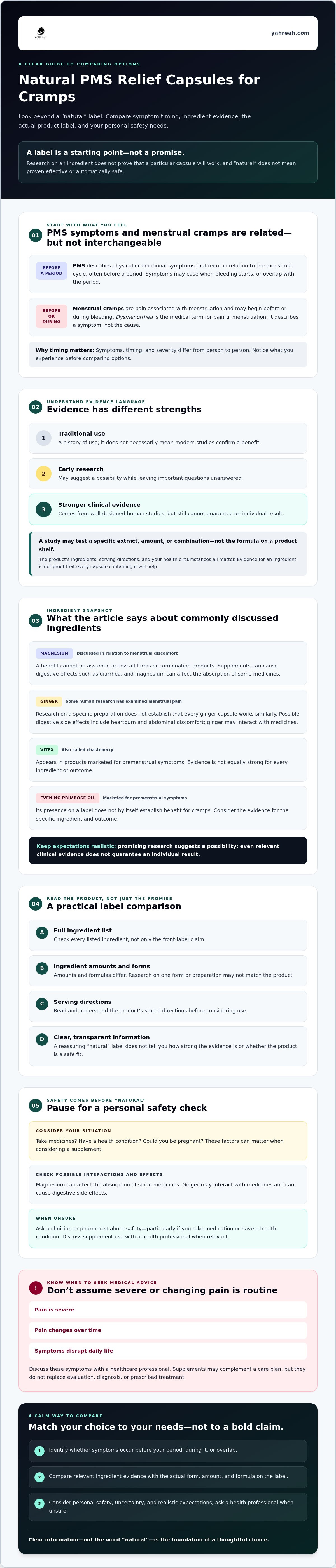
A considered choice starts with your symptoms, not a product promise. Use this process to decide what to ask, what to check, and when a supplement may not be the right next step.
Is the ingredient amount fully listed? Is there relevant human research for menstrual cramps, rather than only broader PMS symptoms or traditional use? Could it interact with a medicine or be unsuitable given your health history? Bring the product label, or a clear photo of it, to a healthcare professional. Avoid combining several supplements with overlapping ingredients unless a qualified professional has reviewed them.
Your health history, medicines, and pregnancy status can change whether a supplement is appropriate, so general ingredient research can’t replace personal safety guidance. The National Center for Complementary and Integrative Health recommends discussing supplement use with a healthcare provider, especially when taking medicines. You can keep a simple record of symptoms and supplement use, including when you take it and any changes you notice. Tracking may help a clinical conversation, but it doesn’t replace medical evaluation.
Seek clinical advice for severe, worsening, or new pain, pain that disrupts daily life, unusual bleeding, or other symptoms that concern you. A healthcare professional can assess possible causes, which may include conditions such as endometriosis or fibroids, without assuming that any one explanation applies. Don’t rely on capsules to delay getting persistent or concerning symptoms checked.
If you’re exploring supplements more broadly, you can browse Yahreah Skin’s women’s health supplements. Review each product’s own label and claims; a general supplement range isn’t a substitute for advice about cramps or your personal health needs.
A thoughtful choice comes down to four things: evidence related to the symptom you want to address, a label that clearly lists ingredients and amounts, safety for your personal circumstances, and realistic expectations. Natural pms relief capsules for cramps may be one option to explore, but “natural” alone doesn’t tell you whether a formula is supported by research or suitable for you. Give yourself time to compare before deciding.
Yahreah Skin sells women’s health supplements and other wellness products online, and emphasizes clean ingredients and cruelty-free formulations. The brand also describes its manufacturing as FDA-registered in the USA. That statement is not FDA approval of a supplement, an endorsement of its effects, or evidence that it relieves cramps.
Yahreah Skin offers women’s health supplements, but no specific PMS-cramp capsule or formula is identified here. It wouldn’t be accurate to present a Yahreah Skin product as a cramps solution. Brand values can help you understand a company’s approach, but they can’t replace product-specific label details or clinical evidence.
If you’re considering a supplement, review the current product listing and label directly. Confirm the ingredients, amounts per serving, directions, and safety information. Ask a clinician or pharmacist about suitability if you take medicines, have a health condition, are pregnant, or feel unsure. If your pain is severe, changing, or disrupting everyday life, prioritize medical advice rather than relying on a supplement to address it.
There’s no need to make a rushed decision. Use the evidence and label as a starting point, and keep your health needs at the center. You can Explore Yahreah Skin’s wellness range and verify current product details before purchasing. A calm, informed choice is more valuable than any promise of guaranteed relief.
Choosing natural pms relief capsules for cramps is less about finding the boldest promise and more about weighing relevant evidence, a transparent label, and your own safety needs. Ingredient research can inform a decision, but it can’t guarantee that a particular formula will help. If cramps are severe, changing, or disrupting daily life, seek medical advice rather than relying on supplements alone.
Yahreah Skin emphasizes clean ingredients and cruelty-free formulations, and describes its manufacturing as FDA-registered in the USA. That doesn’t mean its supplements are FDA-approved or proven to relieve cramps. No specific PMS-cramp capsule or formula is identified here, so check current product details before considering any supplement.
Explore the broader range at your own pace: Explore Yahreah Skin’s wellness range. Stay curious, ask questions when you’re unsure, and choose the next step that feels informed and right for you.
Some ingredients have been studied for menstrual discomfort, but evidence varies and doesn’t guarantee that a capsule will ease cramps. Research on an ingredient may involve a different preparation, amount, or symptom than the product you’re considering. “Natural” also doesn’t automatically mean effective or safe. Compare relevant human research with the product’s full label, and talk with a healthcare professional if pain is severe or keeps disrupting daily life.
Magnesium and ginger are often discussed, alongside ingredients such as vitex, also called chasteberry, and evening primrose oil. The amount and quality of evidence differ, and research about broader PMS symptoms doesn’t necessarily establish a benefit for period cramps. Compare the ingredient form and amount listed on the label with the preparation studied. A clinician or pharmacist can help you consider safety and whether the evidence is relevant to your needs.
There isn’t one reliable timeline for natural capsules to relieve cramps. Studies may examine a particular ingredient or preparation over a defined period, but their results can’t predict how quickly a different product may work for you. Follow the label directions and don’t increase the serving to try to speed up an effect. Track symptoms and supplement use, and seek medical advice if pain is severe, worsening, or disruptive rather than waiting for a supplement to help.
Not always. Supplements can interact with medicines, and safety depends on the specific ingredients, your health conditions, and other products you use. Before starting one, show a clinician or pharmacist the full label, including amounts and other ingredients. Ask first if you’re pregnant, trying to become pregnant, or managing a health condition. Avoid combining products with overlapping ingredients unless a qualified healthcare professional has reviewed them.
Look for a complete label that identifies each active ingredient and its amount per serving. Review directions, other ingredients, allergen information, and manufacturer contact details. Check whether human research relates to menstrual cramps and to a preparation like the one in the capsule. Be cautious with proprietary blends that obscure individual amounts and claims promising guaranteed relief. For natural pms relief capsules for cramps, clear labeling supports comparison, but doesn’t prove effectiveness.
Seek medical advice for cramps that are severe, new, worsening, or interfering with daily activities, and for unusual bleeding or other concerning symptoms. A healthcare professional can assess what may be contributing to the pain and discuss appropriate care. Don’t assume persistent or changing cramps are routine, and don’t use supplements as a substitute for evaluation. If you’re uncertain whether a product is safe, ask a clinician or pharmacist before taking it.


