

 USD
 EUR
 AUD
 GBP
 JPY
 INR
 MXN
 CAD
 JMD
Total: $0.00
Taxes and shipping calculated at checkout


A change in estrogen metabolism isn’t the same as treating “estrogen dominance.” If you’re considering a dim diindolylmethane supplement for estrogen dominance, it’s understandable to want clarity amid bold claims and symptoms that may have many causes.
DIM may influence the way the body processes estrogen, but research on a change in estrogen-metabolite ratios doesn’t prove that it balances hormones or relieves symptoms. And “estrogen dominance” isn’t a recognized medical diagnosis, so it’s important not to assume that one label explains how you feel.
This guide explores what DIM may do, what human research can and can’t tell us, and why a promising mechanism isn’t the same as a proven health outcome. You’ll also learn about potential side effects and interactions, including why extra care matters if you take hormonal contraceptives, tamoxifen, anticoagulants, or other medicines. A thoughtful supplement choice starts with evidence and your individual health needs. Before adding DIM, speak with a healthcare professional who can help you consider whether it’s appropriate for you.
Conflicting advice about hormones can make it hard to know which claims to trust. Some wellness content describes “estrogen dominance” as a catch-all explanation for changes in mood, periods, or energy, then presents a dim diindolylmethane supplement for estrogen dominance as a simple answer. A steadier starting point is to separate the popular phrase from what can actually be assessed.
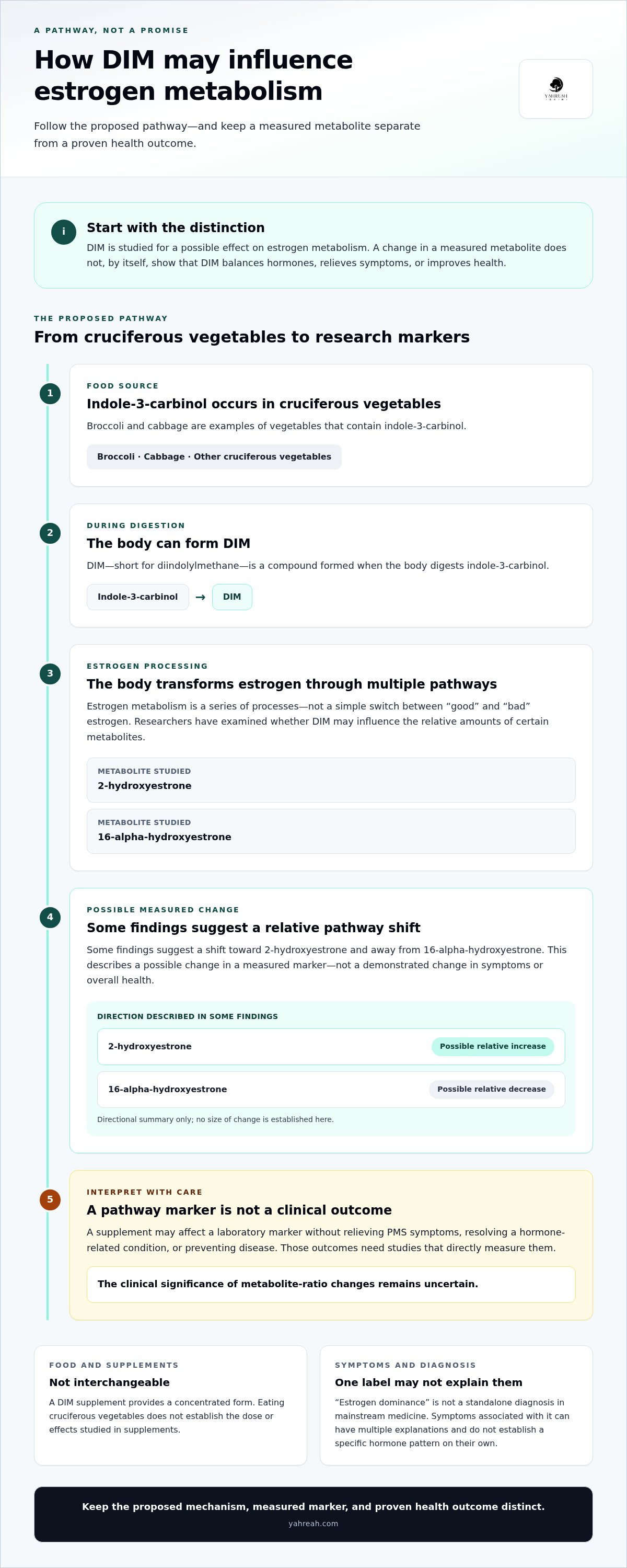
DIM, short for diindolylmethane, is a compound formed when the body digests indole-3-carbinol, a substance found in cruciferous vegetables. It’s studied for its possible influence on estrogen metabolism. That proposed role is not proof that DIM corrects a hormone imbalance or treats symptoms.
“Estrogen dominance” is commonly used in wellness settings, but it isn’t a standalone diagnosis in mainstream medicine. Symptoms often linked to it, such as breast tenderness, cycle changes, or mood shifts, can have multiple explanations. They don’t establish that estrogen is high or reveal a specific hormone pattern on their own. A clinician can interpret symptoms in context, considering personal health history and any appropriate assessment.
Indole-3-carbinol occurs in vegetables such as broccoli and cabbage. During digestion, it can form DIM; you can read a foundational overview of 3,3'-Diindolylmethane (DIM) for more background on the compound and its research. Eating cruciferous vegetables and taking a DIM supplement aren’t interchangeable: supplements provide a concentrated form, and food intake doesn’t establish the dose or effects studied in supplements.
A useful distinction: DIM is a compound being studied for how it may affect estrogen metabolism, not a proven treatment for “estrogen dominance.” Estrogen metabolism involves several processes, rather than a simple switch between “good” and “bad” estrogen. Even if a supplement changes a measured metabolite, that alone doesn’t show that it improves symptoms or health outcomes.
If symptoms concern you, avoid using a broad wellness label as a self-diagnosis. Note what you’re experiencing and when it occurs, then discuss it with a qualified healthcare professional who can consider your individual history and circumstances. That context matters before deciding whether any supplement belongs in your routine.
Estrogen metabolism is a series of processes, not a simple switch that sorts hormones into “good” and “bad” categories. Estradiol is one form of estrogen, and its levels or metabolites are only part of a much broader picture. The body transforms hormones through multiple pathways, and what a test result means can depend on individual biology, health context, and how a study was designed.
As the body processes estrogen, it forms different metabolites. Researchers have studied whether DIM may influence the relative amounts of certain metabolites, including 2-hydroxyestrone and 16-alpha-hydroxyestrone. Some findings suggest a shift toward the first pathway and away from the second. That describes a possible change in a measured marker, not necessarily a change in symptoms or overall health.
These labels can make complex biology sound more certain than it is. Metabolites have different properties, but calling one “good” and another “bad” can imply a clear-cut effect on health that a pathway measurement alone can’t establish. DIM hasn’t been shown to selectively remove harmful estrogen or guarantee hormonal balance. The clinical significance of changes in metabolite ratios remains uncertain.
Here’s the key distinction: a proposed mechanism does not prove clinical benefit. A supplement may affect a laboratory marker without relieving PMS symptoms, resolving a hormone-related condition, or preventing disease. Those outcomes require evidence from studies that directly measure them, not assumptions based on how a compound may work.
The Memorial Sloan Kettering Cancer Center summarizes research on DIM and estrogen metabolism, while emphasizing that evidence and safety considerations need careful interpretation. This context matters if you’re weighing claims about a dim diindolylmethane supplement for estrogen dominance: a proposed pathway effect is not proof that a supplement treats the informal condition or explains symptoms.
For a more thoughtful approach to wellness, keep the distinction between mechanisms and proven outcomes in view as you explore Yahreah Skin wellness supplements and informed choices. In the next section, we’ll look more closely at what laboratory and human studies can tell us, and where the evidence still falls short.
The evidence for DIM is easier to assess when separated by what each type of research can show. Laboratory research can explore biological mechanisms. Human studies can measure changes in people, but a change in a hormone marker isn’t automatically a health benefit. Clinical guidance considers whether research supports using a supplement for a particular concern.
The 2025 study focused on estrogen profiles in a specific group: postmenopausal women using transdermal estradiol. That hormone-therapy context matters. The research question was narrower than whether DIM treats “estrogen dominance” generally, and it cannot establish that DIM relieves symptoms or is suitable for people with different health histories or hormone use.
Without verified details of the full paper’s methods and results, it would be misleading to assign a specific outcome or claim the study proved effectiveness. Even a measured change in estrogen profiles would not establish long-term safety or broad benefit. One focused study can guide further research, but it can’t answer every question about use in other populations.
Laboratory studies help explain why DIM is being investigated, while human research has primarily examined estrogen metabolites and related markers. The National Cancer Institute describes DIM in relation to estrogen metabolism; that mechanistic description should not be read as proof of a treatment effect.
Current evidence has not shown in human clinical trials that DIM “balances hormones,” prevents cancer, or resolves conditions such as PMS or PCOS. Its clearest reported effect is on urinary estrogen-metabolite ratios, not established clinical outcomes. That doesn’t prove DIM can never help with a health concern; it means the evidence doesn’t justify treating a marker shift as symptom relief.
Bottom line: A change in a measured hormone profile is not the same as a proven treatment effect. Claims about a dim diindolylmethane supplement for estrogen dominance should be weighed against the specific outcomes studied, the population involved, and the limits of the evidence. The next question is personal safety, especially if you take medication or hormone therapy.
Whether DIM is appropriate for you depends on more than the ingredient name. Health history, current medicines, dose, and the product’s full formulation all matter. Studies have generally described DIM as well-tolerated at doses up to 300 mg daily, but that does not establish a universally safe dose or guarantee safety for every person.
Potentially, and this deserves individual review. DIM may affect enzymes involved in how the body processes medicines. A 2025 study involving postmenopausal women using transdermal estradiol makes hormone therapy a particular reason to speak with a healthcare professional before considering DIM. Its focused population and research question do not provide a definitive interaction rule for everyone.
Ask a clinician or pharmacist to review your full medication and supplement list, especially if you take tamoxifen, hormonal contraceptives, anticoagulants, or hormone therapy. Don’t stop, change, or delay prescribed treatment on your own. The goal is to understand possible interactions in the context of your care, not to replace established treatment with a supplement.
Read the label carefully, and bring it to a healthcare professional if you’re unsure how it fits with your routine. Check:
Discuss DIM with a qualified healthcare professional if you’re pregnant or breastfeeding, have a chronic condition, or have a procedure planned. These circumstances can affect whether a supplement is appropriate and how its use should be considered. Seek medical advice for symptoms that are persistent, severe, or unexplained rather than trying to self-diagnose or manage them with a supplement.
Before choosing a dim diindolylmethane supplement for estrogen dominance, make the decision a considered one: clarify your concern, review your medications and health context, and ask what evidence applies to your situation. A label or online claim can’t account for those details.
For a more mindful approach to supplement choices, explore wellness supplements for an informed routine, and keep individualized safety guidance at the center of any decision.
A considered supplement decision doesn’t begin with a product. It begins with understanding what you’re hoping to address, what the evidence actually says, and whether a supplement makes sense in your personal health context. DIM is one researched compound, not a substitute for diagnosis or care.
Try this simple sequence before adding anything new:
This approach can help put claims about a dim diindolylmethane supplement for estrogen dominance into perspective. For broader guidance on assessing ingredients and supplement choices, explore this women’s health supplements guide.
It may help to think of DIM as one compound under study, rather than a shortcut to hormonal balance. A clinician can help you consider whether symptoms need assessment and whether a supplement is suitable alongside your existing care. If you’re learning about a specific concern such as PMS, this guide to PMS symptom education offers another starting point for informed questions.
Everyday habits can support a thoughtful routine, too. A varied diet that includes vegetables such as broccoli and cabbage can be part of whole-food variety, but eating particular foods shouldn’t be presented as a treatment for a hormone condition. Individual needs differ, and food choices don’t replace assessment when symptoms persist or feel concerning.
For related ingredient education, read about evening primrose oil evidence and safety. Let curiosity lead, and let evidence and personal context guide the next step. Explore Yahreah Skin’s thoughtful approach to women’s wellness supplements for a calm, informed perspective on building your routine.
DIM may influence how the body processes estrogen, but changes in estrogen-metabolite ratios don’t prove that it relieves symptoms, treats “estrogen dominance,” or prevents disease. That phrase isn’t a standalone medical diagnosis, and symptoms associated with it can have many possible causes.
If you’re considering a dim diindolylmethane supplement for estrogen dominance, pause to review what the research measured, check for possible interactions with your medicines or hormone therapy, and discuss your personal circumstances with a qualified healthcare professional. Supplement decisions are most thoughtful when they’re grounded in evidence, ingredient transparency, and your own health needs.
Yahreah Skin’s wellness approach reflects a focus on clean ingredients and cruelty-free formulations, with manufacturing described as FDA-registered in the USA. FDA-registered manufacturing does not mean a product is FDA-approved to treat a condition. Explore that considered perspective here: Explore Yahreah Skin’s thoughtful approach to wellness.
Small, informed steps can bring more confidence to your wellness routine. Let curiosity guide you, and let your individual needs shape the way forward.
DIM, or diindolylmethane, is a compound formed from indole-3-carbinol, which occurs in cruciferous vegetables such as broccoli and cabbage. Eating these foods isn’t equivalent to taking a concentrated DIM supplement. Researchers study whether DIM may influence estrogen metabolism, but a proposed mechanism doesn’t establish symptom relief or another health benefit. Supplement research also can’t replace advice tailored to your health history and needs.
Research hasn’t established DIM as a treatment for “estrogen dominance,” a phrase often used in wellness discussions rather than as a standalone medical diagnosis. Studies explore DIM’s possible effects on estrogen metabolism, but findings about hormone markers don’t prove that it relieves symptoms. If you’re considering a dim diindolylmethane supplement for estrogen dominance, discuss your concerns with a healthcare professional, especially if symptoms persist, rather than self-diagnosing.
There isn’t a simple answer that applies to everyone. DIM is studied for potential effects on estrogen metabolism and measured hormone profiles, but results may depend on the person and study context. A 2025 study examined estrogen profiles in postmenopausal women using transdermal estradiol; its specific population limits broader conclusions. A change in a hormone marker isn’t automatically beneficial and shouldn’t become a treatment goal without clinical guidance.
Speak with your healthcare professional before taking DIM if you use hormone therapy. A 2025 study examined DIM in postmenopausal women using transdermal estradiol, but one study can’t establish a universal safety rule. Ask a clinician or pharmacist to review your hormone treatment, other medicines, supplements, and health history. Don’t stop, change, or delay prescribed hormones on your own based on supplement claims or study findings.
Reported effects and product information can vary, so there isn’t a definitive side-effect list that applies to every DIM supplement or person. Follow the product’s serving directions, and seek professional advice if you notice new or concerning symptoms. Health conditions, medicines, dose, and other ingredients can affect whether a particular formulation is suitable. Don’t assume that a supplement is safe for everyone simply because it’s sold over the counter.
There’s no universal dose established for treating “estrogen dominance,” and DIM hasn’t been proven to treat that informal wellness term. Supplement formulations and study protocols differ, while a serving amount on a label doesn’t prove effectiveness. Review the label with a healthcare professional before use, particularly if you take medicines, hormone therapy, or other supplements. They can consider your health context rather than relying on a general dose recommendation.
Cruciferous vegetables contain indole-3-carbinol, from which DIM can form during digestion. Broccoli, cabbage, and Brussels sprouts are examples of these vegetables. Eating them isn’t equivalent to taking a concentrated DIM supplement, and food intake doesn’t establish the same dose or effects studied in supplements. Enjoying varied foods can be part of a balanced diet, but neither dietary choices nor supplements should be treated as therapy for a diagnosed hormone condition.


