

 USD
USD EUR
EUR
 AUD
AUD
 GBP
GBP
 JPY
JPY
 INR
INR
 MXN
MXN
 CAD
CAD
 JMD
JMD
Total: $0.00
Taxes and shipping calculated at checkout


What if a supplement linked to “hormone balance” has less certain evidence than the claims suggest? If you’re researching evening primrose oil capsules for womens wellness, it’s understandable to want clear answers about cycle support and changing symptoms, not another sweeping promise.
Evening primrose oil contains gamma-linolenic acid (GLA), an omega-6 fatty acid involved in the production of prostaglandins. That role helps explain why the oil is discussed in relation to women’s health, but it doesn’t prove that taking capsules will balance hormones or relieve symptoms. Research on concerns such as premenstrual syndrome and menopause remains limited or mixed.
This guide separates what’s known from what’s still uncertain. You’ll learn what GLA is thought to do, how to interpret the evidence without treating evening primrose oil as a proven remedy, and what to check on a supplement label. We’ll also cover common side effects, possible medication interactions, and when it’s sensible to ask a clinician before adding a supplement to your routine.
Evening primrose oil is an oil extracted from the seeds of the evening primrose, Oenothera biennis, a flowering plant. The evening primrose plant has a long history of traditional use, but that history doesn’t establish that its oil treats a health concern. Today, it’s commonly sold as a dietary supplement, including in capsule form.
One of the oil’s notable components is gamma-linolenic acid, or GLA, a polyunsaturated omega-6 fatty acid. The amount can vary between products, so the oil’s name alone doesn’t tell you how much GLA a serving provides.
GLA belongs to the omega-6 family, but it isn’t the same fatty acid as linoleic acid, the more familiar omega-6 found in foods such as vegetable oils. The body can convert some linoleic acid into GLA, which can then be used in processes that produce signaling compounds, including prostaglandins.
This biological pathway gives researchers a reason to study GLA and its possible effects. It doesn’t show that taking a capsule will reliably change those processes in a meaningful way, or improve a particular symptom. A plausible explanation is a starting point for research, not proof of a wellness outcome.
People often explore evening primrose oil in the hope of supporting cyclical comfort or other aspects of women’s wellness. Those interests help explain the ingredient’s popularity, but common use isn’t the same as evidence that it works, and it shouldn’t be taken as a medical recommendation. Research findings need to be considered separately for each concern, with attention to study quality and whether results are consistent.
If you’re weighing evening primrose oil capsules for womens wellness, start by identifying the specific goal rather than relying on broad claims about “hormone balance.” Then consider what the available human research actually shows, and whether the product label gives enough information to assess its ingredients and serving details. The next sections look more closely at evidence and safety.
For a broader perspective on evaluating ingredients and making informed choices, explore this women’s health supplements guide. A thoughtful supplement routine begins with clear information, not assumptions about what an ingredient can do.
Evening primrose oil contains gamma-linolenic acid (GLA), which the body can use to make prostaglandins, signaling compounds involved in various processes. This gives researchers a biological reason to study GLA. It doesn’t establish that taking the oil produces a reliable, meaningful benefit for a particular symptom.
A proposed biological mechanism can explain why an ingredient is studied, but only well-designed human research can show whether it delivers a clinically meaningful benefit. Results may vary by health concern, study design, and the people enrolled, so evidence for one outcome shouldn’t be treated as proof for another.
For premenstrual syndrome (PMS), the research doesn’t point to a firm conclusion. A 2022 review reported contradictory findings: some studies suggested improvement, while others found no difference compared with placebo. An earlier meta-analysis of seven placebo-controlled trials found that only two were well-controlled, and their small sample sizes limited what researchers could conclude.
That leaves uncertainty, not proof that evening primrose oil eases PMS or other menstrual symptoms. It shouldn’t be presented as a treatment for pain, infertility, or hormonal disorders. The National Center for Complementary and Integrative Health’s overview of studies on evening primrose oil also cautions that there isn’t enough evidence to support its use for any health condition.
No. A pathway that sounds plausible in biology doesn’t tell us whether a capsule’s contents are absorbed in a way that changes symptoms, or whether any change is large enough to matter in everyday life. That’s why human trials and their quality matter more than mechanism alone.
Evidence also differs by outcome. For menopause symptoms, a 2026 meta-analysis of six randomized controlled trials involving 450 women found a reduction in hot-flash duration, but the average decrease in the number of daily hot flashes was not statistically significant compared with control. This is a mixed result, not confirmation that the oil reliably relieves hot flashes. A finding for one menopause outcome also can’t be assumed to apply to PMS or other concerns.
For a related discussion focused on cramps and supplement claims, read this guide to natural PMS relief capsules. As you assess evening primrose oil capsules for womens wellness, keep the question specific: what outcome was studied, how strong was the evidence, and does it support the claim being made?
Marketing may group cycle support, skin health, and “hormone balance” under one promise. Research doesn’t support treating these as interchangeable outcomes. Evidence for evening primrose oil varies by health concern, and no result should be read as a guarantee that it will treat a condition.
The following summary reflects the limits of the available human evidence, not a prediction of what any individual will experience.
| Common claim | Evidence status | Careful interpretation |
|---|---|---|
| Supports PMS or cyclical comfort | Mixed and limited | A 2022 review found contradictory results across studies. Personal reports may matter to individuals, but they don’t establish a reliable effect. |
| Eases menopause symptoms | Limited, with mixed outcomes | A 2026 meta-analysis found a statistically significant reduction in hot-flash duration, but not in the number of daily hot flashes compared with control. One outcome doesn’t prove broad menopause support. |
| Improves eczema or skin health | Conflicting findings | A 2018 study in South Korea reported improvement in eczema severity for people with mild eczema, while a 2022 analysis of 19 studies concluded evening primrose oil wasn’t an effective eczema treatment. These findings don’t establish general skin benefits. |
| Balances hormones or promotes general wellness | Not established | These broad claims need specific outcomes and strong evidence. A fatty-acid pathway alone doesn’t show that capsules regulate hormones or improve overall wellness. |
“Hormone balance” is too vague to verify without identifying which hormone, what change is expected, and how that change would be measured. The available evidence doesn’t establish that evening primrose oil regulates hormones or corrects an underlying condition. Persistent or concerning symptoms deserve assessment by a qualified clinician rather than self-diagnosis or relying on a supplement.
Not broadly. Traditional use and popular claims can explain why people explore an ingredient, but they aren’t substitutes for consistent, well-designed human research. The National Center for Complementary and Integrative Health says there isn’t enough evidence to support evening primrose oil for any health condition. That doesn’t invalidate someone’s personal experience; it means the result can’t be confidently generalized to others.
For evening primrose oil capsules for womens wellness, assess each claim on its own evidence and keep oral supplement claims separate from claims about topical skincare. Neither a study of one condition nor a proposed mechanism establishes a benefit across different concerns.
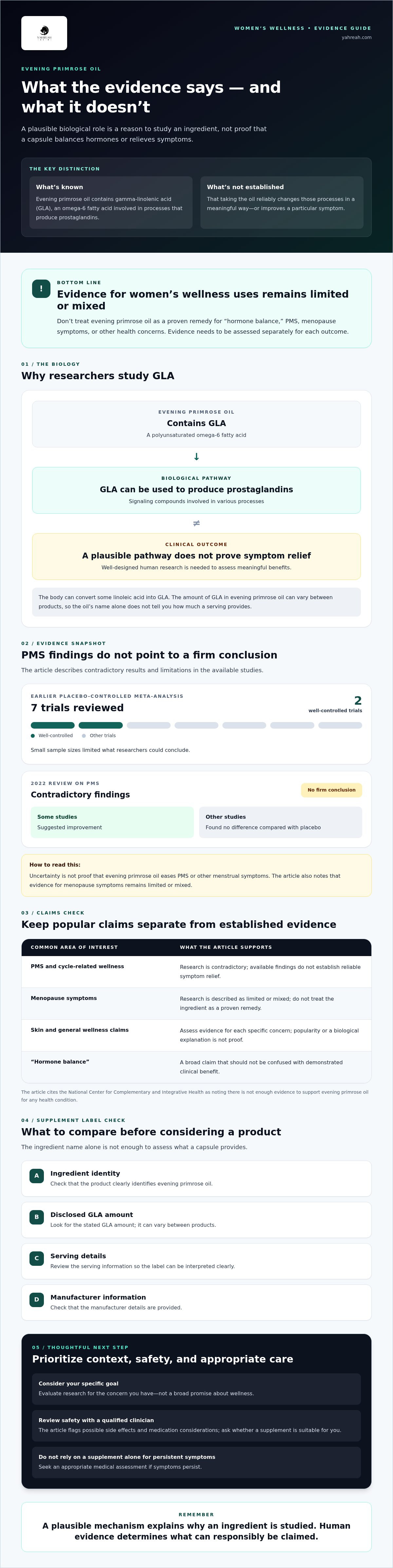
A clear label helps you understand what’s in a supplement, but it can’t prove that the product will deliver a particular wellness benefit. Use this checklist to compare details, then follow the product’s own directions and seek qualified advice about whether it’s appropriate for you.
Manufacturing in an FDA-registered facility does not mean the FDA has approved a dietary supplement or confirmed its safety or effectiveness. Treat registration and approval as different claims, and don’t rely on a facility statement as proof of a product’s benefits.
Ask a qualified clinician or pharmacist to review your situation before using evening primrose oil if you take medication, have a health condition, or have a planned procedure. The National Center for Complementary and Integrative Health notes that possible side effects can include stomach upset, nausea, and diarrhea. Evening primrose oil may also increase bleeding risk, so extra care is warranted with bleeding disorders or anticoagulant medicines. Its safety in pregnancy and breastfeeding isn’t established, so seek individualized professional advice before use.
Tell your care team about supplements you take, including the product name and label directions. The NCCIH evening primrose oil overview provides further context on evidence and safety; it doesn’t replace advice based on your health history.
If you’re comparing evening primrose oil capsules for womens wellness, let ingredient transparency and personal suitability guide your next step, not a broad marketing promise. For a low-pressure look at the brand’s women’s health supplements, explore Yahreah Skin’s supplement options.
A considered supplement decision starts with a clear goal, then moves through the evidence, the label, and your own health context. With evening primrose oil capsules for womens wellness, a transparent ingredient list can help you understand what a product contains, but it can’t establish that the product will deliver a specific result. A proposed biological explanation is not the same as a benefit demonstrated in people.
Take time to check what the research says about the outcome you care about, rather than relying on broad promises about cycle support or hormone balance. Review the serving information and disclosed GLA content, and consider possible side effects, medicines, health conditions, and other personal factors. If a detail is unclear, pause and ask a qualified professional rather than guessing.
Seek an appropriate medical assessment if symptoms persist, worsen, or interfere with daily life. A clinician can help evaluate possible causes and discuss options suited to your situation. Before speaking with a clinician or pharmacist, bring the supplement label and a current list of medicines and other supplements. These details make it easier to discuss ingredients and potential interactions.
This article offers general education. It can’t diagnose a condition or replace individualized care, and a supplement shouldn’t become a reason to delay an assessment for symptoms that concern you.
Keep three ideas distinct: a clear label tells you what the manufacturer says is in the product; a plausible mechanism offers a reason an ingredient may be studied; and a proven outcome requires reliable evidence in people. Each can inform your decision, but none should be mistaken for another. Check current product details before connecting any ingredient to a particular brand, since availability and formulation can change.
Yahreah Skin describes its formulations as cruelty-free and states that its products are made in FDA-registered manufacturing facilities in the United States. Those are brand values and manufacturing statements, not proof that a supplement is FDA-approved or that it will produce a health outcome. Thoughtful evaluation means looking at ingredient transparency while keeping evidence and personal suitability in view.
For a broader look at the brand’s wellness perspective, explore Yahreah Skin's wellness approach. Choose with care, and seek professional guidance whenever your symptoms or health circumstances call for it.
Evening primrose oil contains GLA, but a plausible biological role isn’t proof of a specific wellness benefit. Research on cycle-related and menopause concerns remains mixed or limited, so broad promises about “hormone balance” deserve a careful look.
If you’re considering evening primrose oil capsules for womens wellness, start with your goal, assess the evidence for that outcome, and check the label for ingredient and serving details. Personal safety matters, too. Ask a qualified clinician or pharmacist about possible interactions or health concerns, and seek an assessment for symptoms that persist or interfere with daily life.
Yahreah describes its formulations as cruelty-free and states that its products are made in FDA-registered U.S. manufacturing facilities. These are brand and manufacturing claims, not FDA approval or proof of supplement effectiveness. Thoughtful choices begin with transparency and realistic expectations. Explore Yahreah's thoughtful approach to wellness, and take your next step with care and confidence.
Evening primrose oil is extracted from the seeds of Oenothera biennis, a flowering plant. It contains gamma-linolenic acid (GLA), a type of omega-6 fatty acid. Researchers study GLA because the body uses fatty acids in various processes, but a proposed biological role doesn’t prove that taking the oil improves a health concern. Check a supplement label for the amount of GLA, as oil content and GLA content aren’t interchangeable.
It hasn’t been established as a reliable way to relieve premenstrual syndrome (PMS). Research findings are mixed: some studies report improvement, while others find no difference compared with placebo. Limitations in study quality and size make firm conclusions difficult. A personal experience may be meaningful, but it can’t show that the supplement will work for others. If symptoms are persistent or disruptive, seek an appropriate medical assessment rather than relying on a supplement alone.
There’s not enough evidence to say that evening primrose oil balances or regulates women’s hormones. “Hormone balance” is a broad phrase, not a specific, measured outcome, and a proposed fatty-acid pathway doesn’t prove that capsules correct hormonal changes or an underlying condition. If you have persistent or concerning symptoms, a qualified clinician can help assess possible causes. Avoid using a supplement as a substitute for evaluation or recommended care.
Compare labels for the ingredient identity, the amount of oil, any clearly disclosed GLA content, serving details, and manufacturer information. Check whether third-party testing claims identify a program and apply to the specific product. Marketing terms alone don’t verify quality. Follow the directions on the product you’re considering, and ask a clinician or pharmacist about personal suitability, especially if you take medication or have a health condition. FDA-registered manufacturing doesn’t mean FDA approval of a supplement.
No supplement is suitable for everyone. Evening primrose oil may cause mild effects such as stomach upset, nausea, or diarrhea, and it may increase bleeding risk. Ask a clinician or pharmacist before use if you take anticoagulant medication, have a bleeding disorder, are pregnant or breastfeeding, or have a planned procedure. The safety of long-term use isn’t well established. Share the product label and your medication list when seeking advice.
There’s no established timeline for evening primrose oil to work, and research hasn’t confirmed a dependable benefit for many claimed uses. Study durations and outcomes differ, so they can’t establish a universal schedule for capsules. Don’t increase the amount or keep taking a supplement longer than its label directs in hopes of seeing a result. Ask a qualified clinician or pharmacist about use, and seek care if symptoms persist or worsen.


