

 USD
USD EUR
EUR
 AUD
AUD
 GBP
GBP
 JPY
JPY
 INR
INR
 MXN
MXN
 CAD
CAD
 JMD
JMD
Total: $0.00
Taxes and shipping calculated at checkout


Could a plant-based supplement help steady your cycle, or might it distract from the reason your timing changed? If you’re considering a vitex chasteberry supplement for menstrual regularity, it’s understandable to want clear answers amid conflicting claims online. Vitex may help with some menstrual symptoms, but cycle changes can have many causes, and a supplement isn’t a universal fix.
It helps to understand what the evidence supports, what remains uncertain, and whether vitex is appropriate given your health and medicines. Results aren’t immediate, and online claims shouldn’t replace personalized medical advice, especially if your periods have changed unexpectedly or you use hormonal contraception.
This guide explains how vitex may affect menstrual symptoms and cycle timing, how to interpret the research, and what’s known about safety, interactions, and timelines. You’ll also find practical questions to discuss with a healthcare professional and ways to track your cycle as you consider your next step.
A change in cycle timing can feel confusing, especially when online advice makes one “normal” pattern sound universal. Before considering a vitex chasteberry supplement for menstrual regularity, clarify what vitex is, what cycle regularity describes, and what it cannot tell you. This overview is a practical starting point, not a diagnosis.
Menstrual regularity describes the pattern of your cycles, including the time from the first day of one period to the first day of the next and whether that timing stays relatively consistent for you. Bleeding duration and flow are useful details to record, but they aren’t the same as cycle timing. Premenstrual symptoms, such as mood changes or cramps, can occur whether cycles are regular or not.
Chasteberry is the fruit of the chaste tree, botanically named Vitex agnus-castus. Its botanical background and historical folk uses are described in this overview of Vitex agnus-castus. That history helps explain why chasteberry appears in discussions of women’s health, but traditional use alone doesn’t establish that a supplement is effective for a specific outcome.
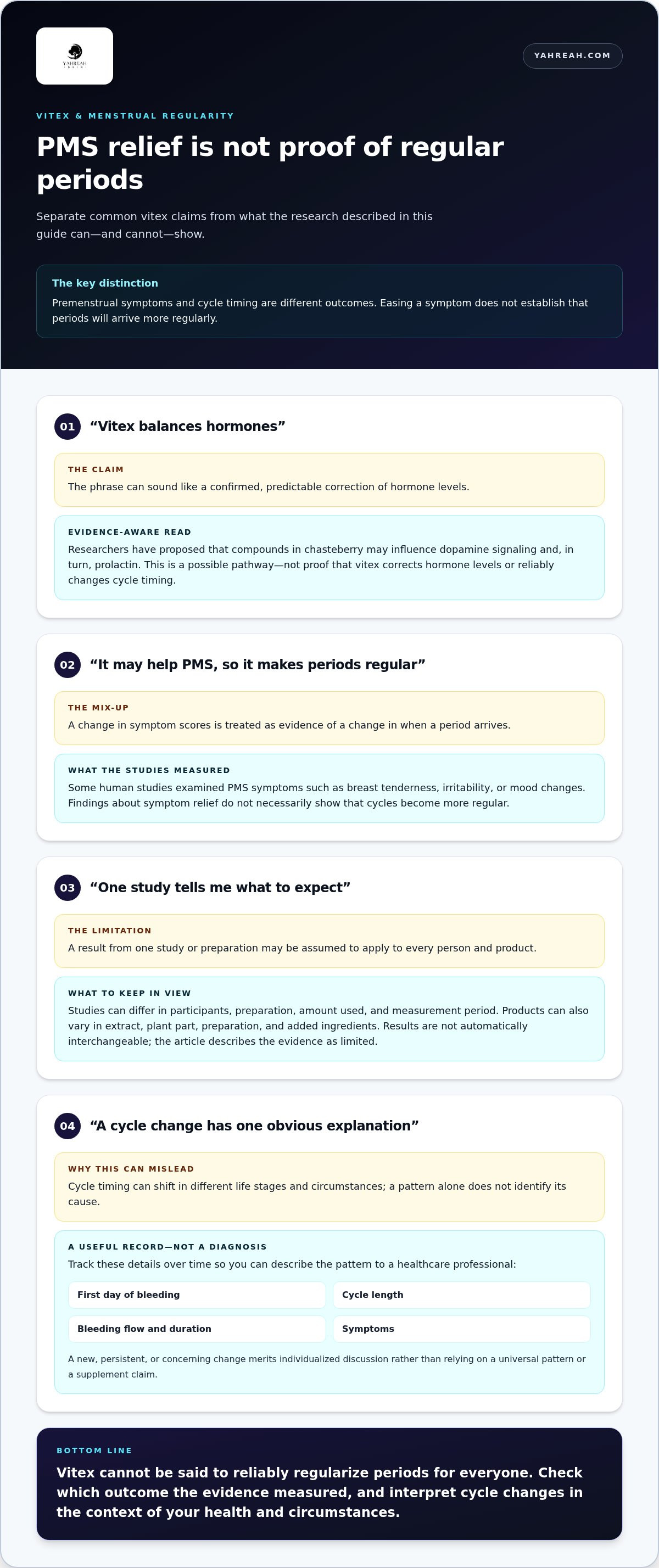
The plant isn’t the same as a finished supplement. Products may differ in extract, plant part, preparation, or additional ingredients, so their contents and evidence aren’t necessarily interchangeable. A study of one preparation doesn’t automatically predict what to expect from another.
There isn’t one cycle pattern that applies to everyone at every stage of life. Timing and bleeding can shift during adolescence, after pregnancy, around perimenopause, or with hormonal contraception, among other circumstances. Track the first day of bleeding, cycle length, flow, and symptoms over time. This record can help you describe a pattern to a healthcare professional, but it can’t identify the cause.
Age, health history, and life stage all affect how a cycle change should be interpreted. Discuss a new, persistent, or concerning change with a healthcare professional rather than relying on a universal cutoff or a supplement claim. The next step is to understand what research says about vitex and where its limits remain.
Vitex is sometimes described online as a way to “balance hormones,” but that phrase suggests more certainty than the evidence supports. Researchers have proposed that compounds in chasteberry may influence dopamine signaling in the brain and, in turn, affect prolactin released by the pituitary gland. This is a possible pathway, not proof that vitex corrects hormone levels or reliably changes cycle timing.
Because prolactin can affect reproductive function, researchers have explored whether vitex’s potential influence on prolactin could help explain some reported effects. The NCCIH evidence on chasteberry describes research into these proposed effects while emphasizing the limits of current conclusions. A plausible mechanism doesn’t establish a predictable benefit for an individual. Vitex shouldn’t be treated as a hormone-balancing treatment or a substitute for evaluating a menstrual change.
Some human studies have examined chasteberry for premenstrual syndrome (PMS), measuring symptoms such as breast tenderness, irritability, or mood changes. Those findings concern symptom relief. They don’t necessarily show that cycles become more regular: symptom scores and cycle timing are different outcomes.
Research also needs to be read in context. Studies may differ in their participants, the preparation tested, the amount used, and how long outcomes were measured. Results from one extract or group can’t automatically be applied to every supplement or to people whose cycle changes have different causes. NCCIH characterizes the evidence for chasteberry’s uses as limited, and further well-designed research would help clarify where benefits may exist.
Evidence for easing a premenstrual symptom does not prove that vitex regulates cycle timing. For a vitex chasteberry supplement for menstrual regularity, this distinction matters: less discomfort isn’t the same as a predictable change in when a period arrives.
When reviewing a study, check the exact outcome it measured before applying its conclusion to your situation. If you’re exploring women’s health supplements, ingredient transparency is one useful part of an informed decision, but it can’t guarantee an effect. A healthcare professional can help interpret cycle changes alongside your health history and medicines.
Explore women’s health supplements with a thoughtful eye toward ingredient information and evidence-aware expectations.
No, vitex can’t be said to reliably regularize periods for everyone. Research explores menstrual outcomes, but results from a specific study or preparation don’t guarantee the same effect for another person. Uncertainty doesn’t prove vitex has no effect. It’s a reason to avoid promises and check which outcome the evidence actually measured.
| Common claim | Evidence-aware interpretation |
|---|---|
| Vitex “balances hormones.” | This broad phrase can imply a confirmed correction. Researchers have proposed biological pathways, but a proposed mechanism doesn’t establish a reliable clinical effect. |
| Vitex helps with PMS, so it makes periods regular. | PMS symptoms and cycle timing are different outcomes. Research on discomfort or mood symptoms doesn’t prove that periods will arrive on a predictable schedule. |
| Vitex improves fertility or ovulation because it affects reproductive hormones. | Those are separate outcomes. Findings about one symptom or hormone measure can’t establish benefits for fertility, ovulation, or cycle regularity. |
| A supplement can correct an irregular cycle. | A supplement can’t identify why a cycle changed. Similar patterns can have different explanations and may call for different next steps. |
Studies of chasteberry have often focused on premenstrual symptoms. Findings need to be considered in light of the preparation used, study design, participants, and outcome measured. Memorial Sloan Kettering’s analysis reviews proposed mechanisms and clinical research, but evidence related to PMS shouldn’t be stretched into claims about cycle timing. A reduction in breast tenderness, for example, doesn’t show that the next period will start more consistently.
That distinction matters when weighing a vitex chasteberry supplement for menstrual regularity. Look for evidence about the specific outcome you care about instead of assuming that results for a related symptom answer the same question.
Cycle patterns can shift with life stage, stress, health conditions, or medication changes. These are possibilities, not diagnoses, and the same change may have different explanations for different people. A supplement can’t determine the cause.
Record when bleeding starts, how long it lasts, and any notable changes or symptoms. This information can make a conversation with a healthcare professional more useful. If a change is sudden, persistent, or concerning, seek individualized clinical assessment rather than relying on a general supplement claim. The point isn’t to dismiss vitex, but to keep expectations grounded in what the evidence can show.
Before considering a vitex chasteberry supplement for menstrual regularity, review your health circumstances and current medicines with a qualified healthcare professional. Herbal supplements can still cause side effects and interact with medicines. This is especially relevant for vitex because it may affect hormone-related and dopamine-related pathways. The Memorial Sloan Kettering safety overview discusses potential precautions and interactions.
Use this checklist to guide a conversation, not as a self-prescribing plan. A clinician or pharmacist can help assess how these considerations apply to you and the specific product.
A clear record can make a health discussion more useful. Note when the cycle change began and whether it is sudden, persistent, or worsening. Track period start dates, changes in bleeding, symptoms, and any relevant medication or supplement changes. Include the name and label details of anything you’re considering or already taking.
Ask what might explain the change, whether a supplement could affect your medicines or health conditions, and what signs should prompt follow-up. Seek prompt medical care for severe symptoms or changes that concern you. Don’t delay an evaluation to see whether a supplement changes your cycle.
Thoughtful supplement choices start with clear ingredient information and a safety conversation, not a promise of results. After reviewing what’s appropriate for you with a healthcare professional, you can explore women’s health supplements as part of your broader wellness research.
Understanding a cycle change starts with noticing what has changed, not assuming a supplement is the answer. Vitex may interest some people, but the evidence doesn’t establish that it will make periods regular for everyone. If you’re considering a vitex chasteberry supplement for menstrual regularity, treat research as context for a personal decision, not a promise of results.
Take a calm, practical approach:
You don’t have to decide about vitex before understanding what might be behind a change. A conversation with a qualified professional can help put your observations and options into perspective.
If you’re considering a supplement, read the full ingredient label, serving directions, and manufacturer information. Check whether the product clearly identifies its ingredients and preparation. If you have questions about safety or interactions, bring the label to a clinician or pharmacist. Formulations can differ, so evidence about one preparation may not apply to another.
Clean ingredients or cruelty-free practices may matter to your values, but those qualities don’t establish that a supplement is risk-free or clinically effective. Manufacturing in an FDA-registered facility doesn’t mean the FDA has approved a supplement or its health claims. Clear information supports an informed choice; it can’t guarantee an outcome.
For broader context as you explore options, explore women’s health supplements at your own pace. Let your needs, the available evidence, and personalized professional guidance shape your next step.
Vitex may be discussed for menstrual and premenstrual concerns, but evidence about symptom relief doesn’t establish that it will make periods regular. A vitex chasteberry supplement for menstrual regularity isn’t a guaranteed answer, and it can’t identify why your cycle has changed.
Start with what you’ve noticed. Track cycle dates, bleeding patterns, and symptoms, then share that context with a healthcare professional if changes persist, feel unusual, or concern you. Review the evidence for the outcome you care about, and discuss possible interactions or health considerations with a clinician or pharmacist before using a supplement.
Ingredient and manufacturer transparency can help you make a more informed choice, though it can’t promise effectiveness or eliminate risk. Yahreah Skin emphasizes clean ingredients and cruelty-free formulations, and describes its products as manufactured in FDA-registered facilities in the United States. FDA registration does not mean a supplement or its claims are FDA-approved.
When you’re ready to explore, browse women’s health supplements with your needs and questions in mind. Let evidence, care, and confidence in your choices guide your next step.
Vitex may affect menstrual outcomes for some people, but it hasn’t been shown to reliably regularize periods for everyone. Research on premenstrual symptoms, such as discomfort, doesn’t automatically prove an effect on cycle timing. Evidence for a vitex chasteberry supplement for menstrual regularity depends on the preparation studied and the outcome measured. Cycle changes can have different causes, so tracking your pattern and discussing persistent changes with a healthcare professional is a more informed first step.
There’s no guaranteed timeline. Research suggesting effects after consistent use for up to three months doesn’t establish that everyone will see a change in cycle timing. Studies may use different vitex preparations and measure different outcomes, including premenstrual symptoms rather than period regularity. Don’t delay medical advice while waiting for a supplement to work if cycle changes are sudden, persistent, or concerning. Ask a healthcare professional what timeline, if any, is appropriate for your situation.
Don’t assume vitex is safe to combine with hormonal birth control or other medicines. Australia’s Therapeutic Goods Administration has warned that vitex may interact with oral contraceptives and could reduce their effectiveness. It may also interact with dopamine-related medicines, including some antipsychotics. Before considering vitex, show a clinician or pharmacist a complete list of your prescriptions, over-the-counter medicines, and supplements, along with the product label. Don’t change prescribed treatment without professional guidance.
Vitex isn’t recommended during pregnancy or breastfeeding, so speak with a qualified healthcare professional before using it in either situation. If you’re trying to conceive, get individualized advice before starting a supplement. Evidence about one reproductive outcome doesn’t establish that vitex improves fertility or is appropriate for you. Share your plans, health history, medicines, and any supplement label with your clinician. If you become pregnant while taking a supplement, contact a healthcare professional for guidance.
Vitex is generally described as well tolerated, but mild side effects can occur. Individual responses may differ, and products can vary in their extracts and other ingredients. Stop and seek professional advice if you notice a concerning reaction, especially if symptoms are severe or worsening. Before use, review possible interactions and personal health considerations with a clinician or pharmacist. Keep the container or ingredient label available so they can assess the specific product you’re considering.
Seek individualized medical advice if a cycle change is sudden, persists, feels unusual for you, or causes concern. Contact a healthcare professional promptly for severe symptoms, such as unusually heavy bleeding or intense pain. Note when the change began, period dates, bleeding patterns, symptoms, and any recent medication or supplement changes. This record can help guide a conversation, but tracking can’t diagnose the reason for a change. Don’t rely on a supplement instead of getting concerning symptoms assessed.


