

 USD
USD EUR
EUR
 AUD
AUD
 GBP
GBP
 JPY
JPY
 INR
INR
 MXN
MXN
 CAD
CAD
 JMD
JMD
Total: $0.00
Taxes and shipping calculated at checkout


What if the biggest number on a magnesium label isn’t the amount of magnesium you’ll actually get? The weight of the magnesium bisglycinate compound and its elemental magnesium content are not the same. That distinction can make comparing a magnesium bisglycinate supplement less straightforward than it should be. Add conflicting claims about sleep, relaxation, and other benefits, and it’s easy to wonder what the evidence really supports.
That uncertainty makes sense. A supplement may suit one person and not another, and labels don’t always make key details easy to spot. A closer look can help you make a considered choice without treating marketing claims as guarantees.
This guide explains what magnesium bisglycinate is and how to read its label, including the amount of elemental magnesium per serving. You’ll also learn what research can and can’t tell you about commonly discussed benefits, what to consider around side effects and medication interactions, and when it’s wise to ask a healthcare professional. The goal is practical clarity, not sweeping promises.
Magnesium bisglycinate is a form of magnesium in which magnesium is bound to two glycine-derived components. A supplement provides this compound as a source of magnesium. Terminology can vary across labels and references: magnesium glycinate is also commonly used to describe magnesium bisglycinate. The Magnesium glycinate reference outlines the compound’s chemical structure, though Wikipedia is a general reference, not a substitute for clinical or regulatory guidance.
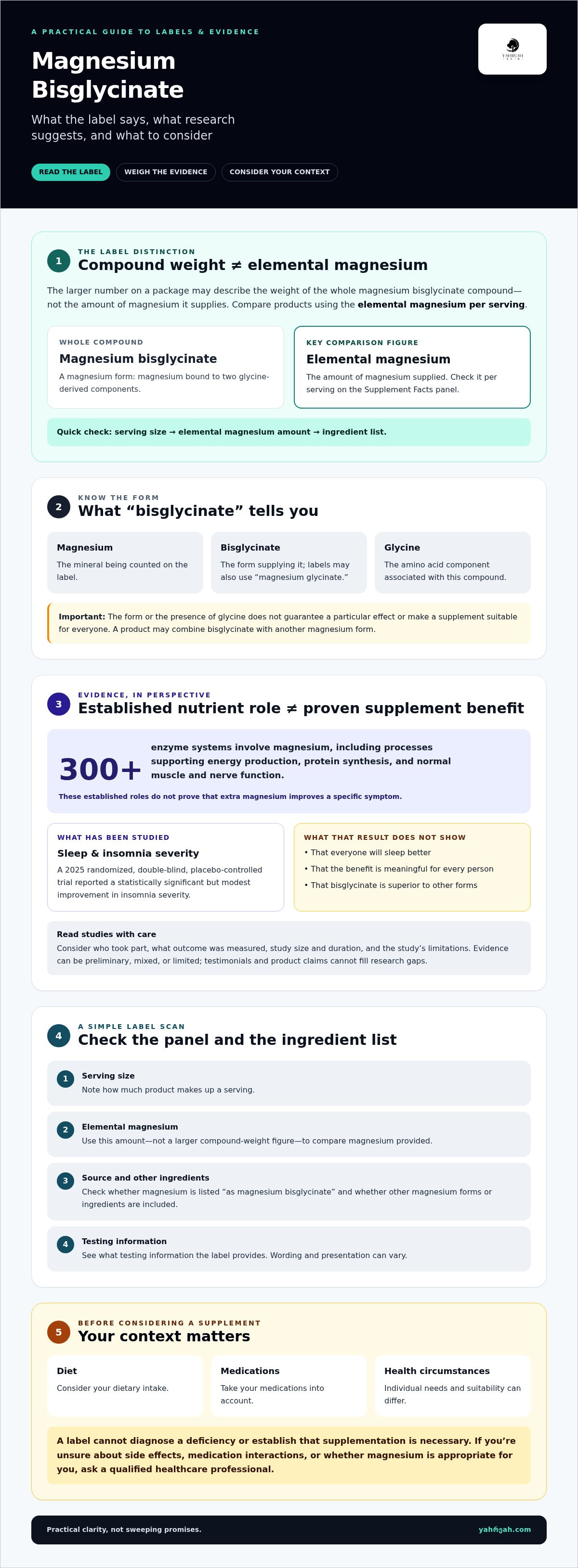
The key label distinction is between the weight of the whole compound and the amount of elemental magnesium it supplies. Use the elemental magnesium figure to compare how much magnesium different products provide. In a U.S. Supplement Facts panel, for instance, the magnesium amount may be stated separately, with “as magnesium bisglycinate” identifying its source. Check both the full panel and the ingredient list. Wording and presentation vary, and a product may combine bisglycinate with another magnesium form.
“Magnesium” on a label can refer to the mineral being counted, while bisglycinate describes the form supplying it. Glycine is the amino acid component associated with this compound. Its presence doesn’t guarantee a particular effect or make the supplement suitable for everyone. When comparing labels, focus on elemental magnesium per serving rather than a larger number elsewhere on the package that may refer to the compound’s total weight.
People often research magnesium in connection with everyday nutrition, sleep, or muscle function. Those are reasons to ask questions, not proof that a specific magnesium bisglycinate supplement will improve sleep, relieve muscle concerns, or meet an individual need. Magnesium has roles in the body, but evidence about the mineral generally shouldn’t automatically be treated as evidence for a particular form or product.
A label tells you what the manufacturer says the product contains and how it should be used. It can’t diagnose a deficiency or establish that supplementation is necessary. Personal needs depend on factors such as dietary intake, health circumstances, and medications. If you’re unsure whether magnesium is appropriate for you, discuss your situation with a qualified healthcare professional rather than treating a product description as a personal recommendation.
Magnesium’s essential role in the body is well established. Whether taking a particular form of magnesium improves sleep, eases cramps, or offers other benefits is a separate question. Nutrient-level evidence describes what magnesium does in the body. Evidence for a magnesium bisglycinate supplement needs to come from studies that test that form in relevant people and measure specific outcomes.
The National Institutes of Health Office of Dietary Supplements describes magnesium as a nutrient involved in more than 300 enzyme systems, including processes that support energy production, protein synthesis, and normal muscle and nerve function. These established roles don’t prove that taking extra magnesium will improve sleep, reduce anxiety, or relieve cramps in someone who already gets enough.
Evidence for a specific outcome can be preliminary, mixed, or limited. Preliminary findings suggest a possibility that needs more research. Mixed results mean studies don’t consistently agree. Limited evidence may reflect too few or too-small studies to draw firm conclusions. Testimonials and product claims can’t fill those gaps.
Researchers have studied magnesium bisglycinate for sleep. A 2025 randomized, double-blind, placebo-controlled trial reported a statistically significant but modest improvement in insomnia severity. That result applies to the measured outcome and study conditions. By itself, it doesn’t show that everyone will sleep better, establish a meaningful benefit for every person, or prove that bisglycinate is superior to other magnesium forms.
Claims about better absorption or fewer digestive effects also need careful interpretation. Results from studies of other magnesium forms can’t automatically be applied to bisglycinate. A comparison is most useful when human participants receive different forms under similar conditions. Study size, duration, participants, and outcome measures all affect how confidently findings can be applied beyond the research setting.
For chemical context, the PubChem database describes magnesium glycinate, a name commonly associated with bisglycinate. A chemical description can clarify what a compound is, but it isn’t evidence that a supplement produces a particular health outcome.
Approach each benefit claim as a question to assess, not a promise to expect. If you’re exploring wellness supplements, review ingredient information with care and look for clear, specific details rather than relying on broad claims.
Start with the Supplement Facts panel, then check the ingredient list and serving directions. Front-label phrases such as “high strength” or “gentle” don’t provide enough information to compare products. Look for the elemental magnesium amount, the serving it applies to, additional ingredients, and any specific testing disclosures. If any of those details are unclear, you may not be able to make a direct comparison.
Find “Magnesium” in Supplement Facts and note the amount and serving size. For example, a hypothetical label might list a serving as two capsules and magnesium as 200 mg per serving, “as magnesium bisglycinate.” That equals 100 mg per capsule, but it isn’t a recommended dose. Compare products using the same serving basis, and follow each product’s directions rather than assuming one capsule equals one serving.
| What to compare | What to check |
|---|---|
| Elemental magnesium | Amount of magnesium listed per serving in Supplement Facts. |
| Serving size | Number of capsules, tablets, or scoops that make up one serving. |
| Other ingredients | Full ingredient list, including other magnesium forms, inactive ingredients, and potential allergens. |
| Testing disclosures | Whether the label identifies independent testing or a quality seal, and who performed or issued it. |
Read the Supplement Facts panel and ingredient list together. Check the directions, allergens, and whether other active ingredients are included, especially when comparing a straightforward formula with a blend. A testing statement or seal is most useful when the label identifies the testing organization and what was assessed. Don’t assume a logo proves every quality claim or a health benefit. The Mayo Clinic Press also offers context on magnesium glycinate and considerations to discuss with a healthcare professional.
Keep regulatory language precise. FDA registration of a manufacturing facility doesn’t mean the FDA has approved a specific supplement, certified its quality, or confirmed that it works. For a magnesium bisglycinate supplement, favor a label that makes the amount, serving, and full set of ingredients clear. For any supplement, check whether quality statements name who performed a test and what it covered, rather than relying on a broad claim or logo.
A magnesium bisglycinate supplement may be unsuitable or require extra care depending on your health, medicines, diet, and other supplements. Before use, pause and check the basics:
Supplemental magnesium can cause diarrhea, nausea, or abdominal cramping, particularly at higher intakes. The adult upper limit of 350 mg per day applies to magnesium from supplements and medications, not magnesium naturally present in food. It’s a general safety limit, not an individual target or a substitute for advice based on your health.
Yes. Magnesium can affect how some medicines are absorbed. The NIH Office of Dietary Supplements identifies interactions with certain antibiotics, including tetracyclines and quinolones, and oral bisphosphonates used for bone health. Timing can matter, but the appropriate interval depends on the medicine and product. Ask a pharmacist or healthcare professional to check your specific labels and medication list. Don’t change medication timing or stop a prescribed medicine based on general information.
Seek guidance before use if you have a chronic health condition, are pregnant or breastfeeding, or take ongoing medication. A clinician can consider the whole picture, including dietary intake and other sources of supplemental magnesium. This is especially relevant if you have reduced kidney function or use products such as antacids or laxatives that may also contain magnesium.
Symptoms such as fatigue or muscle cramps can have many causes. They can’t, by themselves, confirm magnesium deficiency or tell you which form of magnesium, if any, is appropriate. If symptoms are persistent or concerning, ask a healthcare professional about assessment rather than trying to diagnose the cause with a supplement.
For a considered wellness routine, explore Yahreah Skin’s wellness supplements and review each product’s ingredients and label details. For personal safety questions, a pharmacist or healthcare professional is the right person to consult.
Start with a clear question, not a promise on the front of a bottle. A magnesium bisglycinate supplement is one possible source of magnesium, but whether it fits your routine depends on your diet, health circumstances, and other products or medicines you use.
Start with your overall pattern of eating. Foods such as leafy greens, legumes, nuts, seeds, and whole grains can contribute magnesium, and supplements aren’t a replacement for varied nutrition. Your needs may also depend on personal circumstances, so a general label or article can’t determine what’s right for you.
Take stock of everything you already use before adding another product. A daily multivitamin, for example, may contain magnesium or other overlapping nutrients. If you’re comparing it with a separate product, review both labels side by side and add up the listed amounts per serving. Check the actual labels to confirm what each formula contains, rather than assuming products with similar names have the same ingredients.
Keep the process simple: identify your question, compare clear label details, assess the quality information, and seek individual advice when needed. That supports a more intentional wellness routine without treating supplements as a cure or a substitute for care. Yahreah Skin offers supplements and natural skincare products, so you can explore its broader wellness range while checking the details of each product individually.
A magnesium bisglycinate supplement is best considered through clear label information, balanced evidence, and your own health context, not broad promises. Compare the elemental magnesium per serving, review the full ingredient list, and remember that research on magnesium generally doesn’t automatically prove a specific benefit from this form. If you take medication, have a health condition, or are unsure whether supplementation suits you, ask a qualified healthcare professional.
Your wider routine matters, too. Consider dietary sources of magnesium and check other supplements for overlapping ingredients before adding something new. A thoughtful choice doesn’t need to be complicated. It starts with good questions and information you can verify on the label.
Yahreah Skin offers natural skincare products and supplements, with an emphasis on clean ingredients and cruelty-free formulations. To explore the range, discover Yahreah Skin’s wellness offerings and review each product’s details before deciding what fits your routine.
Magnesium bisglycinate is a form of magnesium bound to glycine-derived components. Other forms, such as magnesium oxide or citrate, have different compounds attached to magnesium. These forms can differ in elemental magnesium content and may be used in different formulations, but the name alone doesn’t establish which is right for you. Compare the elemental magnesium amount and full ingredient list, and don’t assume a form guarantees a particular effect.
It hasn’t been established that bisglycinate is always better absorbed than other forms for every person and purpose. Absorption claims should be based on suitable human studies that directly compare forms, not on research about magnesium generally or a different compound. Results can depend on the study design and participants. If absorption is a concern because of your health or medicines, ask a healthcare professional to help assess your situation.
It has been studied for sleep, but current evidence doesn’t establish a reliable benefit for everyone. A 2025 randomized, double-blind, placebo-controlled trial reported a statistically significant but modest improvement in insomnia severity. That doesn’t prove a substantial or universal effect. Magnesium supports normal muscle function, but that role doesn’t mean a bisglycinate supplement will relieve cramps. Persistent sleep problems or cramps deserve individual assessment rather than self-diagnosis.
Look for “Magnesium” in the Supplement Facts panel and note the amount listed per serving, along with the serving size. That amount represents elemental magnesium, while the weight of the magnesium bisglycinate compound includes its other components. For example, if a hypothetical panel lists 100 mg magnesium per serving of two capsules, it provides 100 mg per two-capsule serving, not per capsule. This is an example, not a dose recommendation.
Yes. Magnesium can affect the absorption of some medicines, including certain tetracycline or quinolone antibiotics and oral bisphosphonates. The appropriate timing depends on the specific medicine and product, so don’t rely on a general article to check your personal interaction risk. If you take prescription or over-the-counter medicines, show a pharmacist or healthcare professional the supplement label and medication list before use. Don’t change medication timing or stop treatment without their guidance.
No supplement is suitable for everyone. Supplemental magnesium can cause diarrhea, nausea, or abdominal cramping, and people with kidney problems may need particular care. The adult upper limit of 350 mg per day applies to magnesium from supplements and medications, not food. It isn’t an individual target. Ask a healthcare professional before use if you have a health condition, are pregnant or breastfeeding, or take ongoing medication.
Check the elemental magnesium per serving, serving directions, complete ingredient list, and potential allergens. Look for clear disclosures about other active ingredients and any testing organization or quality seal, then verify what the testing actually covers. Manufacturing registration isn’t product approval, certification, or proof of effectiveness. Consider your diet and other supplements to avoid overlooking duplicate ingredients, and ask a qualified healthcare professional whether the product fits your personal circumstances.


