

 USD
USD EUR
EUR
 AUD
AUD
 GBP
GBP
 JPY
JPY
 INR
INR
 MXN
MXN
 CAD
CAD
 JMD
JMD
Total: $0.00
Taxes and shipping calculated at checkout


What if the smartest first step toward prostate wellness isn’t choosing a supplement, but understanding what your symptoms may be telling you? Urinary changes can become more common with age, yet persistent or troubling symptoms deserve medical attention rather than guesswork. It’s also understandable to feel caught between confident online claims and conflicting evidence about natural prostate support supplements for aging men.
This guide offers a calmer way to weigh the choices. You’ll learn how general wellness support differs from treating a diagnosed condition, what research suggests about commonly discussed ingredients such as saw palmetto and beta-sitosterol, and where the evidence remains limited. We’ll also cover practical ways to assess labels and product quality, consider possible side effects or medicine interactions, and prepare to discuss supplements with a healthcare professional. Thoughtful choices begin with clear information, not promises.
Questions about prostate health and urination can feel personal, but they’re common reasons to seek clear information. A measured first step is to understand what the prostate does, notice changes without jumping to conclusions, and know when to discuss them with a healthcare professional.
The prostate is a small gland located below the bladder and around the tube that carries urine out of the body. It contributes fluid to semen. As men age, the prostate may enlarge. Benign prostatic hyperplasia, or BPH, is noncancerous enlargement; it can narrow the urine passage and contribute to urinary symptoms. The Benign prostatic hyperplasia (BPH) overview explains common signs and how the condition is assessed.
Still, urinary changes don’t automatically mean BPH, and they aren’t proof of cancer. Frequent urination, urgency, a weak stream, or waking at night to urinate can have several possible causes, including changes involving the bladder, an infection, or other health conditions. A healthcare professional can assess the pattern and decide whether further evaluation is appropriate.
Pay attention to changes that persist, worsen, disrupt sleep, or affect daily routines. Make a note of what’s happening, when it began, and how often it occurs. Seek prompt clinical assessment for symptoms that are sudden, severe, or concerning. Blood in the urine or an inability to urinate warrants urgent medical attention.
Supplements shouldn’t delay this conversation or replace assessment, diagnosis, or prescribed treatment. That distinction matters when considering natural prostate support supplements for aging men: a wellness product is not a way to establish what’s causing symptoms or manage a diagnosed condition.
General wellness support may complement healthy habits, but it doesn’t treat an enlarged prostate or prostate cancer. If symptoms are present, start by understanding their cause with professional guidance. That gives you a safer foundation for considering any supplement alongside your overall health needs.
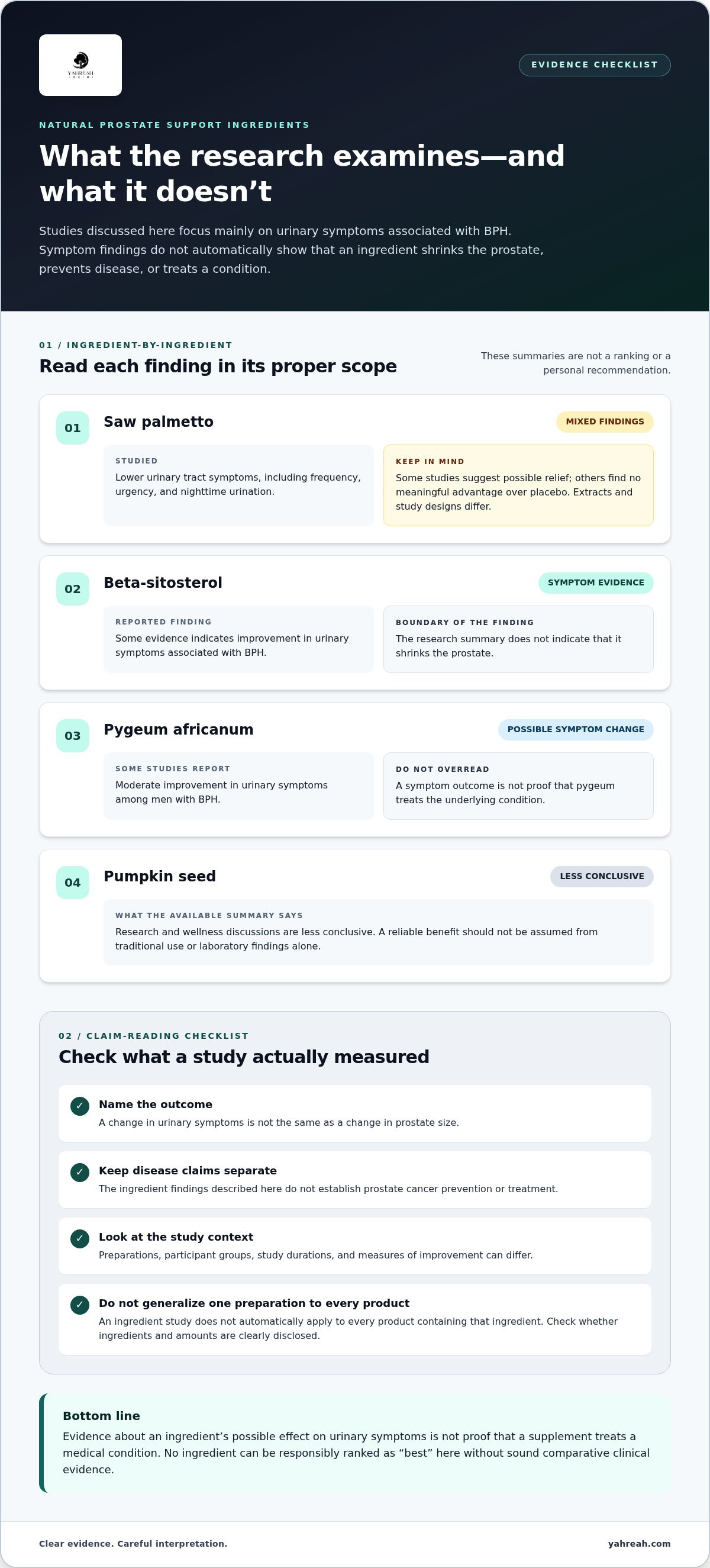
Saw palmetto, beta-sitosterol, pygeum, and pumpkin seed are often discussed in conversations about prostate wellness. Researchers have examined some of these ingredients for urinary symptoms associated with benign prostatic hyperplasia (BPH), such as needing to urinate often or waking at night. But findings aren’t interchangeable: studies may use different preparations, participant groups, durations, and measures of improvement.
For a broader overview of prostate conditions and health considerations, see the Harvard Medical School guide to prostate health. It can help place supplement claims in context, but it doesn’t turn an ingredient study into a personal recommendation.
Saw palmetto has been studied for lower urinary tract symptoms, including urinary frequency, urgency, and nighttime urination. Results are mixed: some studies suggest possible symptom relief, while others find no meaningful advantage over placebo. Differences in extracts and study design make broad conclusions difficult.
Beta-sitosterol has some evidence of improvement in urinary symptoms associated with BPH. That finding should be kept specific: the research summary does not indicate that it shrinks the prostate. Neither ingredient should be presented as preventing prostate cancer.
Some studies of pygeum africanum report moderate improvement in urinary symptoms among men with BPH. That is a possible symptom outcome, not proof that pygeum treats the underlying condition. For pumpkin seed, research and wellness discussions are less conclusive in the available evidence summarized here, so a reliable benefit shouldn’t be assumed from traditional use or laboratory findings alone.
Evidence for a supplement ingredient doesn’t establish that a product treats a medical condition. A study of one preparation also can’t automatically be applied to every product containing that ingredient. For natural prostate support supplements for aging men, consider the specific studied outcome, the limits of the evidence, and whether the product’s ingredients and amounts are clearly disclosed. No ingredient can be responsibly ranked as “best” here without sound comparative clinical evidence.
That same care applies to a broader supplement routine: ingredient transparency and thoughtful choices matter, while medical questions deserve individualized guidance. Explore Yahreah Skin’s broader men’s wellness approach as one part of a considered wellness journey.
A clear claim names what was studied and what changed. For prostate supplements, that may mean a change in urinary symptom scores, not a smaller prostate or protection from disease. This distinction helps keep research in perspective as you compare natural prostate support supplements for aging men.
| Ingredient | Studied outcome | Evidence limitation | Safety question |
|---|---|---|---|
| Saw palmetto | Urinary symptoms, such as frequency and nighttime urination | Findings are mixed; some studies show no meaningful benefit over placebo. | Could it interact with a medicine or affect a health condition? |
| Beta-sitosterol | Urinary symptoms associated with BPH | Some evidence suggests symptom improvement, not prostate shrinkage. | Is this ingredient appropriate alongside current medicines or supplements? |
| Pygeum | Urinary symptoms in men with BPH | Some studies suggest moderate improvement, but results don’t establish treatment effectiveness. | Are there relevant cautions for my health history? |
| Pumpkin seed | Potential urinary symptom support | Evidence is limited; traditional use alone doesn’t prove a benefit. | What side effects or interactions should I watch for? |
Be wary of guaranteed results, “cure” language, or claims that a supplement prevents prostate cancer. Research on an ingredient doesn’t prove that every finished product containing it has the same effects. Products may differ in extract, amount, and other ingredients. Testimonials can describe one person’s experience, but they can’t establish effectiveness or replace controlled studies.
Also look closely at the outcome being claimed. A change in reported urinary symptoms isn’t proof that a supplement changes prostate size, prevents disease, or treats a diagnosed condition. Evidence for an ingredient is not proof that a supplement treats a disease.
Studies may use different plant preparations, extract standardization, serving amounts, participant groups, and symptom measures. Small study populations and short follow-up can make it harder to judge how reliable or lasting a result is. “Natural” doesn’t automatically mean safe, effective, or free of interactions, especially when combined with medicines or other supplements.
For balanced background, review current information from the NIH Office of Dietary Supplements or the National Center for Complementary and Integrative Health (NCCIH), then discuss personal safety questions with a qualified healthcare professional. For a broader perspective on men’s wellness, explore supplements for men’s vitality.
Before adding a supplement, make the decision part of a broader health conversation. This is especially useful if you take prescription or over-the-counter medicines, use other supplements, or have ongoing health concerns. “Natural” describes an ingredient’s source, not whether it’s safe for every person or free of interactions.
Prepare a simple record to share with a qualified healthcare professional:
Ingredients may affect people differently, and combining products can make it harder to understand a side effect or interaction. Review the full label with a clinician or pharmacist before starting, rather than relying on a “natural” or “clean” claim alone. Disclose every supplement to your healthcare team because interactions can matter. Don’t stop, reduce, or change a prescribed medicine without medical guidance.
PSA testing and prostate evaluation are individualized clinical decisions. They depend on personal circumstances and a conversation with a healthcare professional, not on which supplement you’re considering. A supplement should never be used to interpret a test result or replace an appropriate evaluation.
Arrange a medical conversation if urinary symptoms persist, worsen, or interfere with daily life. Symptoms alone can’t identify their cause or rule out a serious condition, so trying a supplement first may delay useful assessment. Be clear about when symptoms started and how they’ve changed.
Urgent warning signs call for prompt medical attention, not routine supplement research. Blood in the urine or being unable to urinate warrants urgent care. For less urgent concerns, bring your symptom and supplement list to your appointment and ask what next steps make sense for you.
For a thoughtful approach to men’s wellness, explore men’s health supplements while keeping individual health decisions grounded in professional guidance.
A steady routine starts with a clear purpose, not a promise on a label. Decide what you want to understand or support, such as changes in your urinary habits, then review those symptoms and discuss possible next steps with a qualified healthcare professional. If a supplement is being considered, ask whether it fits your health history and medicines. Reassess together rather than assuming a product has helped.
Keep a simple record of symptoms and questions to make conversations more focused. A log can help you notice patterns, but it can’t diagnose the cause. If a professional agrees that trying a supplement is appropriate, avoid changing several routine elements at once unless advised otherwise. That makes it easier to discuss what has changed. No wellness product can guarantee a particular prostate or urinary outcome.
Read the full label before deciding. Look for:
Manufacturing language deserves careful interpretation. A statement that a facility is FDA-registered doesn’t mean the FDA approved the supplement, endorsed it, or confirmed its effectiveness. Registration and evidence of a health benefit are not the same thing.
Keep the goal modest and informed: assess the evidence, use professional guidance for personal decisions, and choose products with readable, transparent labels. This is a more grounded approach to natural prostate support supplements for aging men than relying on dramatic claims or a single testimonial.
Prostate concerns and urinary-tract concerns are not interchangeable. For a separate look at urinary-tract-focused ingredients, see D-mannose and cranberry supplements for urinary tract health; it isn’t a substitute for prostate assessment. To continue exploring ingredient transparency and quality considerations, browse this guide to clean supplement brands and Yahreah Skin's broader men’s wellness approach.
Prostate and urinary changes deserve attention, but they don’t point to one cause on their own. Research on ingredients such as saw palmetto, beta-sitosterol, and pygeum varies, and evidence of a possible change in urinary symptoms is not proof of treatment, prevention, or cure. The most grounded approach is to understand your goal, review symptoms, check product labels, and discuss supplements with a qualified healthcare professional, especially if you take medicines.
For natural prostate support supplements for aging men, let transparency matter more than bold promises. Look for clear ingredient and serving information, and remember that FDA-registered manufacturing does not mean the FDA has approved a supplement or established its effectiveness.
Yahreah offers men’s health supplements and emphasizes clean ingredients, cruelty-free formulations, and manufacturing in the USA at FDA-registered facilities. Explore Yahreah’s thoughtful approach to men’s wellness as you consider your broader wellness choices.
Small, well-informed steps can help you feel more confident in your choices.
No, saw palmetto isn’t proven to treat prostate conditions or prevent prostate disease. Research has examined urinary symptoms associated with benign prostatic hyperplasia, but findings are mixed and can vary with the preparation, study population, and outcome measured. A result involving one extract doesn’t establish that all products work the same way. If symptoms persist or you’re considering a supplement, discuss it with a healthcare professional, especially if you take medication.
No. Supplements shouldn’t replace a clinician’s assessment, prescribed treatment, or recommended follow-up. “Natural” doesn’t guarantee safety or effectiveness, and an ingredient may not be suitable alongside certain medicines or health conditions. Persistent, worsening, or disruptive urinary symptoms call for individualized medical advice, not self-diagnosis with a supplement. Don’t stop or change a prescribed medicine on your own. A healthcare professional can help clarify the cause of symptoms and discuss appropriate options.
Saw palmetto, beta-sitosterol, pygeum, and pumpkin seed are commonly discussed in relation to prostate or urinary wellness. The strength and findings of research differ by ingredient, preparation, and outcome, and studies of an ingredient don’t prove that every product containing it has the same effect. For natural prostate support supplements for aging men, review current evidence and show the full product label to a qualified healthcare professional before starting.
Read the full label, including ingredient names, amounts, serving directions, and cautions. Be cautious of cure language, guaranteed results, or claims to prevent cancer. Look for clear manufacturer and quality information, but don’t mistake a registration or manufacturing statement for FDA approval or proof of effectiveness. Before using a product, share its label with a healthcare professional or pharmacist, particularly if you take medicines or have a diagnosed condition.
Arrange medical assessment if symptoms persist, worsen, disrupt sleep or daily activities, or concern you. Frequent or urgent urination, difficulty urinating, and a weak stream can have different causes, so symptoms alone can’t establish a diagnosis. Blood in the urine or inability to urinate warrants urgent medical attention. A clinician can assess your circumstances and advise whether further evaluation is appropriate. Don’t rely on a supplement to identify the cause.
No. Benign prostatic hyperplasia (BPH) is noncancerous prostate enlargement, while prostate cancer is a different condition. Urinary symptoms can have several causes, and their presence or absence can’t confirm or rule out cancer. Don’t use supplements to self-diagnose. If you notice changes or have concerns about screening, discuss your individual circumstances with a qualified healthcare professional, who can advise whether evaluation or follow-up is appropriate.
They may raise safety questions, and products can vary in their ingredients and formulation. Don’t assume a supplement is irrelevant to a PSA test or other medical care. Tell your healthcare team about every supplement, medicine, and over-the-counter product you use, and ask whether a specific product matters for your evaluation or treatment. Bring the label if possible. Never stop or change prescribed medicine without professional guidance.


